View methods side by side.
Choose up to four methods. Add them using the search and share the comparison by copying its link.
Selected:Event ModelingATAM (Architecture Tradeoff Analysis Method)SAAM (Software Architecture Analysis Method)EventStorming
| Criterion |  Knowledge Modeling Event Modeling |  Architecture ATAM (Architecture Tradeoff Analysis Method) | 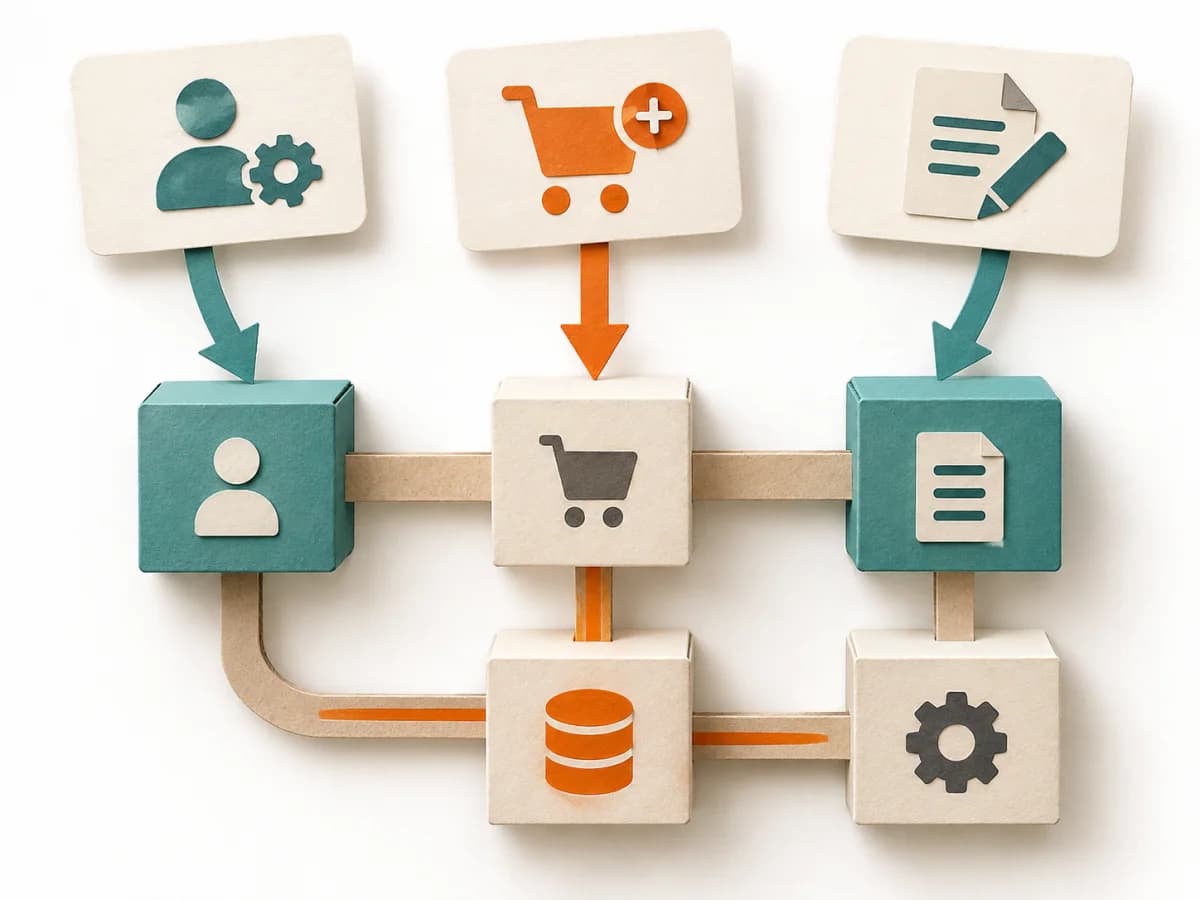 Architecture SAAM (Software Architecture Analysis Method) |  Domain Modeling EventStorming |
|---|---|---|---|---|
Purposedifferent | Event Modeling connects business workflows with commands, events, and views into one coherent mental model. It helps design behavior, UI, and technical slices from the same underlying logic. | ATAM helps teams weigh architecture decisions when quality goals compete. The team considers business goals, stakeholder expectations, and technical decisions together. The evaluation shows which risks need further investigation. | SAAM helps teams judge an architecture’s suitability for selected tasks and changes. It is particularly useful for examining modifiability and comparing architecture alternatives with clear reasoning. | When a domain consists of many events, rules, and states, it creates a shared modeling space for the team. It bundles language, flows, and boundaries before domain knowledge fragments into siloed views. |
Complexitydifferent | Medium | High | High | Medium |
Timedifferent | 2-6 h | Several meetings plus preparation and analysis; total effort depends on scope | Preparation, scenario analysis, and findings review; effort depends on scope | 2-8 h |
Participantsdifferent | 2-8 | Evaluation team, architects, and relevant stakeholders | Architecture experts and stakeholders for scenarios and weighting | 5-12 |
Formatdifferent | Workshop + async | Workshop + async | Workshop + async | Workshop |
Outputdifferent | Event Model, UI Flow, Commands, Read Models | Prioritized quality scenarios in a utility tree, Architecture risks with reasoning and assumptions, Sensitivity and trade-off points, Findings report with open investigations | Domain functions mapped to components and connections, Quality attributes and evaluation criteria, Typical tasks and their effects on the architecture, Reasoned evaluation or comparison of alternatives | Event Timeline, Ubiquitous Language, Boundaries, Open Questions |
Tagsno overlap | EventsBlueprintDomain-Driven DesignBehavior | ArchitectureQualityRiskTradeoffsStakeholders | ArchitectureChangeAnalysisComparisonQuality | Domain-Driven DesignEventsDiscoveryWorkshop |