View methods side by side.
Choose up to four methods. Add them using the search and share the comparison by copying its link.
| Criterion | 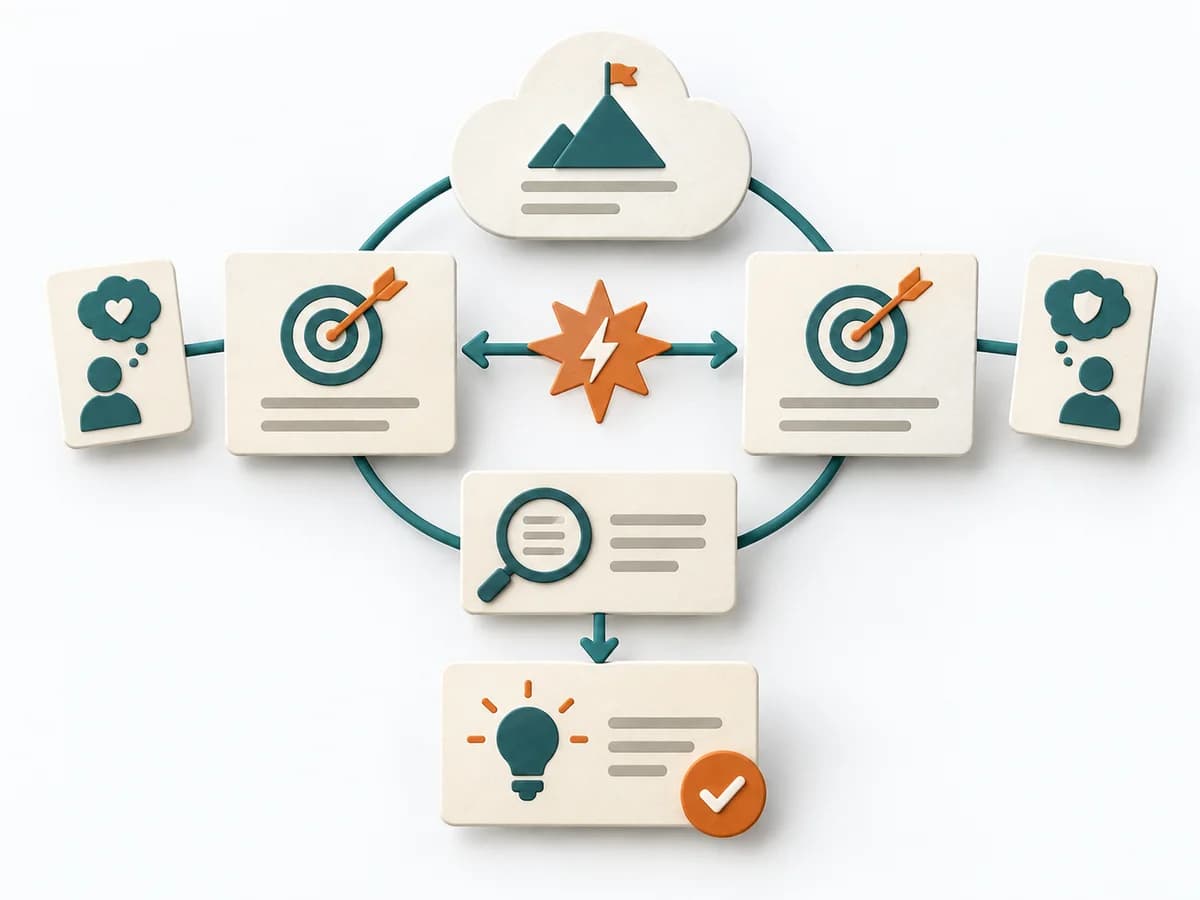 Systems Thinking Evaporating Cloud |  Domain Modeling Context Map |  Decision Making Assumption Surfacing |  Domain Modeling Bounded Context Canvas |
|---|---|---|---|---|
Purposedifferent | The method makes visible why two seemingly incompatible demands arise and which assumption must be tested to resolve the conflict. | When several contexts need to talk to each other, it makes their relationships and dependencies legible. It helps sort integration pressure and responsibilities across system boundaries. | Plans often contain assumptions that were never openly stated and remain dangerous precisely because of that. Assumption Surfacing makes these silent premises visible and prioritizes which of them carry the initiative or could sink it. | When a business context is still loosely outlined, it shapes language, responsibility, and integration space. It clarifies what belongs together and where a boundary needs to hold. |
Complexitydifferent | Medium | Medium | Low | Medium |
Timedifferent | 60-120 min | 1-3 h | 45-90 min | 1-3 h |
Participantsdifferent | 2-8 | 2-8 | 2-8 | 3-8 |
Formatdifferent | Workshop | Workshop + async | Workshop + async | Workshop + async |
Outputdifferent | Conflict Cloud, Assumption List, Breakthrough Ideas, Next Experiments | Context Map, Integration Patterns, Boundary Notes | Assumption List, Critical Assumptions, Learning Plan | Context Canvas, Glossary, Integration Notes |
Tagsno overlap | Theory of ConstraintsAssumptionsSystems thinking | Domain-Driven DesignBoundariesStrategy | AssumptionsRiskDecisionDiscovery | Domain-Driven DesignBoundariesModeling |