View methods side by side.
Choose up to four methods. Add them using the search and share the comparison by copying its link.
| Criterion |  UX Research Empathy Mapping | 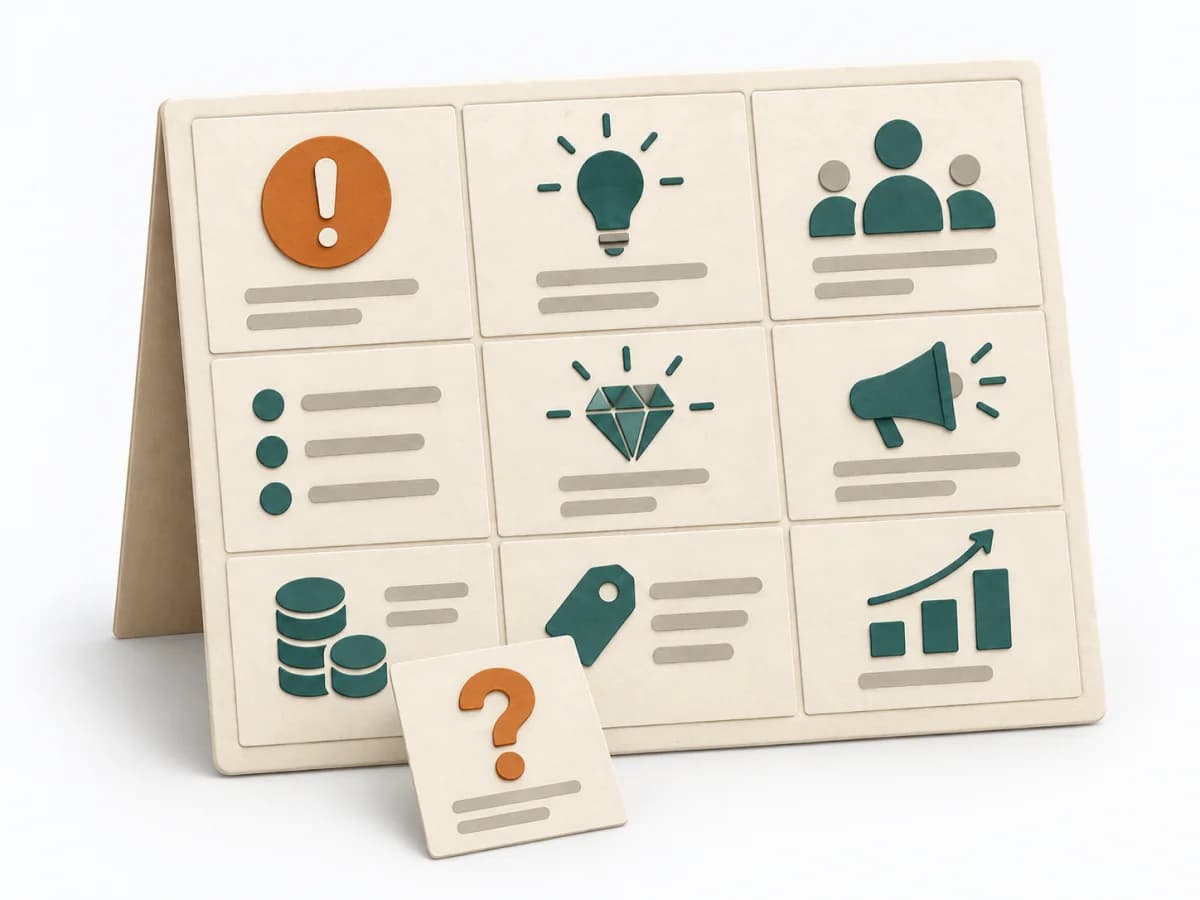 Product Strategy Lean Canvas |  Facilitation Decision Jam |  Decision Making Assumption Surfacing |
|---|---|---|---|---|
Purposedifferent | When a lot is assumed about a target group but little is seen jointly, empathy mapping makes knowledge and gaps directly comparable. The picture also shows which assumptions hold up and where evidence is missing. | When an early product bet still has too many open points, it brings target group, problem, and assumptions into a single view. It condenses the idea so core risks become nameable. | When a decision is stuck, Decision Jam loosens the knot through structured separation of problem, idea, and selection. The format creates movement without jumping prematurely at the first seemingly elegant answer. | Plans often contain assumptions that were never openly stated and remain dangerous precisely because of that. Assumption Surfacing makes these silent premises visible and prioritizes which of them carry the initiative or could sink it. |
Complexitydifferent | Low | Medium | Low | Low |
Timedifferent | 30–60 min | 45-90 min | 60-90 min | 45-90 min |
Participantsdifferent | 4-8 | 1-6 | 4-10 | 2-8 |
Formatdifferent | Workshop | Workshop + async | Workshop | Workshop + async |
Outputdifferent | Empathy Map, Assumptions List, Research Gaps | Lean Canvas, Core Assumptions, Experiment Backlog | Problem Cluster, Prioritized Challenge, Experiment | Assumption List, Critical Assumptions, Learning Plan |
Tagsno overlap | SynthesisQualitativeWorkshop | StartupLeanAssumptionsBusiness model | FacilitationDecisionProblem solvingWorkshop | AssumptionsRiskDecisionDiscovery |