View methods side by side.
Choose up to four methods. Add them using the search and share the comparison by copying its link.
| Criterion |  UX Research Empathy Mapping | 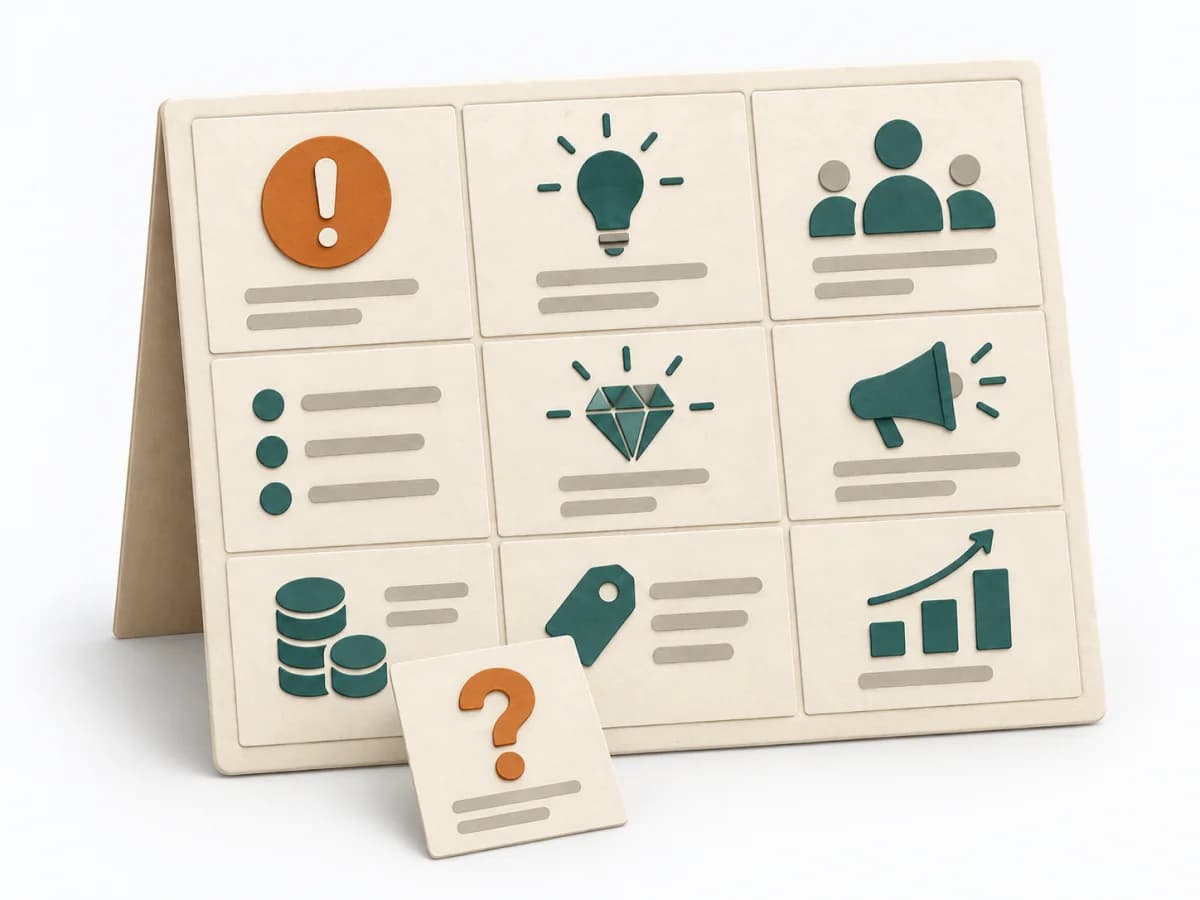 Product Strategy Lean Canvas |  Operations 5 Whys |  Operations A3 Problem Solving |
|---|---|---|---|---|
Purposedifferent | When a lot is assumed about a target group but little is seen jointly, empathy mapping makes knowledge and gaps directly comparable. The picture also shows which assumptions hold up and where evidence is missing. | When an early product bet still has too many open points, it brings target group, problem, and assumptions into a single view. It condenses the idea so core risks become nameable. | For a single, hard-to-explain deviation, the method exposes the causal chain behind the visible symptom. It keeps the cause open until a controllable condition emerges instead of a mere description. | For a complex deviation with several people involved, the method bundles problem, analysis, and decision onto one page. It creates a shared working space where causes, countermeasures, and follow-up fit together. |
Complexitydifferent | Low | Medium | Low | Medium |
Timedifferent | 30–60 min | 45-90 min | 15-30 min | 45-90 min |
Participantsdifferent | 4-8 | 1-6 | 2-6 | 2-5 |
Formatdifferent | Workshop | Workshop + async | Workshop | Workshop + async |
Outputdifferent | Empathy Map, Assumptions List, Research Gaps | Lean Canvas, Core Assumptions, Experiment Backlog | Root cause notes, Countermeasures | A3 Report, Action Plan, Root Cause Analysis |
Tagsno overlap | SynthesisQualitativeWorkshop | StartupLeanAssumptionsBusiness model | Root causeIncidentLeanProblem solving | LeanProblem solvingCoachingOperations |