View methods side by side.
Choose up to four methods. Add them using the search and share the comparison by copying its link.
Selected:Empathy MappingARID (Active Reviews for Intermediate Designs)Problem InterviewEventStorming
| Criterion |  UX Research Empathy Mapping |  Architecture ARID (Active Reviews for Intermediate Designs) | 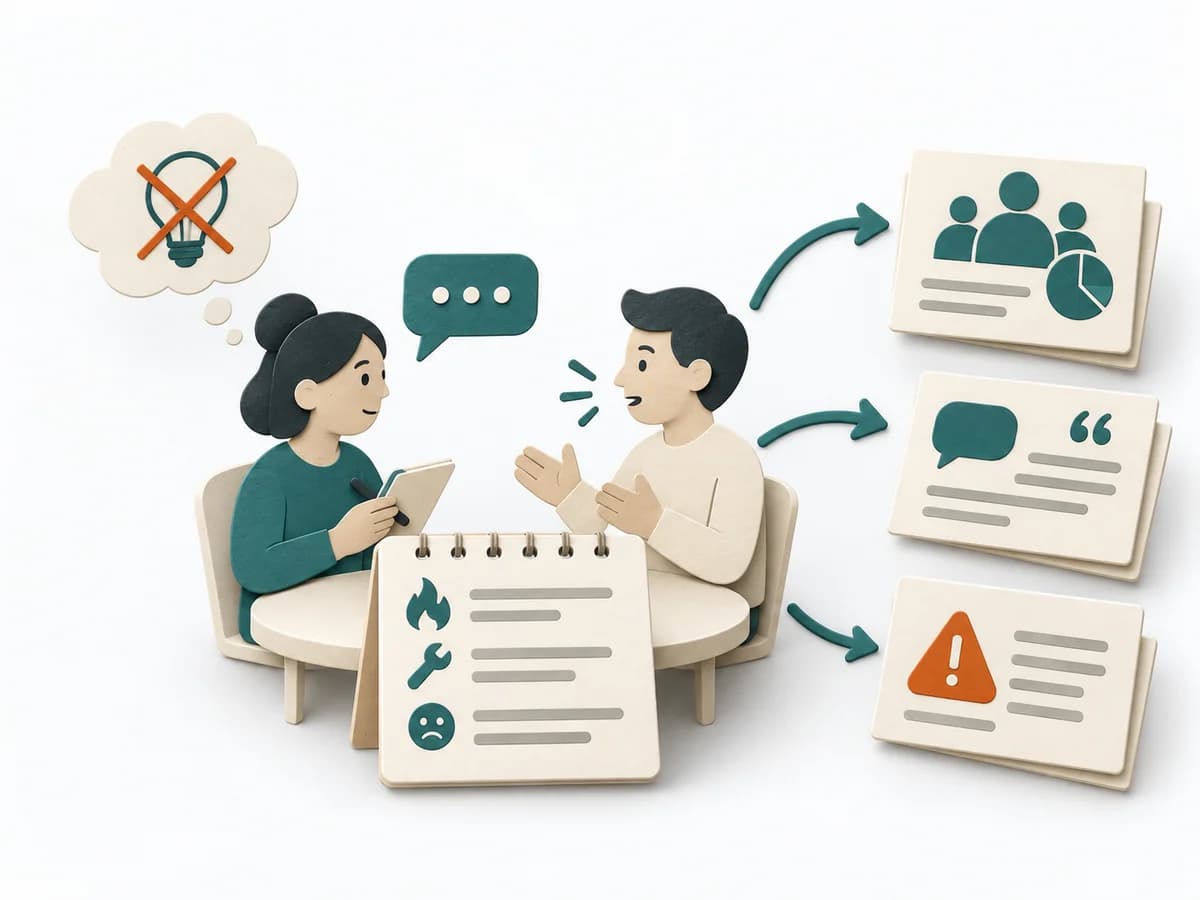 Product Discovery Problem Interview |  Domain Modeling EventStorming |
|---|---|---|---|---|
Purposedifferent | When a lot is assumed about a target group but little is seen jointly, empathy mapping makes knowledge and gaps directly comparable. The picture also shows which assumptions hold up and where evidence is missing. | ARID examines how well developers can work with a technical design. It focuses on a part of the system that can still be revised, between the architecture overview and the detailed specification. | When the picture of the problem still needs to become solid, it asks about real situations and consequences. It separates genuine suffering from mere interest in a solution. | When a domain consists of many events, rules, and states, it creates a shared modeling space for the team. It bundles language, flows, and boundaries before domain knowledge fragments into siloed views. |
Complexitydifferent | Low | Medium | Medium | Medium |
Timedifferent | 30–60 min | 2–4 h review as a planning range; preparation and evaluation additional | 30-60 min je Interview | 2-8 h |
Participantsdifferent | 4-8 | Designers, developers as users, and facilitation | 5-12 Interviews | 5-12 |
Formatdifferent | Workshop | Workshop + async | Workshop + async | Workshop |
Outputdifferent | Empathy Map, Assumptions List, Research Gaps | Prioritized development tasks, Jointly produced code or pseudocode, Observed difficulties and open design questions, Proposed design revisions | Problem Evidence, Risk Notes, Customer Segments | Event Timeline, Ubiquitous Language, Boundaries, Open Questions |
Tagsno overlap | SynthesisQualitativeWorkshop | ArchitectureEngineeringFeedbackValidationTasks | DiscoveryInterviewsValidation | Domain-Driven DesignEventsDiscoveryWorkshop |