View methods side by side.
Choose up to four methods. Add them using the search and share the comparison by copying its link.
| Criterion |  Innovation Double Diamond |  Decision Making Constraint Analysis |  Operations Causal Factor Analysis | 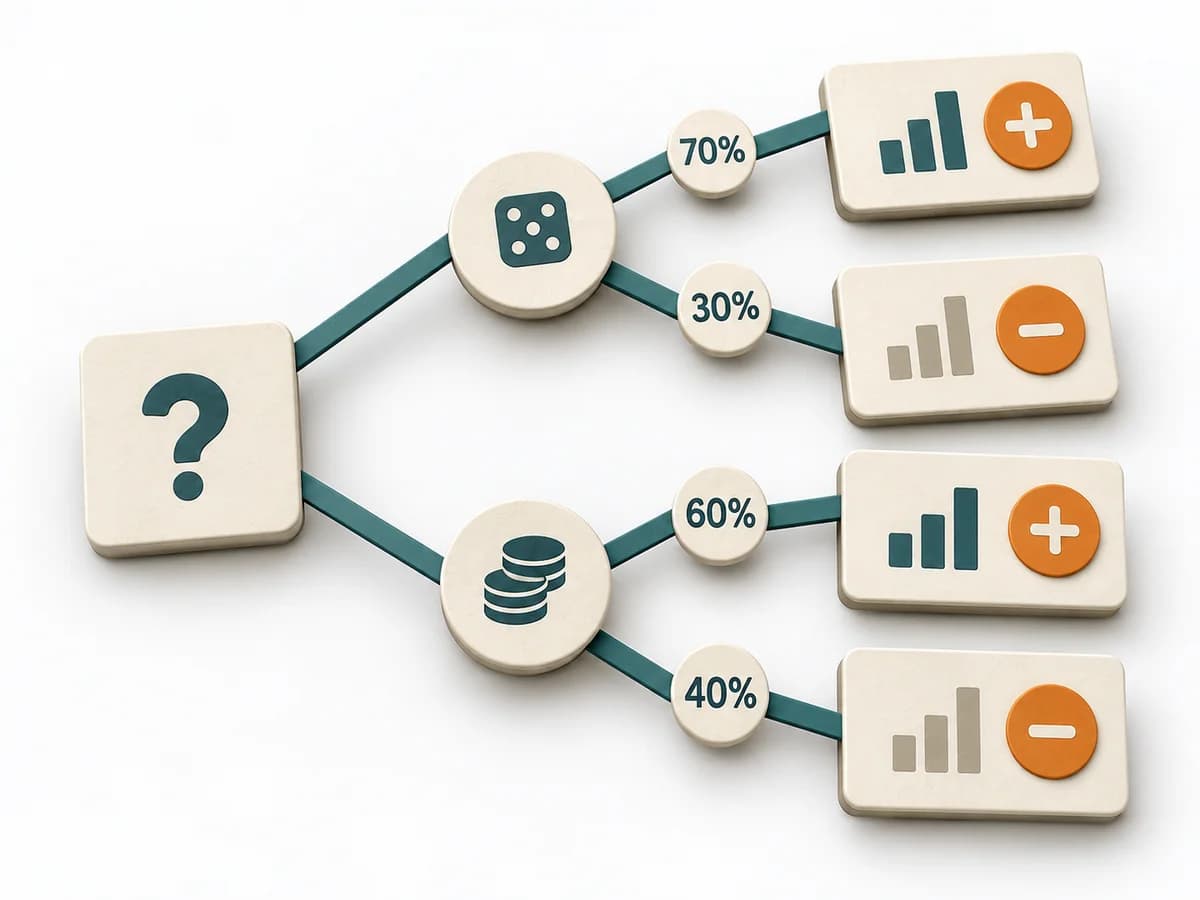 Decision Making Decision Tree |
|---|---|---|---|---|
Purposedifferent | For complex problems with a fuzzy situation, the method cleanly separates search space and decision. It first creates breadth in understanding and then focus in elaboration. This brings open questions, problem definition, and solution path into a traceable movement. | When an initiative stalls, the limit often lies not in the idea but in hard or soft boundary conditions. Constraint Analysis separates these limits and shows which of them can actually be shaped. | For an event with a complicated course, the method breaks down the contributing factors along the timeline. It shows how conditions, decisions, and reactions together produce a course of events. | For decisions with follow-on paths and dependencies, a linear comparison is often not enough. A Decision Tree shows how options branch under conditions and which consequences hang on each branch. |
Complexitydifferent | Medium | Low | High | Medium |
Timedifferent | Wochen bis Monate | 30-90 min | 2-6 h | 30-90 min |
Participantsdifferent | 3-12 | 2-8 | 3-10 | 1-6 |
Formatsame | Workshop + async | Workshop + async | Workshop + async | Workshop + async |
Outputdifferent | Problem Statement, Solution Options, Prototypes, Deliverables per Phase | Constraint List, Hard/Soft Classification, Option Impact Notes, Decision Boundaries | Event Timeline, Causal Factor Chart, Cause List, Corrective Actions | Decision Tree, Option Map, Assumption List |
Tagsno overlap | ProcessDivergenceInnovation | ConstraintsDecisionPlanningOptions | CausalityIncidentRoot causeTimeline | DecisionTreeOptions |