View methods side by side.
Choose up to four methods. Add them using the search and share the comparison by copying its link.
| Criterion | 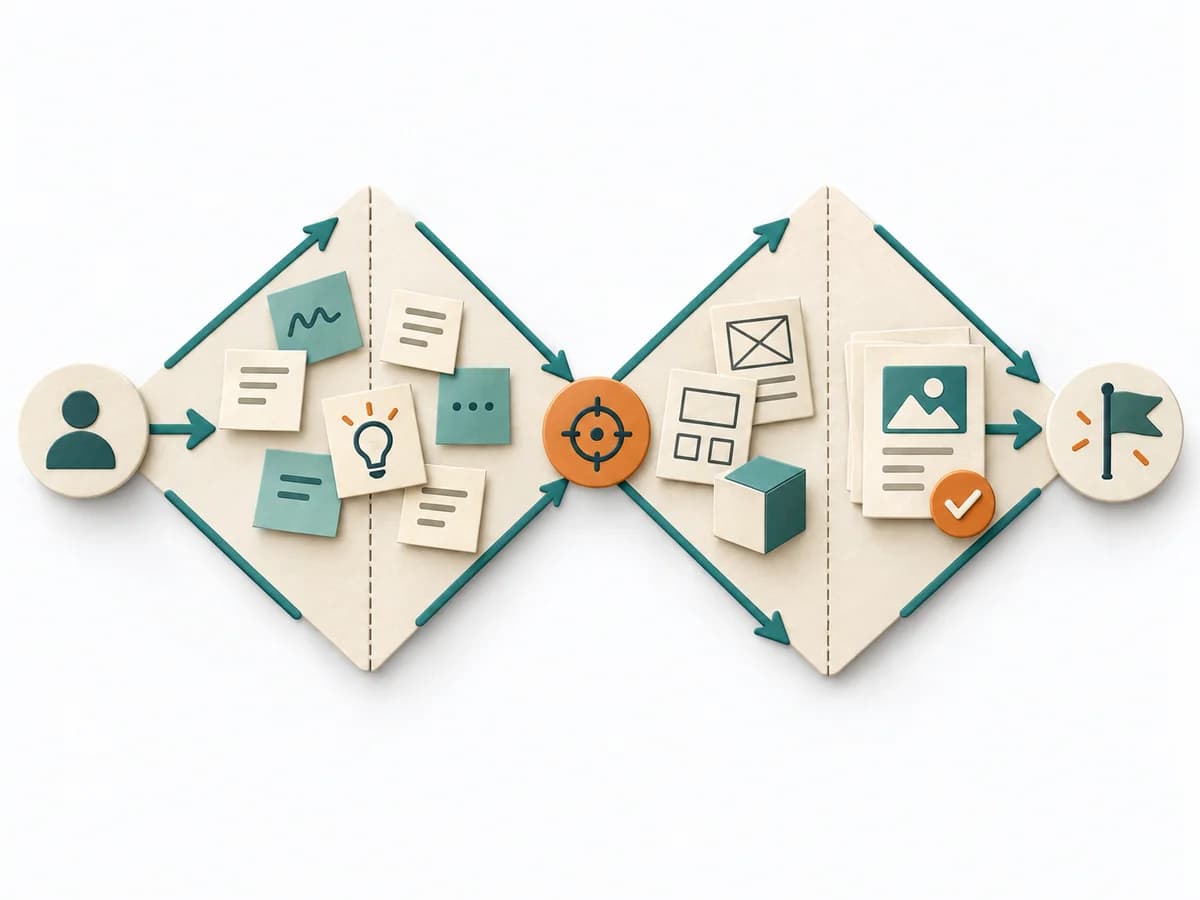 Innovation Double Diamond |  Knowledge Modeling Concept Mapping |  Knowledge Modeling IBIS |  Knowledge Modeling Knowledge Mapping |
|---|---|---|---|---|
Purposedifferent | For complex problems with a fuzzy situation, the method cleanly separates search space and decision. It first creates breadth in understanding and then focus in elaboration. This brings open questions, problem definition, and solution path into a traceable movement. | Concept Mapping arranges terms and relationships in a network that makes subject-matter connections tangible. It fits when a topic needs to be understood structurally rather than linearly. | IBIS structures thinking about complex questions as a sequence of issues, ideas, and arguments. The method keeps discussions open without forcing them into premature consensus. | Knowledge Mapping makes knowledge, gaps, and transfer paths visible across a field. It fits when expertise should not just exist but also be findable and transferable. |
Complexitysame | Medium | Medium | Medium | Medium |
Timedifferent | Wochen bis Monate | 1-2 h | 1-3 h | 1-3 h |
Participantsdifferent | 3-12 | 1-8 | 2-8 | 3-12 |
Formatdifferent | Workshop + async | Workshop + async | Workshop + async | Workshop |
Outputdifferent | Problem Statement, Solution Options, Prototypes, Deliverables per Phase | Concept Map, Relationship Labels, Knowledge Gaps | Issue Map, Positions, Argument Notes | Knowledge Map, Critical Knowledge Areas, Transfer Plan |
Tagsno overlap | ProcessDivergenceInnovation | KnowledgeConceptsMappingSensemaking | RationaleKnowledgeDecision | KnowledgeMappingRisk |