View methods side by side.
Choose up to four methods. Add them using the search and share the comparison by copying its link.
| Criterion |  Innovation Double Diamond | 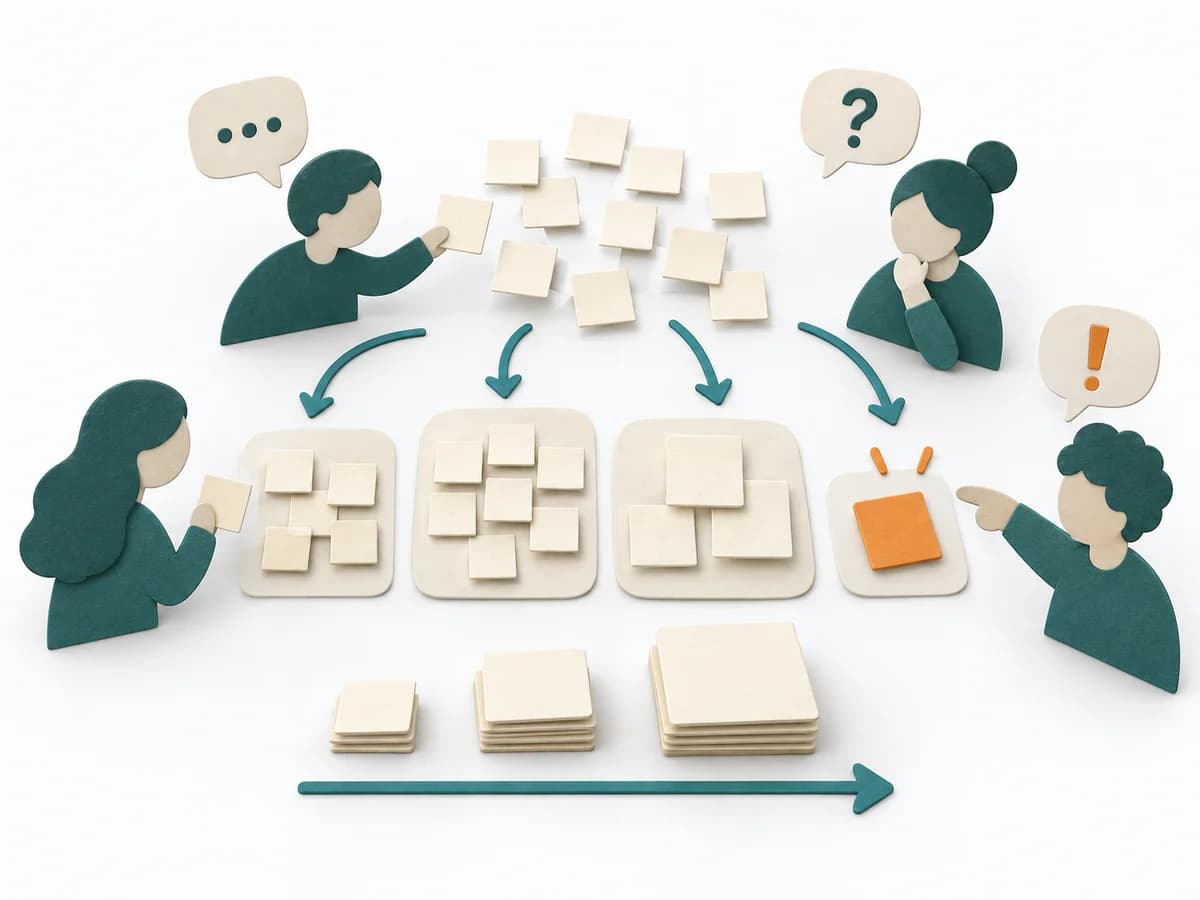 Agile Affinity Estimation |  Agile Planning Poker |  Agile Story Points |
|---|---|---|---|---|
Purposedifferent | For complex problems with a fuzzy situation, the method cleanly separates search space and decision. It first creates breadth in understanding and then focus in elaboration. This brings open questions, problem definition, and solution path into a traceable movement. | When many tasks need to be classified quickly, it sorts them by perceived effort and similarity. It reduces the effort of fine-grained estimation for large volumes. | When estimates within the team diverge too much, it puts differing expectations on a common test bench. It separates rough complexity from unspoken assumptions. | When teams want to rate complexity rather than hours, it creates a shared, relative scale. It sorts work by value, risk, and delivery ability. The result is captured as Point Estimates, Reference Stories, and Velocity Data. |
Complexitydifferent | Medium | Medium | Low | Medium |
Timedifferent | Wochen bis Monate | 30-90 min | 2-5 min je Item | laufend, 1-5 min je Item |
Participantsdifferent | 3-12 | 3-12 | 3-9 | 3-9 |
Formatdifferent | Workshop + async | Workshop | Workshop + async | Workshop + async |
Outputdifferent | Problem Statement, Solution Options, Prototypes, Deliverables per Phase | Affinity Size Map, Grouped Estimates, Unclear Items | Relative Estimates, Assumption Notes, Split Candidates | Point Estimates, Reference Stories, Velocity Data |
Tagsno overlap | ProcessDivergenceInnovation | EstimationBacklogRelative sizing | EstimationAgileRelative sizingTeam | EstimationAgileMeasurement |