View methods side by side.
Choose up to four methods. Add them using the search and share the comparison by copying its link.
| Criterion |  Innovation Double Diamond |  Growth A/B Testing | 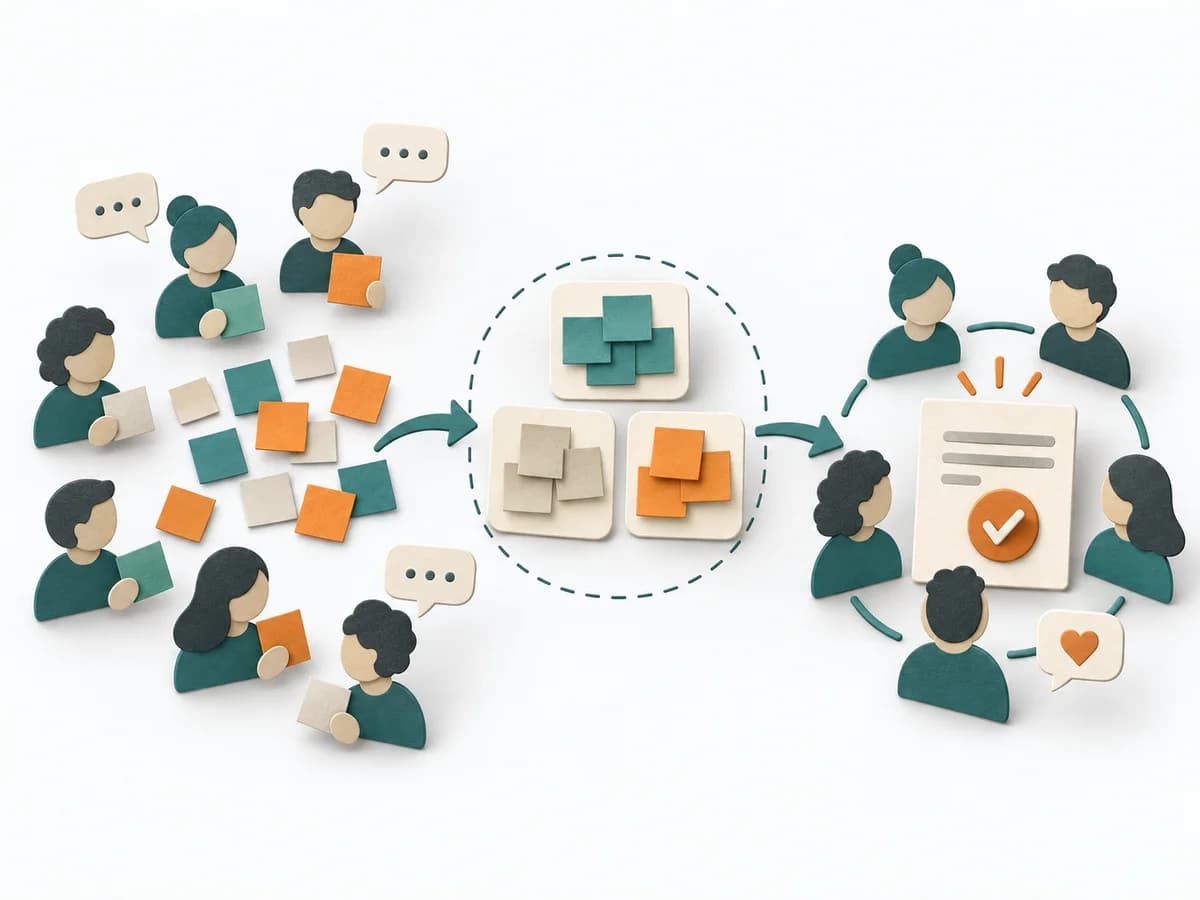 Facilitation Consensus Workshop |  Facilitation Alignment Mapping |
|---|---|---|---|---|
Purposedifferent | For complex problems with a fuzzy situation, the method cleanly separates search space and decision. It first creates breadth in understanding and then focus in elaboration. This brings open questions, problem definition, and solution path into a traceable movement. | When two variants compete, discussions quickly decide by taste rather than effect. A/B Testing checks behavior under controlled conditions and separates real improvement from chance or expectation effects. | When a group needs a solid decision without outvoting individual factions, a Consensus Workshop creates a negotiable common ground. It makes agreement, reservations, and open tensions discussable at the same time. | When several people work toward one goal but hold different mental maps, Alignment Mapping makes the discrepancies visible. It arranges goals, assumptions, and priorities so shared direction becomes verifiable. |
Complexitydifferent | Medium | High | Medium | Medium |
Timedifferent | Wochen bis Monate | 1-4 Wochen | 1-3 h | 1-2 h |
Participantsdifferent | 3-12 | 1-6 | 5-30 | 4-12 |
Formatdifferent | Workshop + async | Async | Workshop | Workshop |
Outputdifferent | Problem Statement, Solution Options, Prototypes, Deliverables per Phase | Experiment results, Decision log, Learning summary | Consensus Clusters, Theme Titles, Priority Areas | Alignment Map, Open Issues, Decision Questions |
Tagsno overlap | ProcessDivergenceInnovation | ExperimentsGrowthAnalyticsValidation | FacilitationConsensusWorkshopAlignment | AlignmentStakeholdersStrategyFacilitation |