View methods side by side.
Choose up to four methods. Add them using the search and share the comparison by copying its link.
| Criterion |  Facilitation Dot Voting | 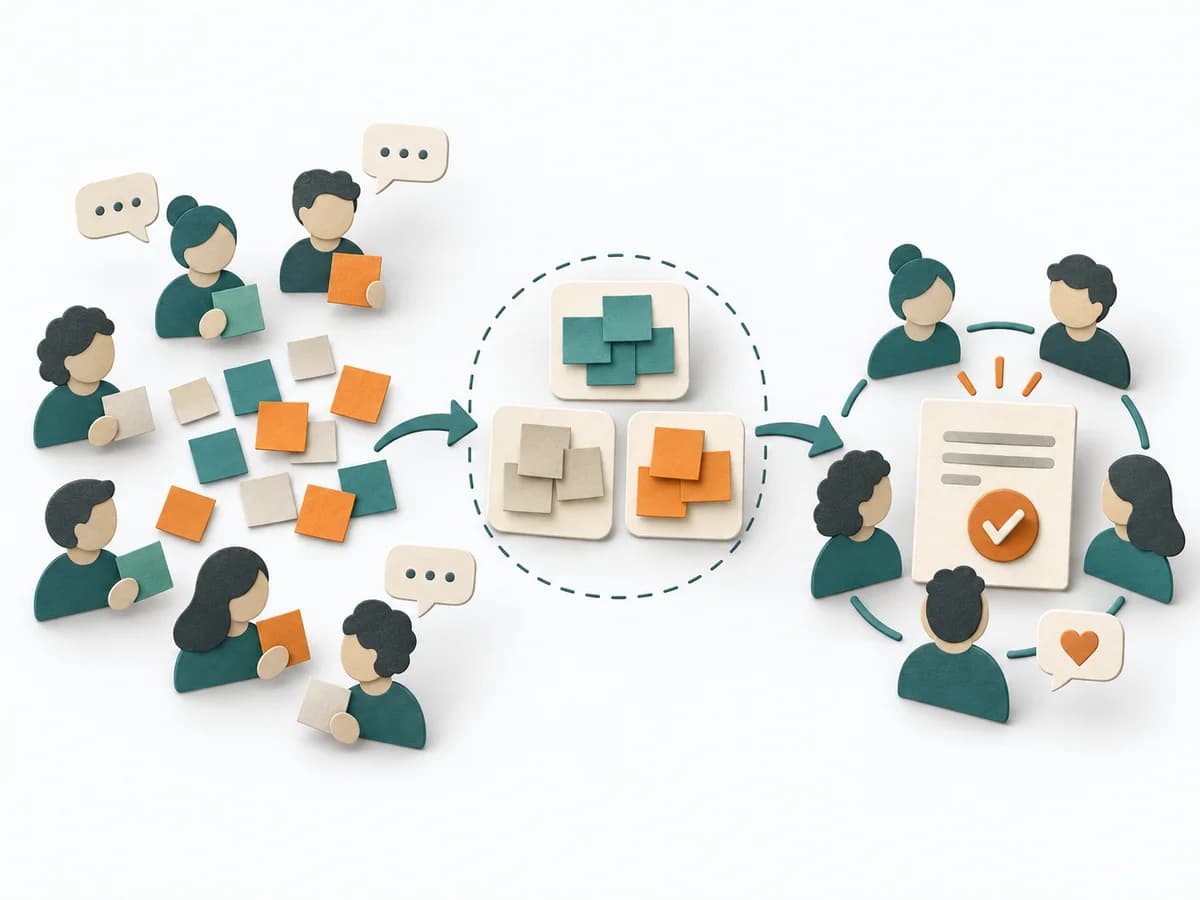 Facilitation Consensus Workshop |  Decision Making RAPID |  Decision Making Decision Rights Mapping |
|---|---|---|---|---|
Purposedifferent | When a workshop has produced too many options and the group needs to condense quickly, dot voting makes preferences visible in a short time. It bundles individual votes into a solid signal for the next selection. | When a group needs a solid decision without outvoting individual factions, a Consensus Workshop creates a negotiable common ground. It makes agreement, reservations, and open tensions discussable at the same time. | In complex management decisions, clarity is often missing about who recommends, who agrees, and who makes the decision. RAPID creates this assignment and stabilizes decisions across several levels. | In organizations with many stakeholders, it often blurs who actually decides and who is merely consulted. It separates options, evaluation criteria, and open risks. The result is captured as a Decision Rights matrix and an agreement. |
Complexitydifferent | Low | Medium | Medium | Medium |
Timedifferent | 5-15 min | 1-3 h | 45-90 min | 90-180 min |
Participantsdifferent | 3-20 | 5-30 | 3-12 | 4-12 |
Formatdifferent | Workshop | Workshop | Workshop + async | Workshop |
Outputdifferent | Ranked list, Consensus signal, Shortlist | Consensus Clusters, Theme Titles, Priority Areas | RAPID Role Map, Recommendation, Decision Log | Decision Rights Matrix, Agreement |
Tagsno overlap | FacilitationVotingConsensusPrioritization | FacilitationConsensusWorkshopAlignment | DecisionRolesGovernance | DecisionGovernanceAlignmentResponsibility |