View methods side by side.
Choose up to four methods. Add them using the search and share the comparison by copying its link.
| Criterion |  Knowledge Modeling Domain Storytelling | 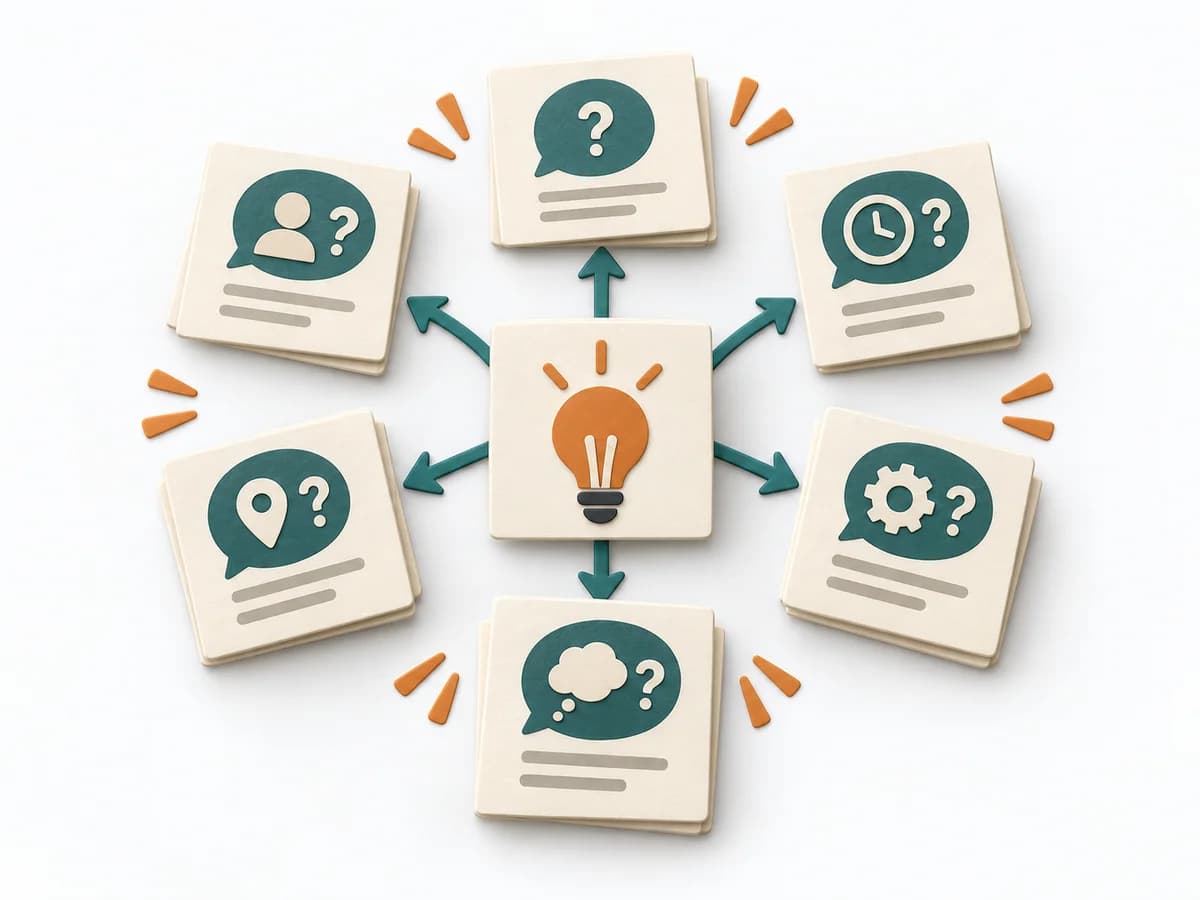 Innovation Starbursting |  Domain Modeling EventStorming |  Innovation Lotus Blossom |
|---|---|---|---|---|
Purposedifferent | Domain Storytelling translates domain knowledge into a shared narrative of actors, objects, and workflows. It is especially useful when language, rules, and process understanding must be tightly connected. | Helps clarify ideas, open questions, and testable next steps in concrete terms. It opens the thinking space, collects ideas, and leads to testable options. The result is captured as a star-shaped question map, question list, and assumption list. | When a domain consists of many events, rules, and states, it creates a shared modeling space for the team. It bundles language, flows, and boundaries before domain knowledge fragments into siloed views. | When a central question feels too large, the method breaks it into neighboring topic fields with their own depth of ideation. It holds structure and openness at the same time, so adjacent perspectives don't get lost. This grows an idea space out of a core problem. |
Complexitydifferent | Low | Low | Medium | Low |
Timedifferent | 1-2 h | 30-60 min | 2-8 h | 45-90 min |
Participantsdifferent | 2-8 | 3-10 | 5-12 | 3-10 |
Formatdifferent | Workshop | Workshop + async | Workshop | Workshop |
Outputdifferent | Domain Story, Glossary Notes, Process Narrative | Star-Shaped Question Map, Question List, Assumption List | Event Timeline, Ubiquitous Language, Boundaries, Open Questions | Lotus Diagram, Idea Themes, Shortlist |
Tagsno overlap | KnowledgeDomain-Driven DesignProcess | BrainstormingIdeationWorkshopDiscovery | Domain-Driven DesignEventsDiscoveryWorkshop | BrainstormingIdeationCreativityDivergenceWorkshop |