View methods side by side.
Choose up to four methods. Add them using the search and share the comparison by copying its link.
| Criterion |  Knowledge Modeling Domain Storytelling |  Business Strategy Scenario Planning |  Business Strategy SWOT Analysis | 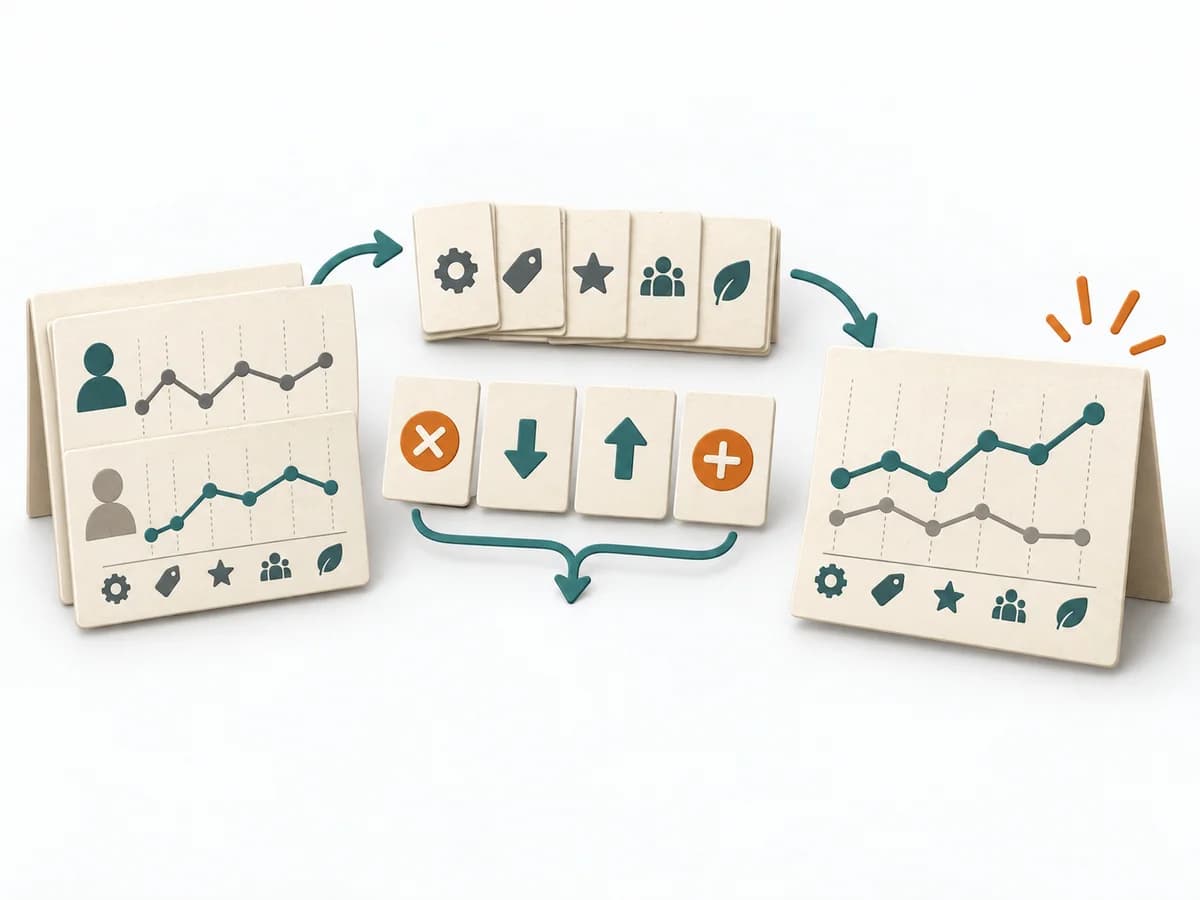 Business Strategy Blue Ocean Strategy Canvas |
|---|---|---|---|---|
Purposedifferent | Domain Storytelling translates domain knowledge into a shared narrative of actors, objects, and workflows. It is especially useful when language, rules, and process understanding must be tightly connected. | Scenario Planning opens the view to several plausible futures instead of a single forecast. The method protects strategies from depending on too narrow an expected path. | SWOT Analysis arranges strengths, weaknesses, opportunities, and threats into a compact picture of the situation. It keeps internal capabilities and external influences separate before strategic options emerge from them. | The Blue Ocean Strategy Canvas shows how an offering is positioned relative to the market. Differentiation thereby becomes tangible in value factors instead of merely being claimed. |
Complexitydifferent | Low | High | Low | Medium |
Timedifferent | 1-2 h | 0.5-2 Tage | 30-60 min | 2-4 h |
Participantsdifferent | 2-8 | 4-12 | 3-12 | 3-10 |
Formatsame | Workshop | Workshop | Workshop | Workshop |
Outputdifferent | Domain Story, Glossary Notes, Process Narrative | Scenario Set, Strategic Implications, Robust Options | SWOT matrix, Strategic options, Action list | Strategy Canvas, Value Curve, ERRC Actions |
Tagsno overlap | KnowledgeDomain-Driven DesignProcess | StrategyUncertaintyPlanning | StrategyAnalysisMarketPositioning | StrategyPositioningInnovationValue |