View methods side by side.
Choose up to four methods. Add them using the search and share the comparison by copying its link.
| Criterion |  Knowledge Modeling Domain Storytelling | 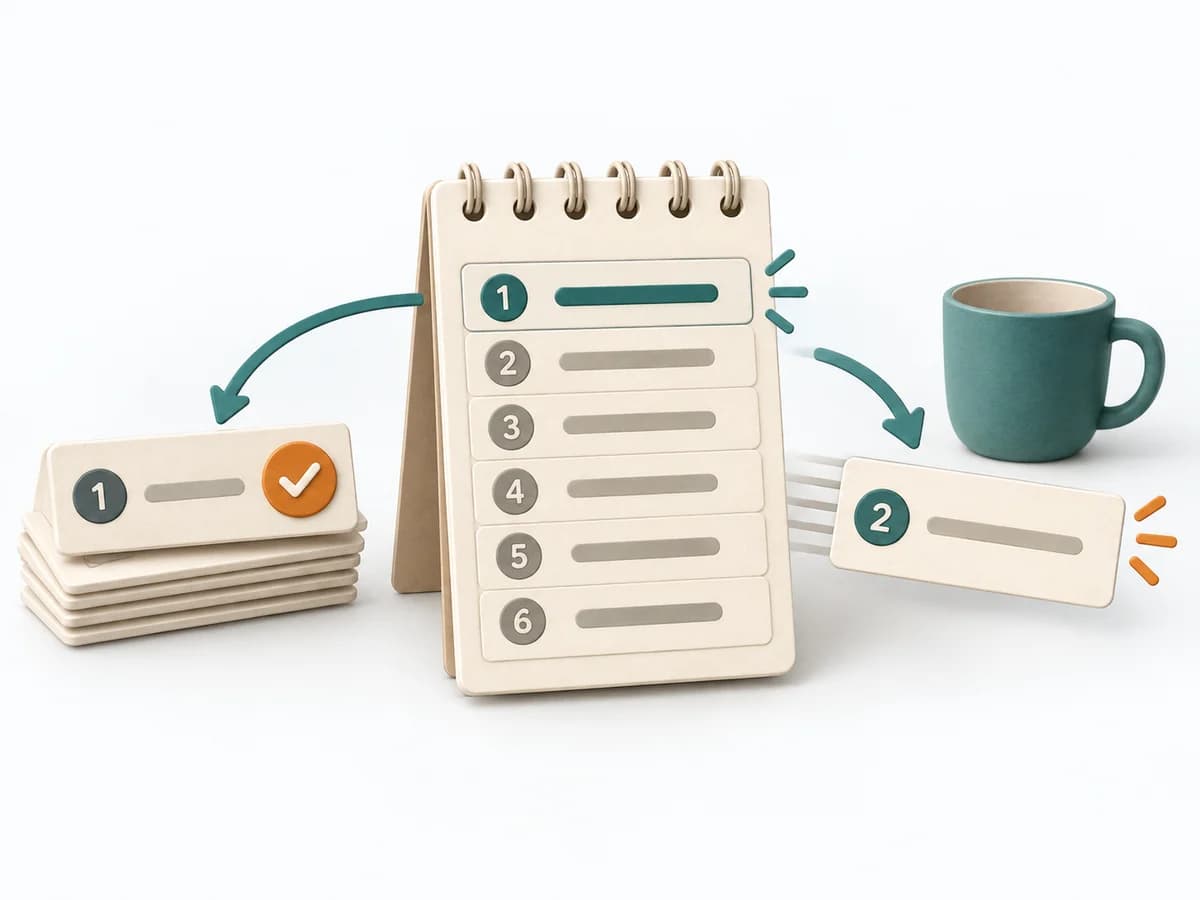 Operations Ivy Lee Method |  Product Discovery Experiment Canvas |  Product Discovery Fake Door Test |
|---|---|---|---|---|
Purposedifferent | Domain Storytelling translates domain knowledge into a shared narrative of actors, objects, and workflows. It is especially useful when language, rules, and process understanding must be tightly connected. | With a restless workday full of too many open items, the method creates radical simplicity. It directs attention to a short sequence instead of a broad, still-open field. | When experiments become unreadable after the fact, it arranges hypothesis, signal, and learning goal on a single canvas. It separates problem, assumption, solution, and evidence. The result is captured as a Completed Experiment Canvas and a Success Metric. | When demand is still unclear, it measures interest in a feature before it is built. It separates real behavior from polite agreement and deliberately keeps build effort small. |
Complexitydifferent | Low | Low | Low | Medium |
Timedifferent | 1-2 h | 5-10 min daily | 30-60 min | 1-5 Tage |
Participantsdifferent | 2-8 | 1 | 1-5 | Nutzertraffic |
Formatdifferent | Workshop | Async | Workshop + async | Async |
Outputdifferent | Domain Story, Glossary Notes, Process Narrative | Daily Priority List, Completion Notes | Completed Experiment Canvas, Success Metric | Click Data, Interest Signal, Learning Decision |
Tagsno overlap | KnowledgeDomain-Driven DesignProcess | PrioritizationProductivityExecution | ExperimentsValidationDiscoveryHypothesis | ValidationExperimentsDemandDiscovery |