View methods side by side.
Choose up to four methods. Add them using the search and share the comparison by copying its link.
| Criterion |  Knowledge Modeling Domain Storytelling | 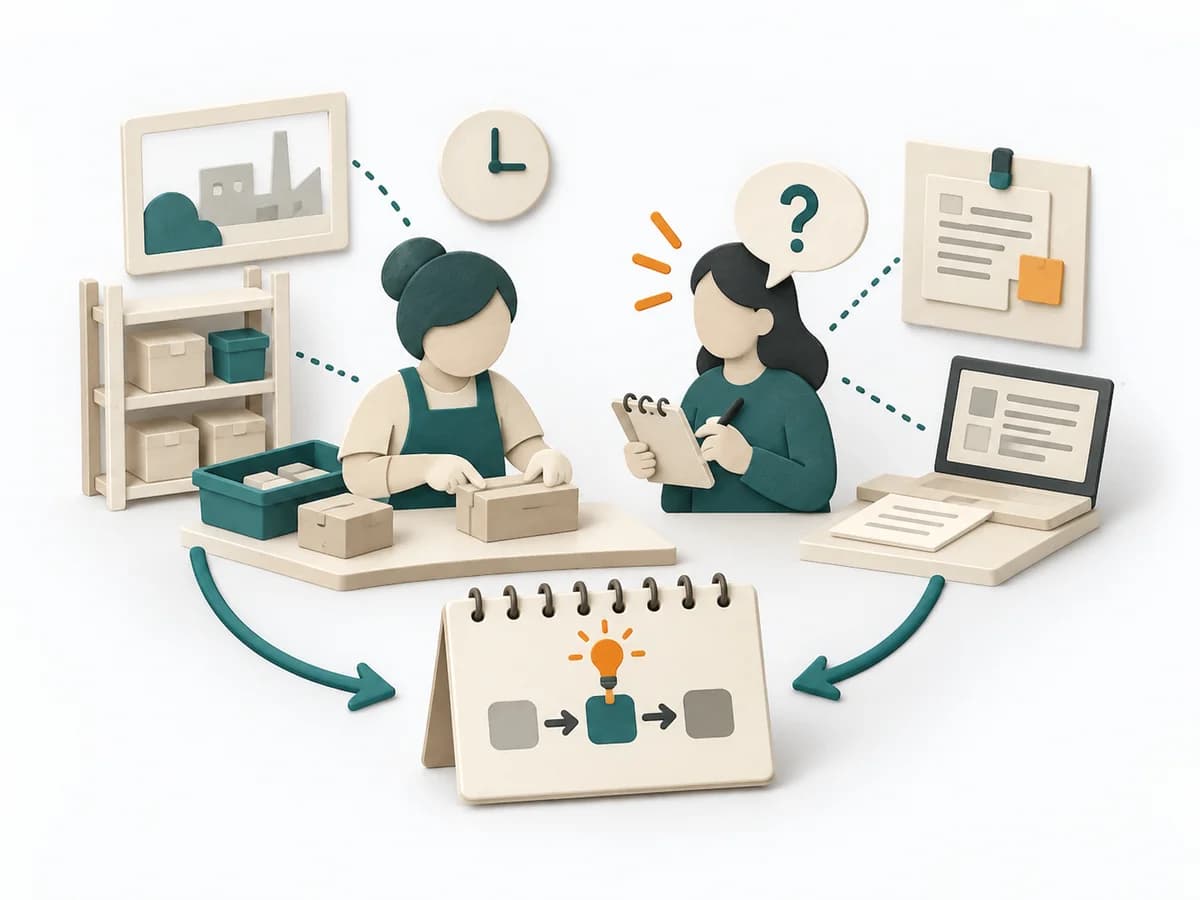 UX Research Contextual Inquiry |  Product Discovery Assumption Mapping |  Decision Making Assumption Surfacing |
|---|---|---|---|---|
Purposedifferent | Domain Storytelling translates domain knowledge into a shared narrative of actors, objects, and workflows. It is especially useful when language, rules, and process understanding must be tightly connected. | When work processes are known only from accounts and the real context stays hidden, Contextual Inquiry makes behavior at the workplace visible. Observation and follow-up questions together show how people actually work, get interrupted, and improvise. | When assumptions still sit unordered in the room, it weighs uncertainty against leverage. It makes visible which hypotheses should be checked first. | Plans often contain assumptions that were never openly stated and remain dangerous precisely because of that. Assumption Surfacing makes these silent premises visible and prioritizes which of them carry the initiative or could sink it. |
Complexitydifferent | Low | Medium | Medium | Low |
Timedifferent | 1-2 h | 1-3 Wochen | 45-60 min | 45-90 min |
Participantsdifferent | 2-8 | 4-12 Beobachtungen | 2-8 | 2-8 |
Formatdifferent | Workshop | Workshop + async | Workshop + async | Workshop + async |
Outputdifferent | Domain Story, Glossary Notes, Process Narrative | Field Notes, Workflow Insights, Pain Points | Assumption map, Test backlog, Risk ranking | Assumption List, Critical Assumptions, Learning Plan |
Tagsno overlap | KnowledgeDomain-Driven DesignProcess | UX researchObservationContext | AssumptionsRiskExperimentsValidation | AssumptionsRiskDecisionDiscovery |