View methods side by side.
Choose up to four methods. Add them using the search and share the comparison by copying its link.
| Criterion | 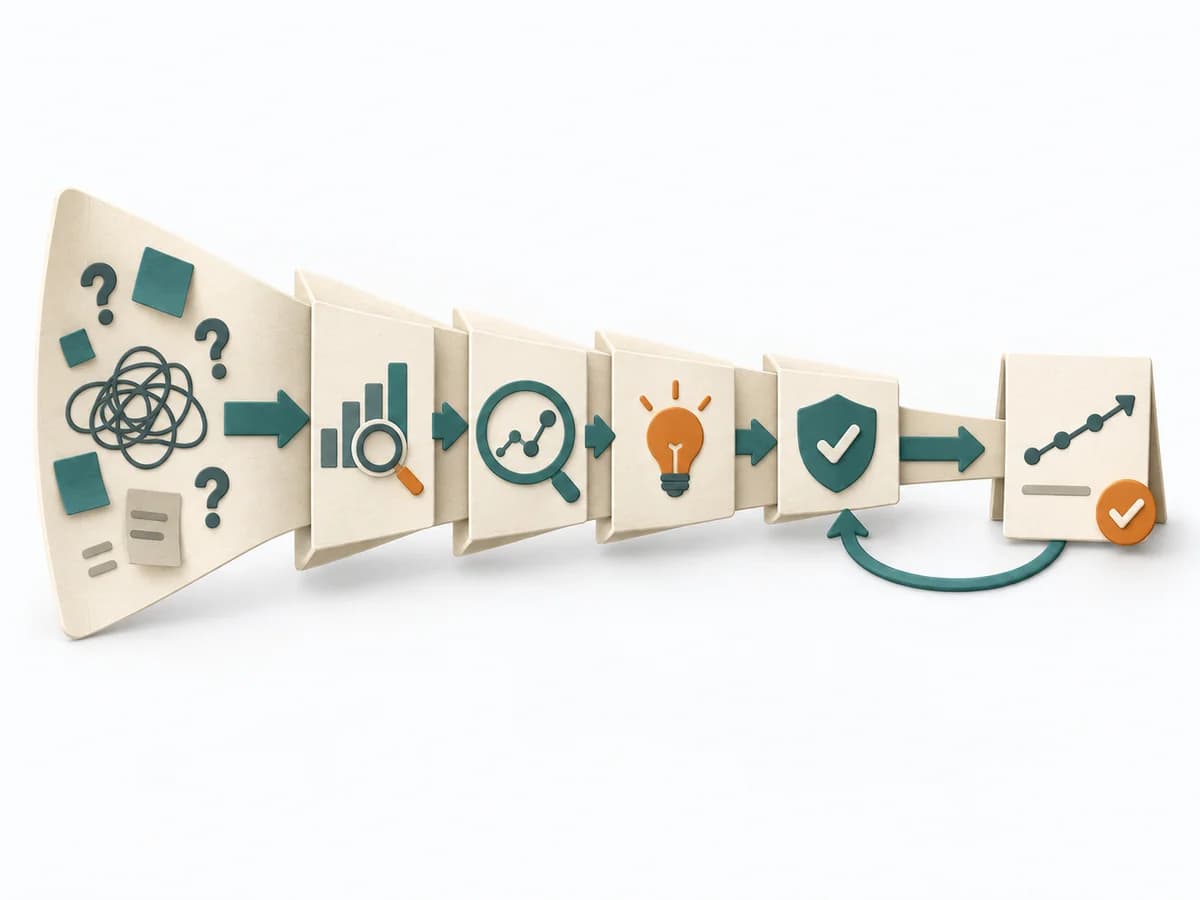 Operations DMAIC |  Business Strategy GAP Analysis |  Growth Flywheel |  Growth Hooked Model |
|---|---|---|---|---|
Purposedifferent | For a process problem with fluctuating performance, the method brings analysis and improvement into a disciplined sequence. It creates a framework in which numbers, causes, and control come together. | GAP Analysis compares the current state with a target picture and makes the distance manageable. It becomes useful when, ahead of new initiatives, it must become clear which capabilities, processes, or resources are missing. | Growth often breaks down where a reinforcing mechanism builds up too much friction. A Flywheel shows the cycle of value, repetition, and reinforcement meant to sustain growth. | The Hooked Model helps clarify engagement loops, user behavior, and experiments. It makes repeat behavior measurable and captures the result as a hooked loop, trigger map, and reward design. |
Complexitydifferent | High | Medium | Medium | Medium |
Timedifferent | 2-12 Wochen | 1-3 h | 60-120 min | Multiple workshops over several weeks |
Participantsdifferent | 3-10 | 2-8 | 3-8 | 2-8 |
Formatdifferent | Workshop + async | Workshop + async | Workshop | Workshop + async |
Outputdifferent | Project Charter, Measurement Plan, Cause Analysis, Control Plan | Gap Matrix, Action Plan, Risk Notes | Flywheel Map, Friction Points, Growth Levers, Experiment Backlog | Hooked loop, Trigger map, Reward design, Ethics check |
Tagsno overlap | Continuous improvementQualityProcess improvement | StrategyAnalysisPlanning | GrowthRetentionConversion | GrowthBehaviorRetention |