View methods side by side.
Choose up to four methods. Add them using the search and share the comparison by copying its link.
| Criterion |  Product Strategy DIBB | 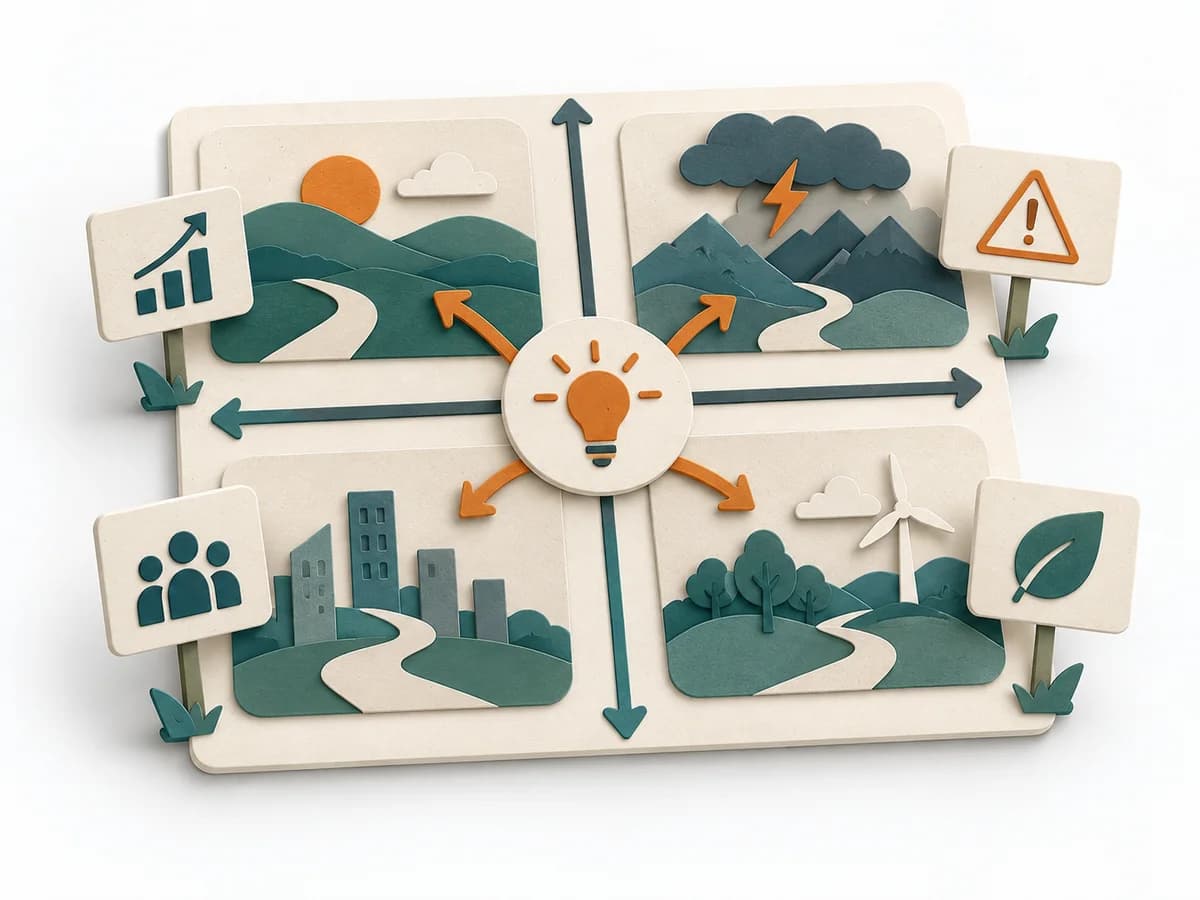 Business Strategy Scenario Planning |  Product Discovery Experiment Canvas |  Decision Making Assumption Surfacing |
|---|---|---|---|---|
Purposedifferent | DIBB helps clarify target groups, value, goals, and priorities by making the logic behind a decision explicit. It captures results as a DIBB document, belief list, bet list, and learning report. | Scenario Planning opens the view to several plausible futures instead of a single forecast. The method protects strategies from depending on too narrow an expected path. | When experiments become unreadable after the fact, it arranges hypothesis, signal, and learning goal on a single canvas. It separates problem, assumption, solution, and evidence. The result is captured as a Completed Experiment Canvas and a Success Metric. | Plans often contain assumptions that were never openly stated and remain dangerous precisely because of that. Assumption Surfacing makes these silent premises visible and prioritizes which of them carry the initiative or could sink it. |
Complexitydifferent | Low | High | Low | Low |
Timedifferent | 1-2 h | 0.5-2 Tage | 30-60 min | 45-90 min |
Participantsdifferent | 2-8 | 4-12 | 1-5 | 2-8 |
Formatdifferent | Workshop + async | Workshop | Workshop + async | Workshop + async |
Outputdifferent | DIBB document, Belief list, Bet list, Learning report | Scenario Set, Strategic Implications, Robust Options | Completed Experiment Canvas, Success Metric | Assumption List, Critical Assumptions, Learning Plan |
Tagsno overlap | StrategyDecisionAssumptionsHypothesis | StrategyUncertaintyPlanning | ExperimentsValidationDiscoveryHypothesis | AssumptionsRiskDecisionDiscovery |