View methods side by side.
Choose up to four methods. Add them using the search and share the comparison by copying its link.
| Criterion |  Product Strategy DIBB |  Facilitation Dot Voting | 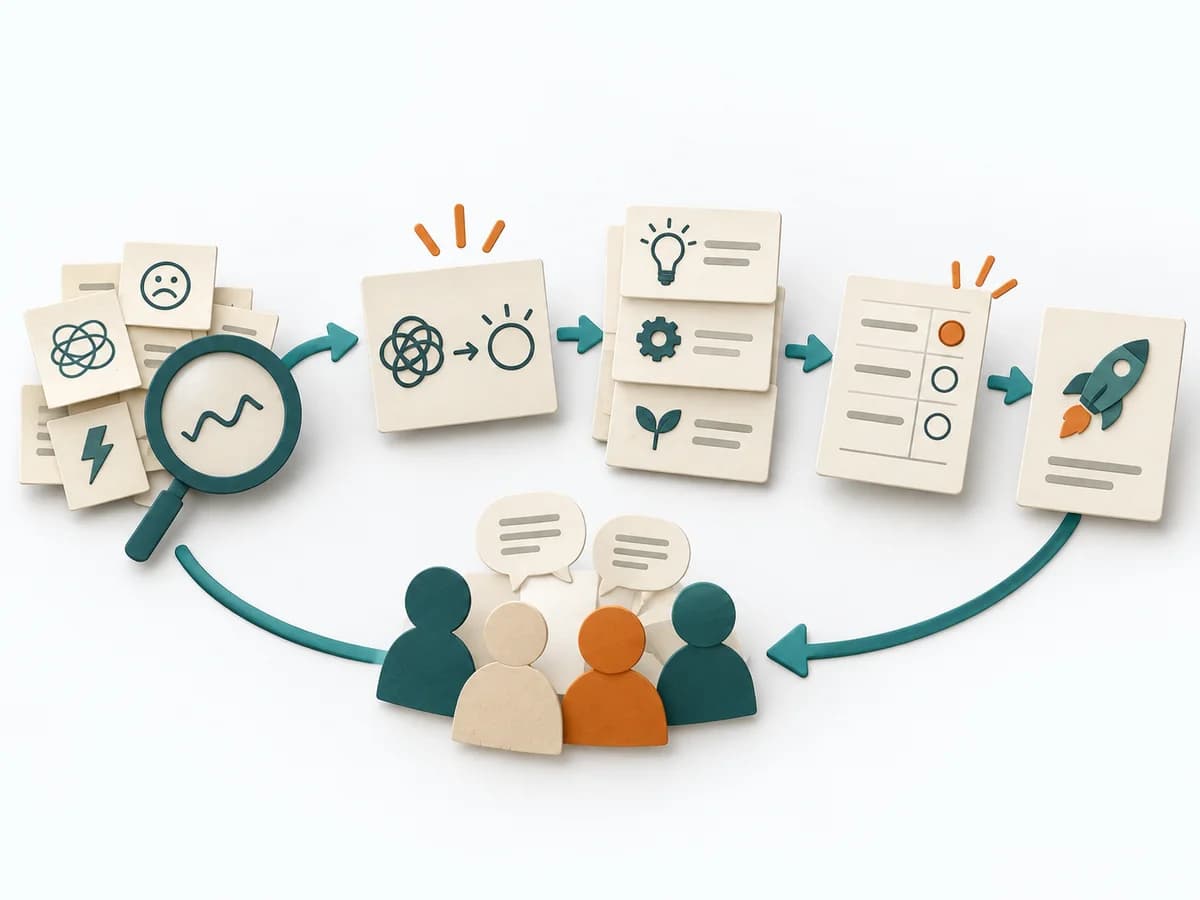 Facilitation Decision Jam |  Facilitation Alignment Mapping |
|---|---|---|---|---|
Purposedifferent | DIBB helps clarify target groups, value, goals, and priorities by making the logic behind a decision explicit. It captures results as a DIBB document, belief list, bet list, and learning report. | When a workshop has produced too many options and the group needs to condense quickly, dot voting makes preferences visible in a short time. It bundles individual votes into a solid signal for the next selection. | When a decision is stuck, Decision Jam loosens the knot through structured separation of problem, idea, and selection. The format creates movement without jumping prematurely at the first seemingly elegant answer. | When several people work toward one goal but hold different mental maps, Alignment Mapping makes the discrepancies visible. It arranges goals, assumptions, and priorities so shared direction becomes verifiable. |
Complexitydifferent | Low | Low | Low | Medium |
Timedifferent | 1-2 h | 5-15 min | 60-90 min | 1-2 h |
Participantsdifferent | 2-8 | 3-20 | 4-10 | 4-12 |
Formatdifferent | Workshop + async | Workshop | Workshop | Workshop |
Outputdifferent | DIBB document, Belief list, Bet list, Learning report | Ranked list, Consensus signal, Shortlist | Problem Cluster, Prioritized Challenge, Experiment | Alignment Map, Open Issues, Decision Questions |
Tagsno overlap | StrategyDecisionAssumptionsHypothesis | FacilitationVotingConsensusPrioritization | FacilitationDecisionProblem solvingWorkshop | AlignmentStakeholdersStrategyFacilitation |