View methods side by side.
Choose up to four methods. Add them using the search and share the comparison by copying its link.
| Criterion |  Product Strategy DIBB | 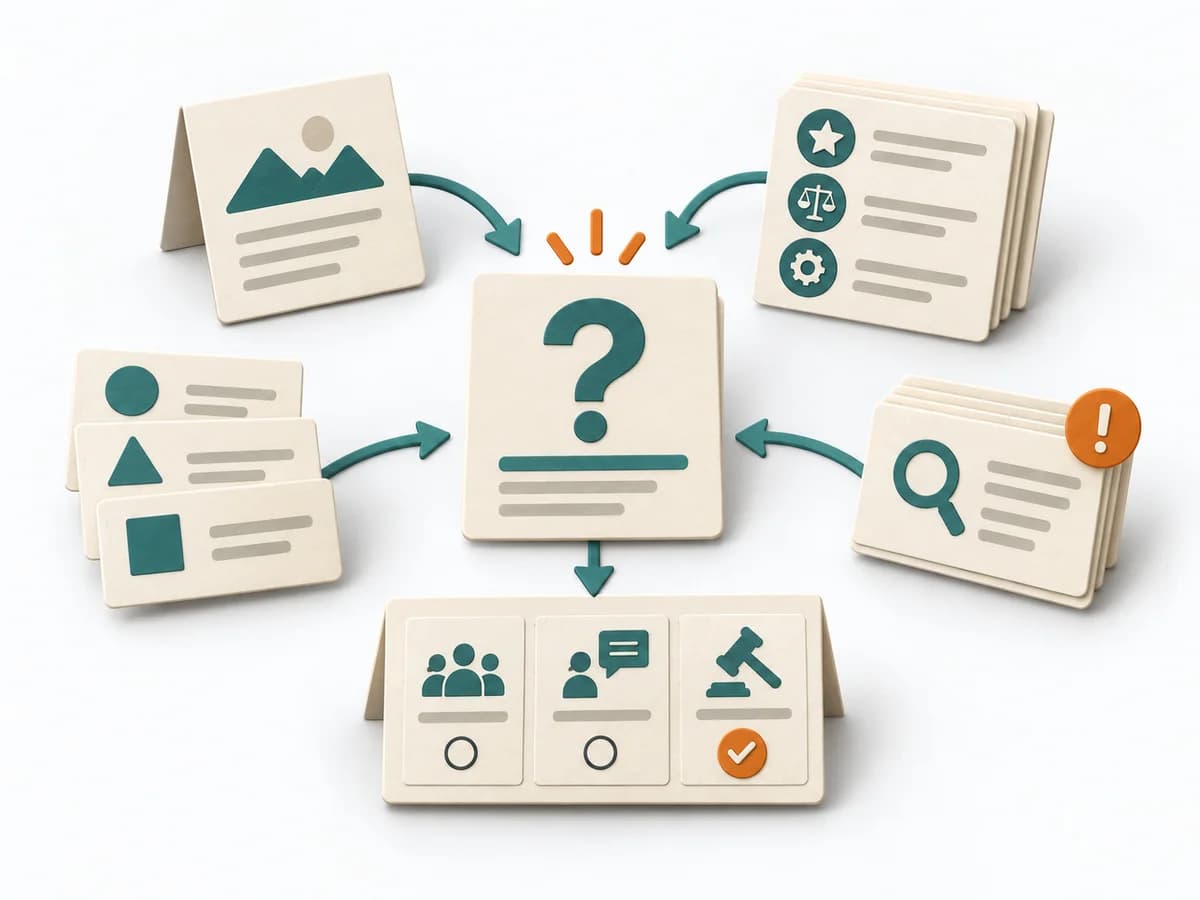 Decision Making Decision Framing Workshop |  Decision Making Assumption Surfacing |  Facilitation Alignment Mapping |
|---|---|---|---|---|
Purposedifferent | DIBB helps clarify target groups, value, goals, and priorities by making the logic behind a decision explicit. It captures results as a DIBB document, belief list, bet list, and learning report. | When a decision is poorly framed, even good answers deliver little value. A Decision Framing Workshop sharpens the problem, goal, and boundaries before the actual weighing begins. | Plans often contain assumptions that were never openly stated and remain dangerous precisely because of that. Assumption Surfacing makes these silent premises visible and prioritizes which of them carry the initiative or could sink it. | When several people work toward one goal but hold different mental maps, Alignment Mapping makes the discrepancies visible. It arranges goals, assumptions, and priorities so shared direction becomes verifiable. |
Complexitydifferent | Low | Medium | Low | Medium |
Timedifferent | 1-2 h | 60-120 min | 45-90 min | 1-2 h |
Participantsdifferent | 2-8 | 4-10 | 2-8 | 4-12 |
Formatdifferent | Workshop + async | Workshop | Workshop + async | Workshop |
Outputdifferent | DIBB document, Belief list, Bet list, Learning report | Decision Frame, Decision Question, Criteria List, Evidence Plan | Assumption List, Critical Assumptions, Learning Plan | Alignment Map, Open Issues, Decision Questions |
Tagsno overlap | StrategyDecisionAssumptionsHypothesis | Decision framingAlignmentCriteriaOptions | AssumptionsRiskDecisionDiscovery | AlignmentStakeholdersStrategyFacilitation |