View methods side by side.
Choose up to four methods. Add them using the search and share the comparison by copying its link.
| Criterion |  UX Research Diary Study |  UX Research Usability Testing |  Product Discovery Smoke Test | 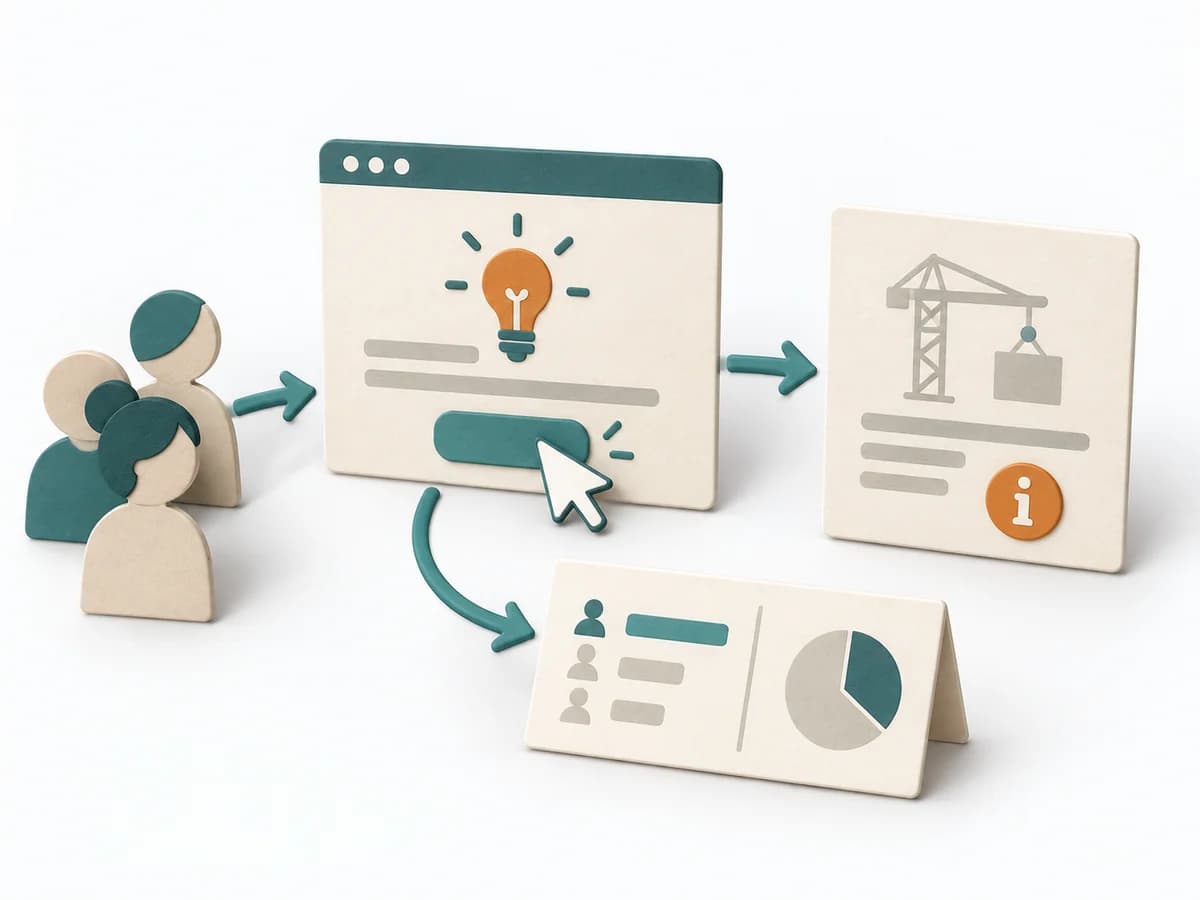 Product Discovery Fake Door Test |
|---|---|---|---|---|
Purposedifferent | When experiences build up over days or weeks and a single session cannot capture them, Diary Study records the course of everyday life. Recurring triggers, moods, and habits become visible this way, beyond the sharpness of memory. | When a product is built but people get stuck on tasks, usability testing shows the friction at concrete points. Observed use instead of self-report makes visible where orientation, understanding, or interaction breaks down. | When demand only needs to be roughly verified, it tests interest with minimal effort. It measures whether people would take a next step at all. | When demand is still unclear, it measures interest in a feature before it is built. It separates real behavior from polite agreement and deliberately keeps build effort small. |
Complexitydifferent | Medium | Medium | Low | Medium |
Timedifferent | 1-4 Wochen | 1-2 h je Session | 1-5 Tage | 1-5 Tage |
Participantsdifferent | 5-20 | Based on research question | Nutzertraffic | Nutzertraffic |
Formatdifferent | Async | Workshop + async | Async | Async |
Outputdifferent | Diary Entries, Longitudinal Patterns, Experience Timeline | Usability Issues, Severity List, Recommendations | Interest Metrics, Conversion Signal, Learning Note | Click Data, Interest Signal, Learning Decision |
Tagsno overlap | UX researchTrackingBehavior | ValidationUXPrototype | ValidationExperimentsDemandGrowth | ValidationExperimentsDemandDiscovery |