View methods side by side.
Choose up to four methods. Add them using the search and share the comparison by copying its link.
| Criterion |  UX Research Diary Study | 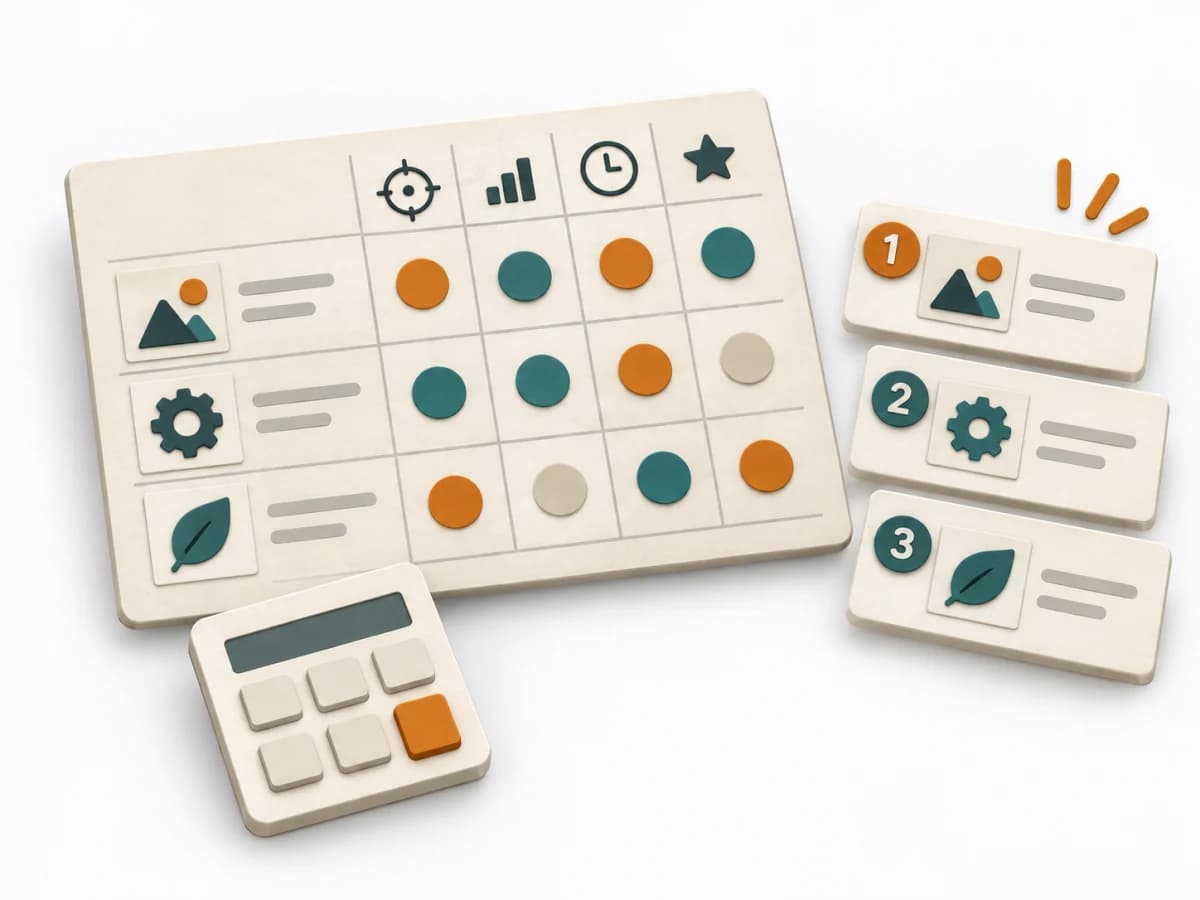 Product Strategy RICE Scoring |  Decision Making Argument Mapping |  Product Strategy ICE Scoring |
|---|---|---|---|---|
Purposedifferent | When experiences build up over days or weeks and a single session cannot capture them, Diary Study records the course of everyday life. Recurring triggers, moods, and habits become visible this way, beyond the sharpness of memory. | When many initiatives compete for the same resources, it brings reach, impact, confidence, and effort into one shared ranking. It makes prioritization economically connectable. | When statements, evidence, and counterarguments get mixed up, a debate quickly loses its structure. Argument Mapping breaks a thesis down into its reasoning and makes visible what it really rests on. | When ideas need sorting quickly, it condenses impact, confidence, and effort into one compact score. It connects customer value, product logic, and decision priorities. The result is captured as an ICE table and top-ideas list. |
Complexitydifferent | Medium | Medium | Medium | Low |
Timedifferent | 1-4 Wochen | 60-90 min | 1-3 h | 30-60 min |
Participantsdifferent | 5-20 | 2-10 | 1-8 | 2-8 |
Formatdifferent | Async | Workshop + async | Workshop + async | Workshop + async |
Outputdifferent | Diary Entries, Longitudinal Patterns, Experience Timeline | RICE Scores, Ranked List, Assumption Log | Argument Map, Evidence Gaps, Decision Rationale | ICE Table, Top Idea List |
Tagsno overlap | UX researchTrackingBehavior | PrioritizationScoringRoadmapTradeoffs | SensemakingDecisionRationale | PrioritizationScoringGrowthDecision |