View methods side by side.
Choose up to four methods. Add them using the search and share the comparison by copying its link.
| Criterion |  UX Research Diary Study |  Product Discovery Kano Model |  Operations Root Cause Analysis | 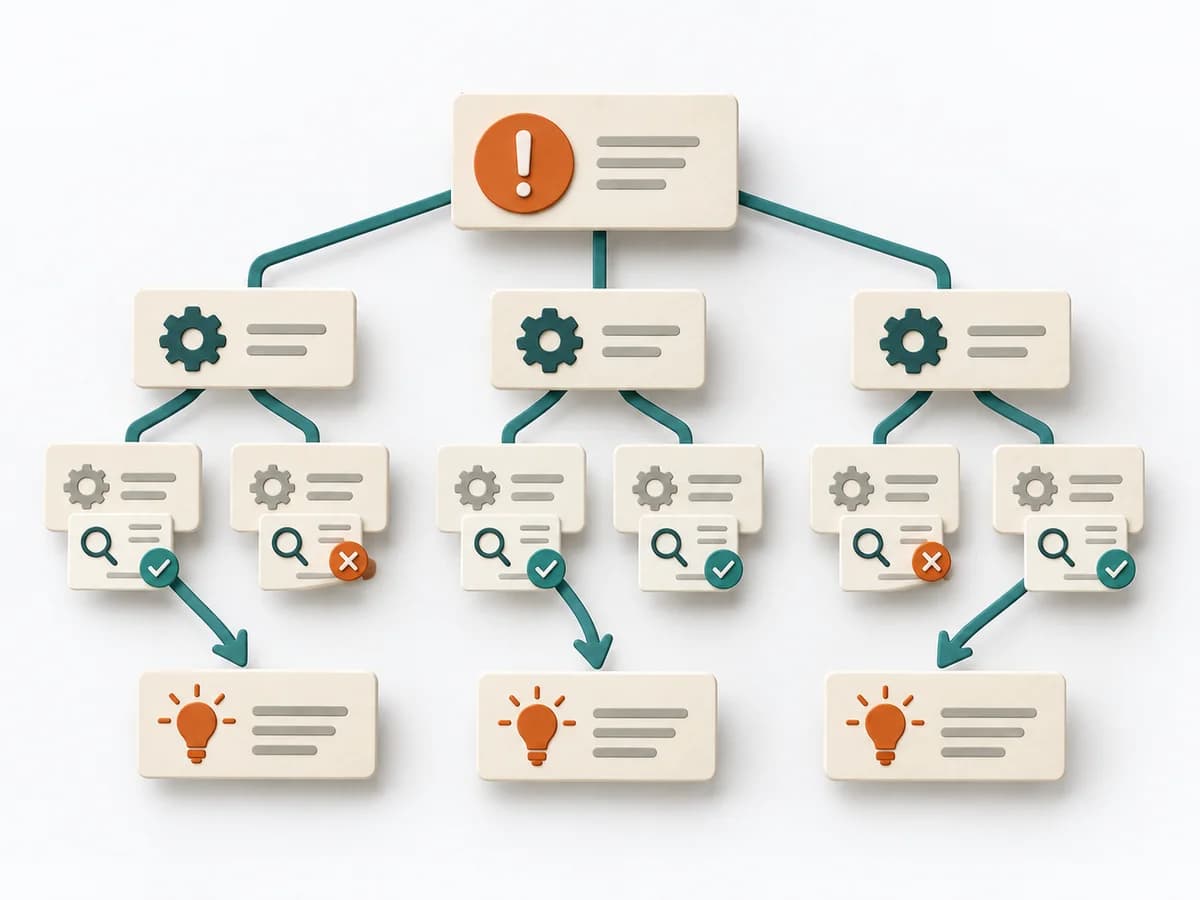 Operations Root Cause Tree Analysis |
|---|---|---|---|---|
Purposedifferent | When experiences build up over days or weeks and a single session cannot capture them, Diary Study records the course of everyday life. Recurring triggers, moods, and habits become visible this way, beyond the sharpness of memory. | When features need to be distinguished by their effect on satisfaction, it makes expectations and surprises comparable. It separates basic needs, performance contribution, and delight. | When a problem keeps recurring and the cause stays unclear, the method exposes the underlying mechanism. It separates symptom, guess, and robust explanation from one another. | For a problem with several suspected causes, the method builds a causal structure instead of a mere list. It makes visible how causes connect and where the strongest points of leverage lie. |
Complexitysame | Medium | Medium | Medium | Medium |
Timedifferent | 1-4 Wochen | 1-2 Tage | 1-4 h | 1-3 h |
Participantsdifferent | 5-20 | 10-50 | 3-8 | 2-8 |
Formatdifferent | Async | Workshop + async | Workshop + async | Workshop |
Outputdifferent | Diary Entries, Longitudinal Patterns, Experience Timeline | Kano Matrix, Feature Classes, Priority Themes | Problem Statement, Cause Hypotheses, Confirmed Causes, Action Plan | Cause Tree, Evidence Notes, Countermeasures |
Tagsno overlap | UX researchTrackingBehavior | SatisfactionPrioritizationCustomer | Root causeProblem solvingQualityIncident | Root causeTreeIncidentQuality |