View methods side by side.
Choose up to four methods. Add them using the search and share the comparison by copying its link.
| Criterion |  UX Research Diary Study | 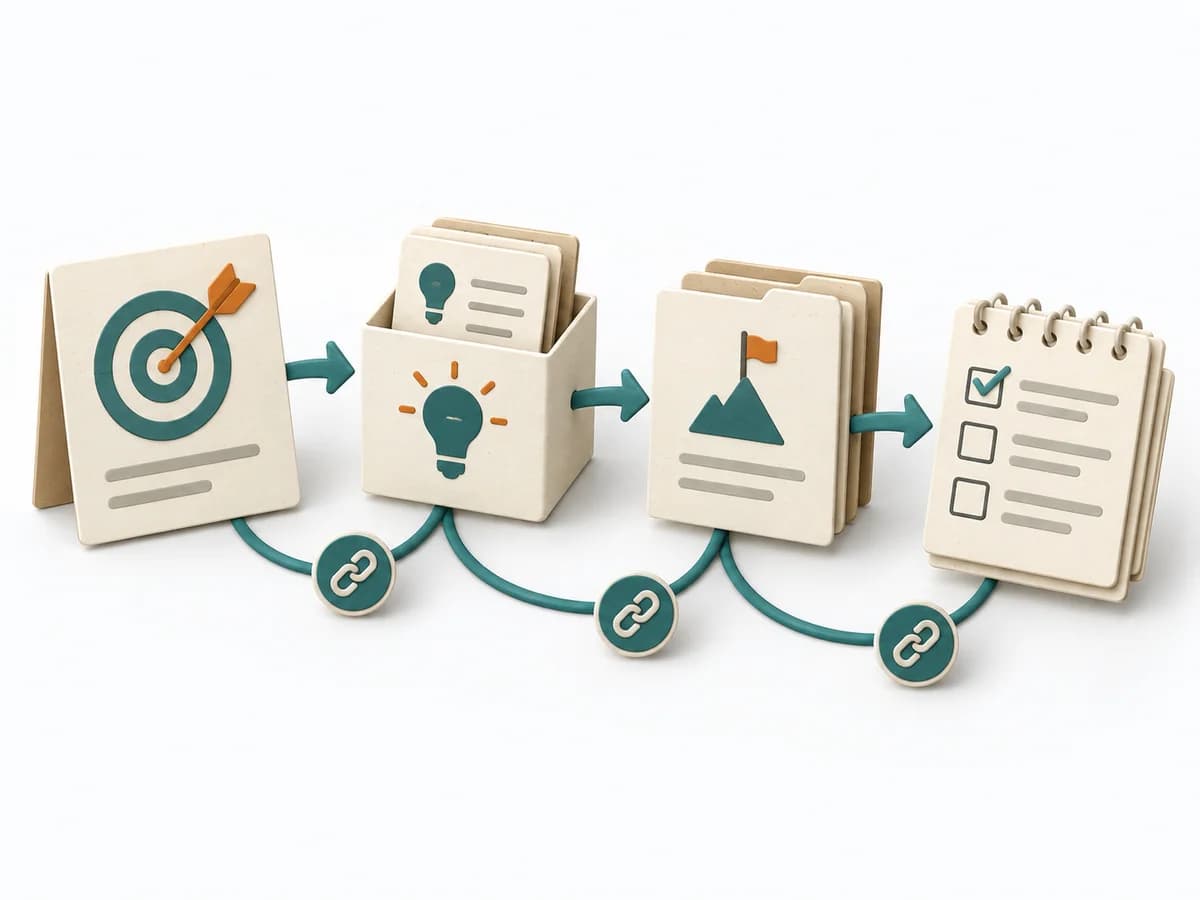 Product Strategy GIST Planning |  Growth Funnel Analysis |  Growth Growth Experiment |
|---|---|---|---|---|
Purposedifferent | When experiences build up over days or weeks and a single session cannot capture them, Diary Study records the course of everyday life. Recurring triggers, moods, and habits become visible this way, beyond the sharpness of memory. | GIST Planning helps clarify target groups, value, goals, and priorities. It links customer value, product logic, and decision priorities, and captures the result as goals, an idea bank, and a step-project list. | When many visitors or users drop off along the way, the reason behind the number often stays hidden. Funnel Analysis exposes these transitions and makes visible exactly where the path collapses. | When growth ideas surface quickly, the temptation to build immediately instead of learning is high. A Growth Experiment frames an assumption so target group, lever, and measurement are clear before the first deployment. |
Complexitysame | Medium | Medium | Medium | Medium |
Timedifferent | 1-4 Wochen | Wochen bis Monate je Goal | 1-3 h | 1-2 Wochen |
Participantsdifferent | 5-20 | 3-10 | 1-5 | 1-6 |
Formatdifferent | Async | Workshop + async | Async | Workshop + async |
Outputdifferent | Diary Entries, Longitudinal Patterns, Experience Timeline | Goals, Idea bank, Step-project list, Tasks, Learning reports | Funnel report, Drop-off analysis, Optimization hypotheses | Experiment card, Result summary, Next bet |
Tagsno overlap | UX researchTrackingBehavior | RoadmapOutcomesPlanningExperiments | AnalyticsConversionGrowth | MarketingGrowthExperimentsLearning |