View methods side by side.
Choose up to four methods. Add them using the search and share the comparison by copying its link.
| Criterion |  UX Research Diary Study | 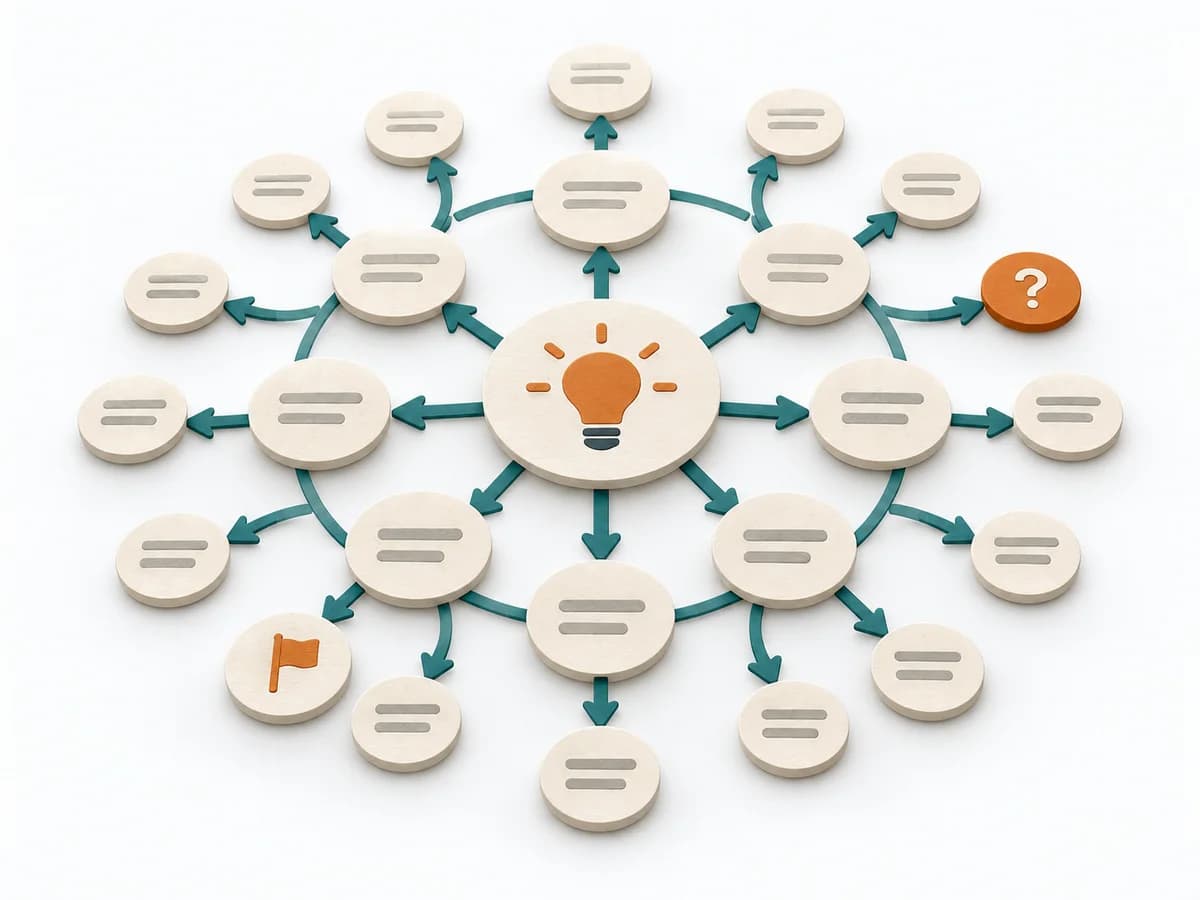 Systems Thinking Futures Wheel |  Systems Thinking Iceberg Model |  Systems Thinking Current Reality Tree |
|---|---|---|---|---|
Purposedifferent | When experiences build up over days or weeks and a single session cannot capture them, Diary Study records the course of everyday life. Recurring triggers, moods, and habits become visible this way, beyond the sharpness of memory. | The Futures Wheel helps explore the consequences of a decision, a trend, or a strategic move in a structured way. It makes visible which first, second, and third-order effects could arise from an event. | The Iceberg Model separates visible events from patterns, structures, and mental models. This turns a single observation into a deeper understanding of why a problem keeps recurring. | A Current Reality Tree condenses many symptoms into a few causal chains. The method makes visible which core problems drive several negative effects at once. |
Complexitydifferent | Medium | Medium | Low | High |
Timedifferent | 1-4 Wochen | 60-120 min | 30-60 min | 2-6 h |
Participantsdifferent | 5-20 | 3-10 | 2-10 | 3-8 |
Formatdifferent | Async | Workshop + async | Workshop + async | Workshop |
Outputdifferent | Diary Entries, Longitudinal Patterns, Experience Timeline | Futures Wheel, Consequence Chains, Strategic Signals | Iceberg Worksheet, Pattern Notes, Intervention Ideas | Current Reality Tree, Core Problems, Intervention Ideas |
Tagsno overlap | UX researchTrackingBehavior | ForesightSystems thinkingSignals | Systems thinkingRoot causePatterns | Systems thinkingRoot causeConstraintsCausality |