View methods side by side.
Choose up to four methods. Add them using the search and share the comparison by copying its link.
| Criterion |  UX Research Diary Study | 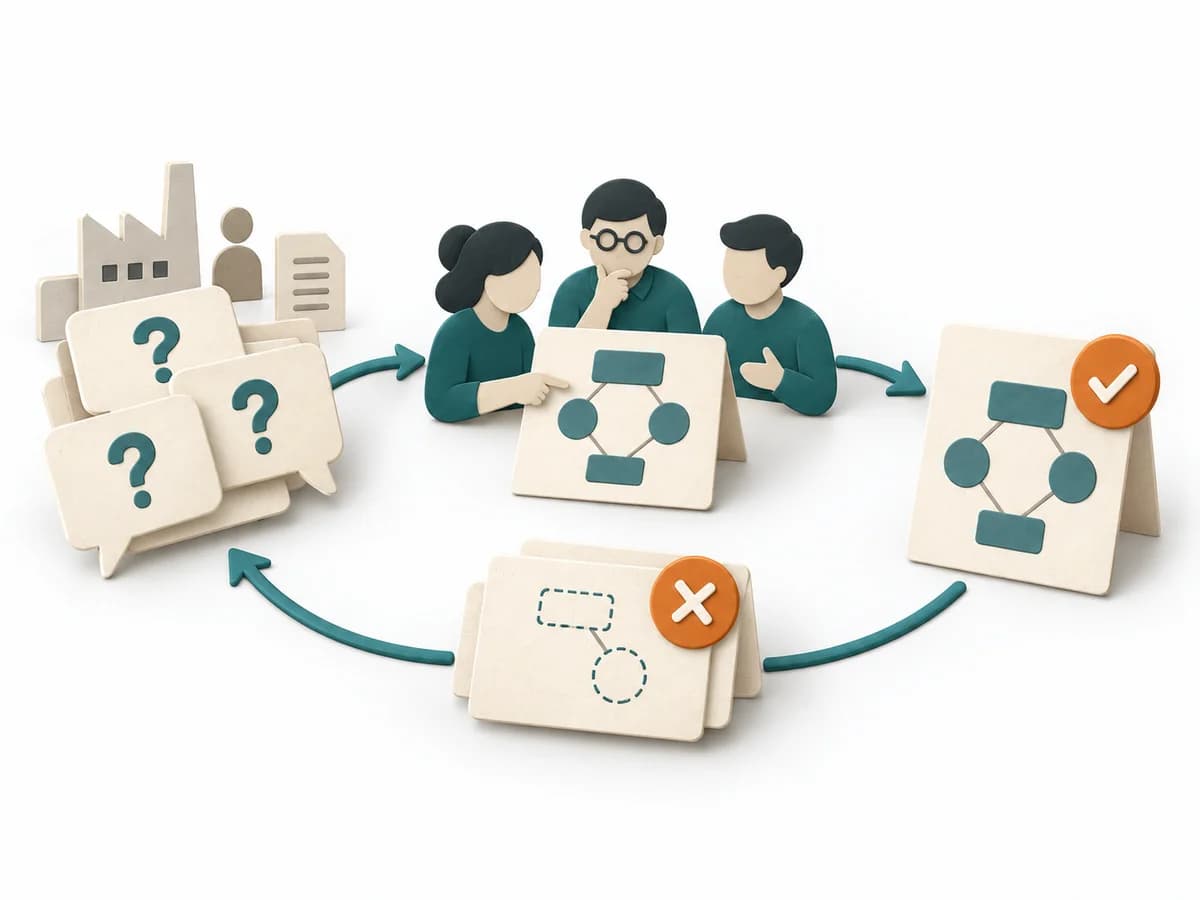 Knowledge Modeling Competency Questions |  Domain Modeling Bounded Context Canvas |  Knowledge Modeling Property Graph Schema Design |
|---|---|---|---|---|
Purposedifferent | When experiences build up over days or weeks and a single session cannot capture them, Diary Study records the course of everyday life. Recurring triggers, moods, and habits become visible this way, beyond the sharpness of memory. | Competency Questions translate a domain model into concrete questions that it must be able to answer. The method keeps the model's scope clean and prevents pretty but useless structures. | When a business context is still loosely outlined, it shapes language, responsibility, and integration space. It clarifies what belongs together and where a boundary needs to hold. | Property Graph Schema Design turns business and technical requirements into a robust graph schema. It fits when query patterns, constraints, and migrations need to be thought about together. |
Complexitysame | Medium | Medium | Medium | Medium |
Timedifferent | 1-4 Wochen | 2-4 h | 1-3 h | 4-8 h initial, dann iterativ |
Participantsdifferent | 5-20 | 2-8 | 3-8 | 1-6 |
Formatdifferent | Async | Workshop + async | Workshop + async | Workshop + async |
Outputdifferent | Diary Entries, Longitudinal Patterns, Experience Timeline | Competency Question Set, Required Concepts, Test Queries, Coverage Matrix | Context Canvas, Glossary, Integration Notes | Schema Diagram, Node and Relationship Catalog, Index Plan, Migration Scripts, Sample Queries |
Tagsno overlap | UX researchTrackingBehavior | OntologyKnowledge graphScopeRequirementsSemantic | Domain-Driven DesignBoundariesModeling | Knowledge graphModelingSemantic |