View methods side by side.
Choose up to four methods. Add them using the search and share the comparison by copying its link.
| Criterion |  UX Research Diary Study | 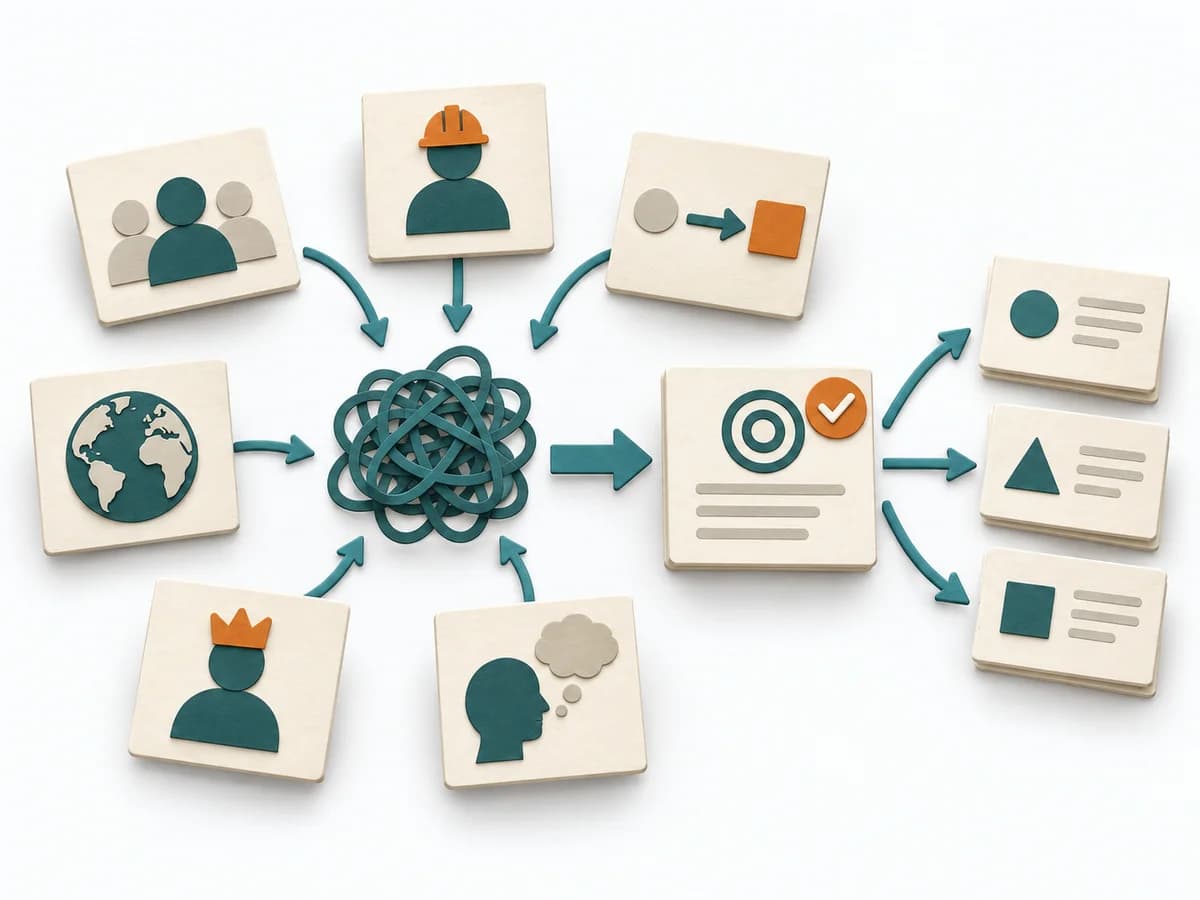 Systems Thinking CATWOE Analysis |  Decision Making Argument Mapping |  Knowledge Modeling IBIS |
|---|---|---|---|---|
Purposedifferent | When experiences build up over days or weeks and a single session cannot capture them, Diary Study records the course of everyday life. Recurring triggers, moods, and habits become visible this way, beyond the sharpness of memory. | CATWOE structures a problem from six viewpoints and prevents too narrow a view of the situation. Different experiences of the system become comparably discussable this way. | When statements, evidence, and counterarguments get mixed up, a debate quickly loses its structure. Argument Mapping breaks a thesis down into its reasoning and makes visible what it really rests on. | IBIS structures thinking about complex questions as a sequence of issues, ideas, and arguments. The method keeps discussions open without forcing them into premature consensus. |
Complexitysame | Medium | Medium | Medium | Medium |
Timedifferent | 1-4 Wochen | 45-90 min | 1-3 h | 1-3 h |
Participantsdifferent | 5-20 | 3-8 | 1-8 | 2-8 |
Formatdifferent | Async | Workshop + async | Workshop + async | Workshop + async |
Outputdifferent | Diary Entries, Longitudinal Patterns, Experience Timeline | CATWOE Canvas, Root Definition, Stakeholder Perspectives, Constraints | Argument Map, Evidence Gaps, Decision Rationale | Issue Map, Positions, Argument Notes |
Tagsno overlap | UX researchTrackingBehavior | Systems thinkingFramingStakeholders | SensemakingDecisionRationale | RationaleKnowledgeDecision |