View methods side by side.
Choose up to four methods. Add them using the search and share the comparison by copying its link.
| Criterion |  UX Research Diary Study |  Innovation Brainwriting | 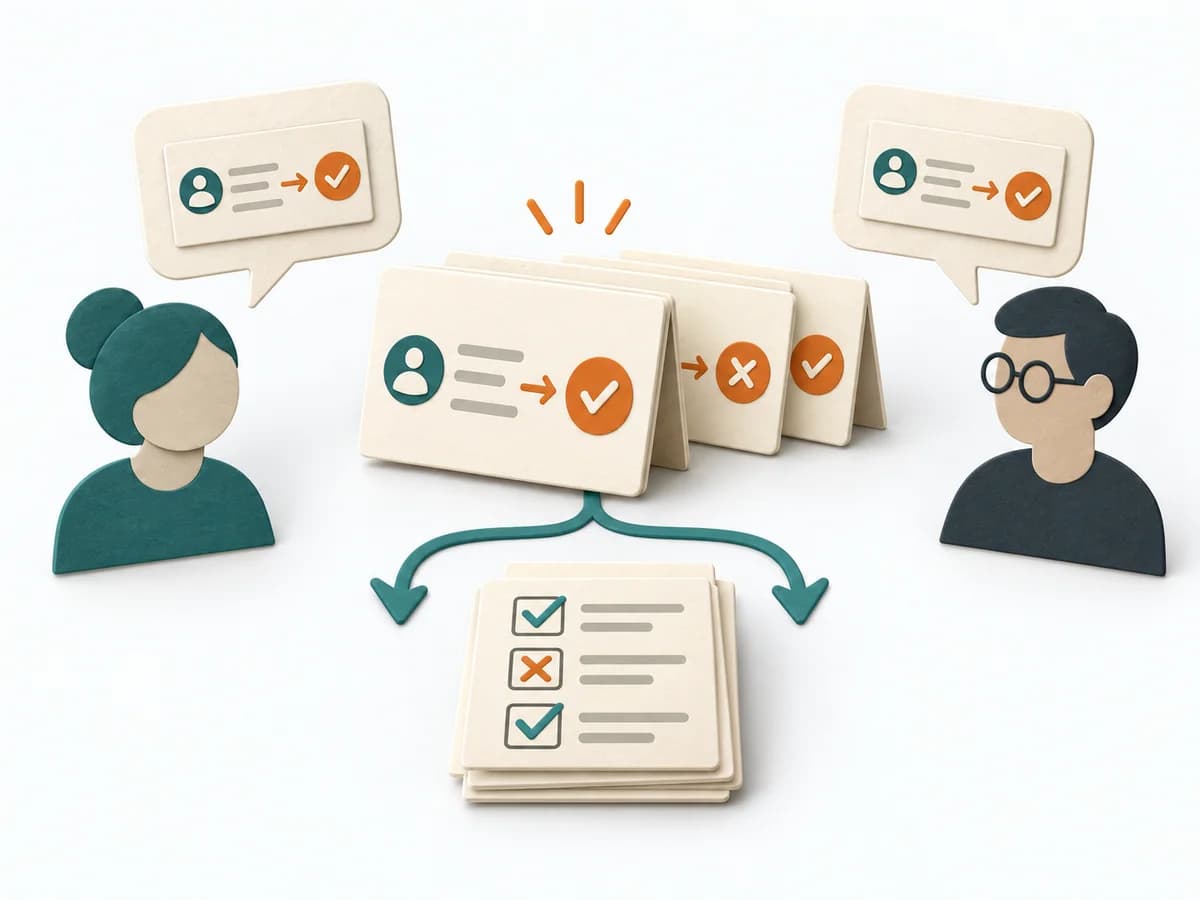 Agile Specification by Example |  Facilitation Mind Mapping |
|---|---|---|---|---|
Purposedifferent | When experiences build up over days or weeks and a single session cannot capture them, Diary Study records the course of everyday life. Recurring triggers, moods, and habits become visible this way, beyond the sharpness of memory. | When loud voices or hierarchy distort the idea search, the method creates a quiet entry into joint development. It gives everyone thinking space and gathers contributions without social brakes, making diversity more visible and easier to build on. | When business rules need to become precise, it ties language, example, and test together. It sorts work by value, risk, and delivery ability. The result is captured as an Example Table and Acceptance Tests. | When a topic is still unclear and too many thoughts surface at once, Mind Mapping creates an open surface for ordering them. It makes connections, subtopics, and starting points visible without fixing them too early. |
Complexitydifferent | Medium | Low | Medium | Low |
Timedifferent | 1-4 Wochen | 15-30 min | 60-90 min pro Feature | 15-45 min |
Participantsdifferent | 5-20 | 3-12 | 3-6 | 1-10 |
Formatdifferent | Async | Workshop + async | Workshop | Workshop + async |
Outputdifferent | Diary Entries, Longitudinal Patterns, Experience Timeline | Idea sheets, Expanded concepts, Prioritized list | Example Table, Acceptance Tests | Mind Map, Topic Clusters, Open Questions |
Tagsno overlap | UX researchTrackingBehavior | BrainstormingCollaborationInclusionIdeas | AgileRequirementsExamplesBehavior-Driven Development | BrainstormingIdeasMappingStructureFacilitation |