View methods side by side.
Choose up to four methods. Add them using the search and share the comparison by copying its link.
| Criterion |  UX Research Diary Study | 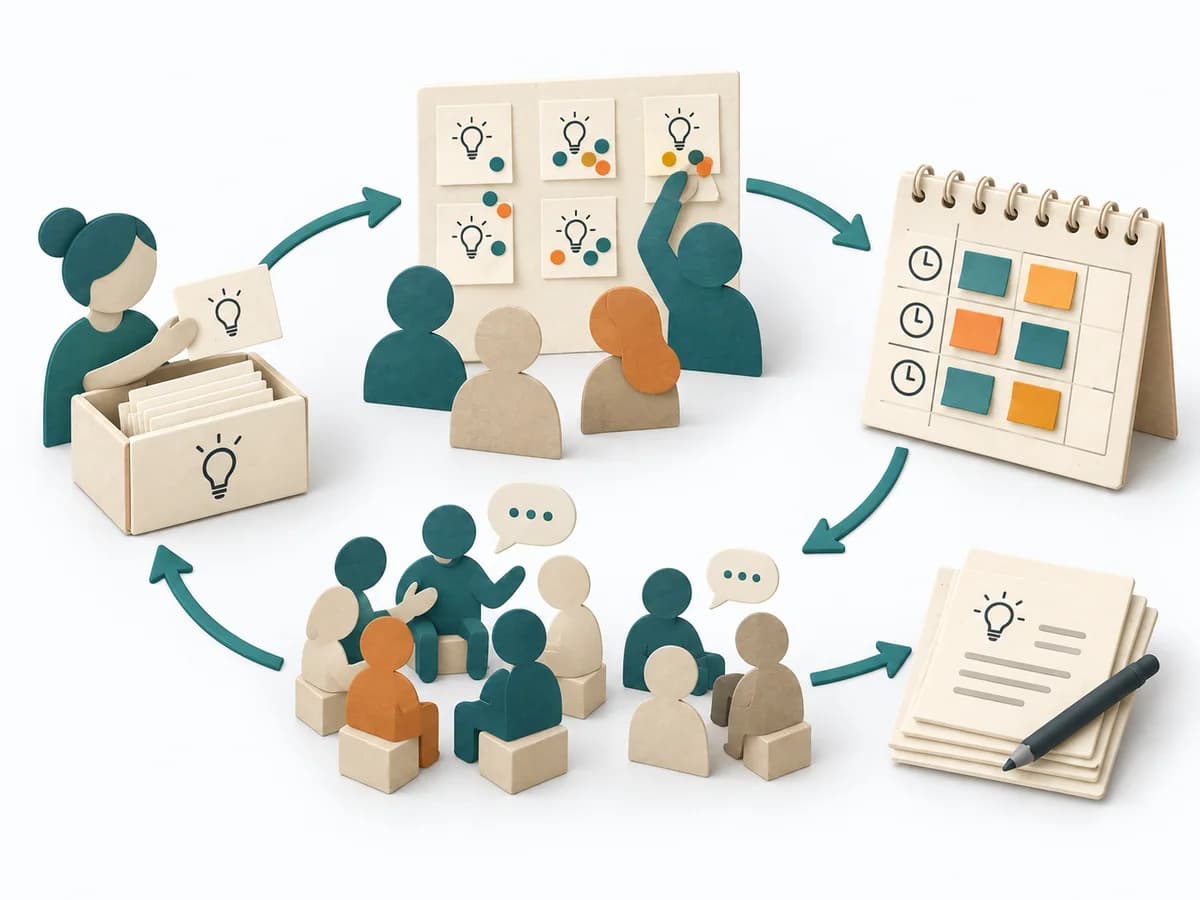 Facilitation Barcamp |  Operations Kepner-Tregoe |  Operations 5 Whys |
|---|---|---|---|---|
Purposedifferent | When experiences build up over days or weeks and a single session cannot capture them, Diary Study records the course of everyday life. Recurring triggers, moods, and habits become visible this way, beyond the sharpness of memory. | When many people can contribute knowledge and the flow should stay open, Barcamp provides a framework for self-organized sessions. The format channels energy without defining the content too narrowly in advance. | For a disturbance that's hard to pin down, the method cleanly separates problem, cause, and decision. It reduces mixing when symptoms allow several interpretations. | For a single, hard-to-explain deviation, the method exposes the causal chain behind the visible symptom. It keeps the cause open until a controllable condition emerges instead of a mere description. |
Complexitydifferent | Medium | Medium | High | Low |
Timedifferent | 1-4 Wochen | Halber Tag bis 2 Tage | 2-8 h | 15-30 min |
Participantsdifferent | 5-20 | 15-200 | 2-8 | 2-6 |
Formatdifferent | Async | Workshop | Workshop + async | Workshop |
Outputdifferent | Diary Entries, Longitudinal Patterns, Experience Timeline | Session Board, Session Notes, Community Learnings | Problem Analysis, Decision Analysis, Risk Plan | Root cause notes, Countermeasures |
Tagsno overlap | UX researchTrackingBehavior | FacilitationLarge groupLearning | Problem solvingRoot causeDecisionOperations | Root causeIncidentLeanProblem solving |