View methods side by side.
Choose up to four methods. Add them using the search and share the comparison by copying its link.
| Criterion |  Innovation Design Thinking |  Operations Root Cause Analysis | 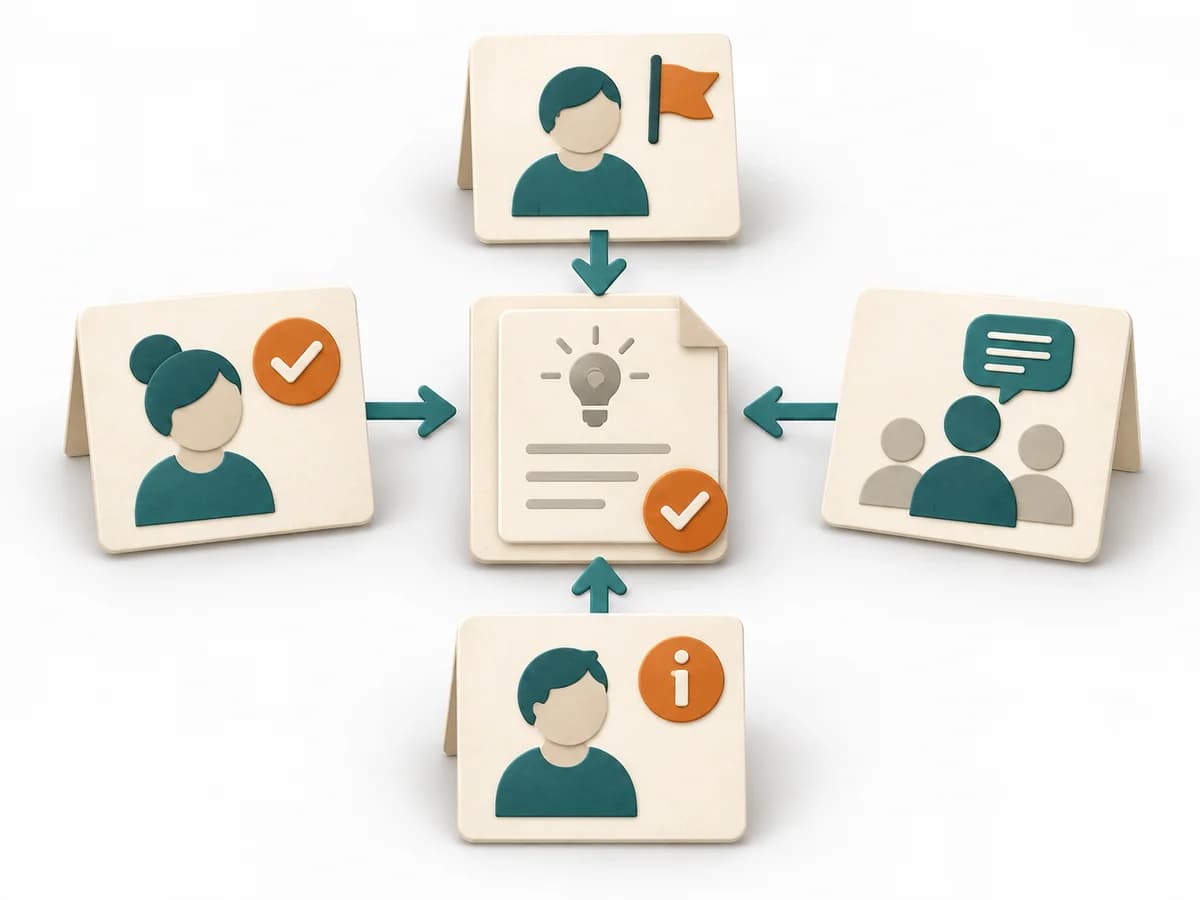 Decision Making DACI |  Operations Kepner-Tregoe |
|---|---|---|---|---|
Purposedifferent | For complex user problems with an uncertain cause, the method connects observation, interpretation, and experiment into a learning cycle. It keeps the focus on real needs and avoids premature solution language. This produces robust decisions for product and service. | When a problem keeps recurring and the cause stays unclear, the method exposes the underlying mechanism. It separates symptom, guess, and robust explanation from one another. | In cross-functional decisions, responsibilities quickly blur between approval, influence, and execution. DACI arranges these roles so decision pressure, contribution, and information stay cleanly separated. | For a disturbance that's hard to pin down, the method cleanly separates problem, cause, and decision. It reduces mixing when symptoms allow several interpretations. |
Complexitydifferent | High | Medium | Low | High |
Timedifferent | 1 Tag bis mehrere Wochen | 1-4 h | 30-60 min | 2-8 h |
Participantsdifferent | 4-10 | 3-8 | 2-10 | 2-8 |
Formatdifferent | Workshop | Workshop + async | Workshop + async | Workshop + async |
Outputdifferent | Problem Statement, Prototype, Test Learnings | Problem Statement, Cause Hypotheses, Confirmed Causes, Action Plan | DACI Matrix, Decision Owner, Decision Log | Problem Analysis, Decision Analysis, Risk Plan |
Tagsno overlap | InnovationPrototypeResearch | Root causeProblem solvingQualityIncident | DecisionRolesGovernanceAlignment | Problem solvingRoot causeDecisionOperations |