View methods side by side.
Choose up to four methods. Add them using the search and share the comparison by copying its link.
| Criterion |  UX Design Design Studio |  Product Discovery Outcome-Driven Innovation | 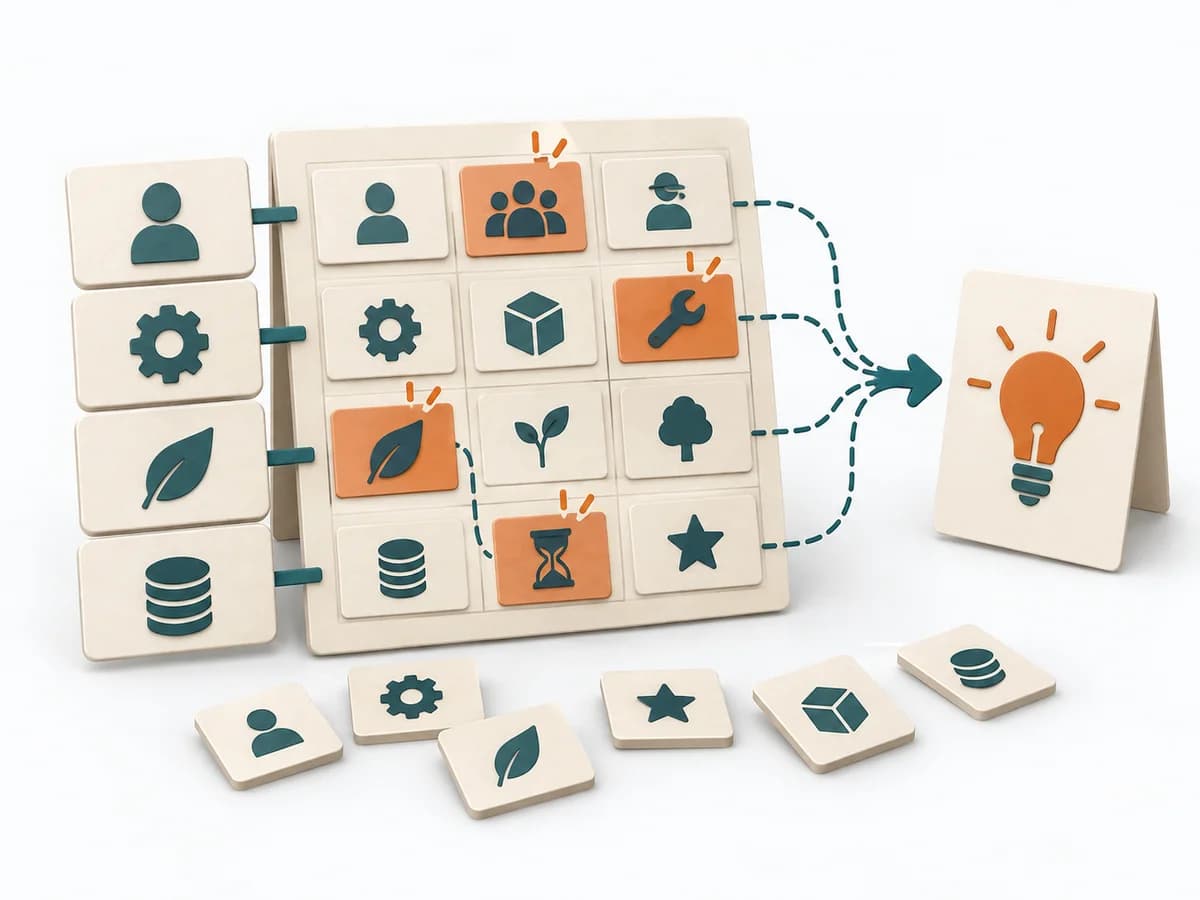 Innovation Morphological Analysis |
|---|---|---|---|
Purposedifferent | When several designs need to be quickly put in relation to each other, it makes ideas visible and comparable. It encourages early variants instead of long upfront debates. | Outcome-Driven Innovation clarifies customer problems, solution opportunities, and evidence. It separates jobs, desired outcomes, importance, satisfaction, and opportunity, and captures results as desired outcome statements, an opportunity landscape, and segments by underserved needs. | For a search for solutions with many degrees of freedom, a grid emerges for systematic combinations. The method separates features, variants, and exclusion criteria, so the space gets explored deliberately. |
Complexitydifferent | Medium | High | Medium |
Timedifferent | 1-3 h | Mehrere Wochen | 1-3 h |
Participantsdifferent | 3-8 | 2-6 researchers plus sample | 2-8 |
Formatdifferent | Workshop | Workshop + async | Workshop + async |
Outputdifferent | Sketches, Concept Directions, Design Decisions | Desired outcome statements, Opportunity landscape, Segmentation by underserved needs, Innovation hypotheses | Morphological Box, Concept Combinations, Idea Shortlist |
Tagsno overlap | SketchingCollaborationIdeation | OutcomesInnovationResearchQuantitative | IdeationInnovationCreativity |
Often compared together
Methods with strong topical overlap with the current selection, not yet in the comparison.