View methods side by side.
Choose up to four methods. Add them using the search and share the comparison by copying its link.
| Criterion |  Decision Making Delphi Method |  Decision Making Force Field Analysis |  Decision Making RAPID | 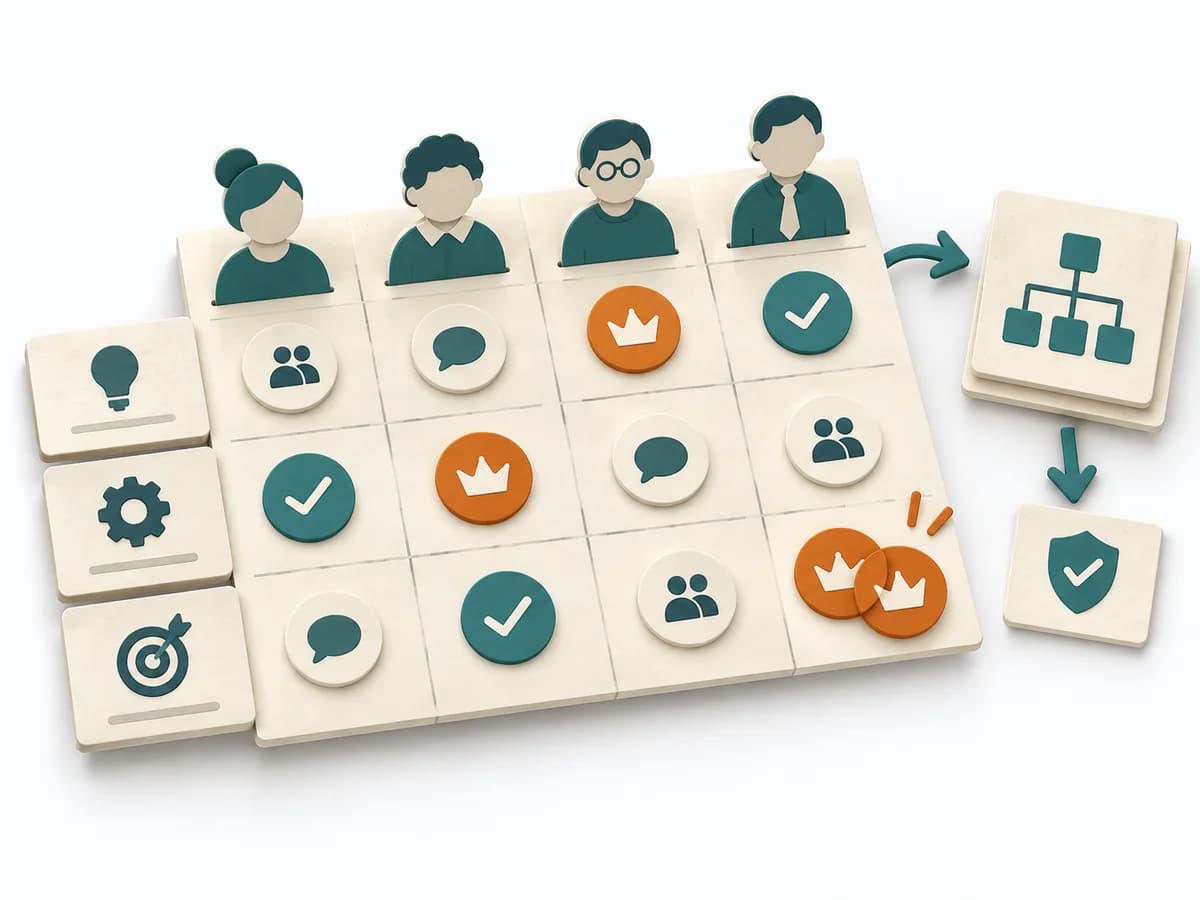 Decision Making Decision Rights Mapping |
|---|---|---|---|---|
Purposedifferent | When knowledge is distributed and direct dominance should be avoided, groups quickly fall under the sway of their opinion leaders. The Delphi Method gathers assessments iteratively and gradually brings expert judgments closer together. | In change initiatives, supporting and restraining forces sit at the table at the same time. Force Field Analysis makes these tensions explicit and shows where change can be pushed forward by strengthening or relieving. | In complex management decisions, clarity is often missing about who recommends, who agrees, and who makes the decision. RAPID creates this assignment and stabilizes decisions across several levels. | In organizations with many stakeholders, it often blurs who actually decides and who is merely consulted. It separates options, evaluation criteria, and open risks. The result is captured as a Decision Rights matrix and an agreement. |
Complexitydifferent | High | Low | Medium | Medium |
Timedifferent | 1-4 Wochen | 45-90 min | 45-90 min | 90-180 min |
Participantsdifferent | 6-30 Experten | 3-12 | 3-12 | 4-12 |
Formatdifferent | Async | Workshop | Workshop + async | Workshop |
Outputdifferent | Expert Forecast, Consensus Range, Assumption Notes | Force Field Map, Change Levers, Risk Notes | RAPID Role Map, Recommendation, Decision Log | Decision Rights Matrix, Agreement |
Tags1 shared | ForecastingExpertsDecisionStrategy | ChangeDecisionStrategy | DecisionRolesGovernance | DecisionGovernanceAlignmentResponsibility |