View methods side by side.
Choose up to four methods. Add them using the search and share the comparison by copying its link.
| Criterion |  Decision Making Delphi Method |  Facilitation Alignment Mapping | 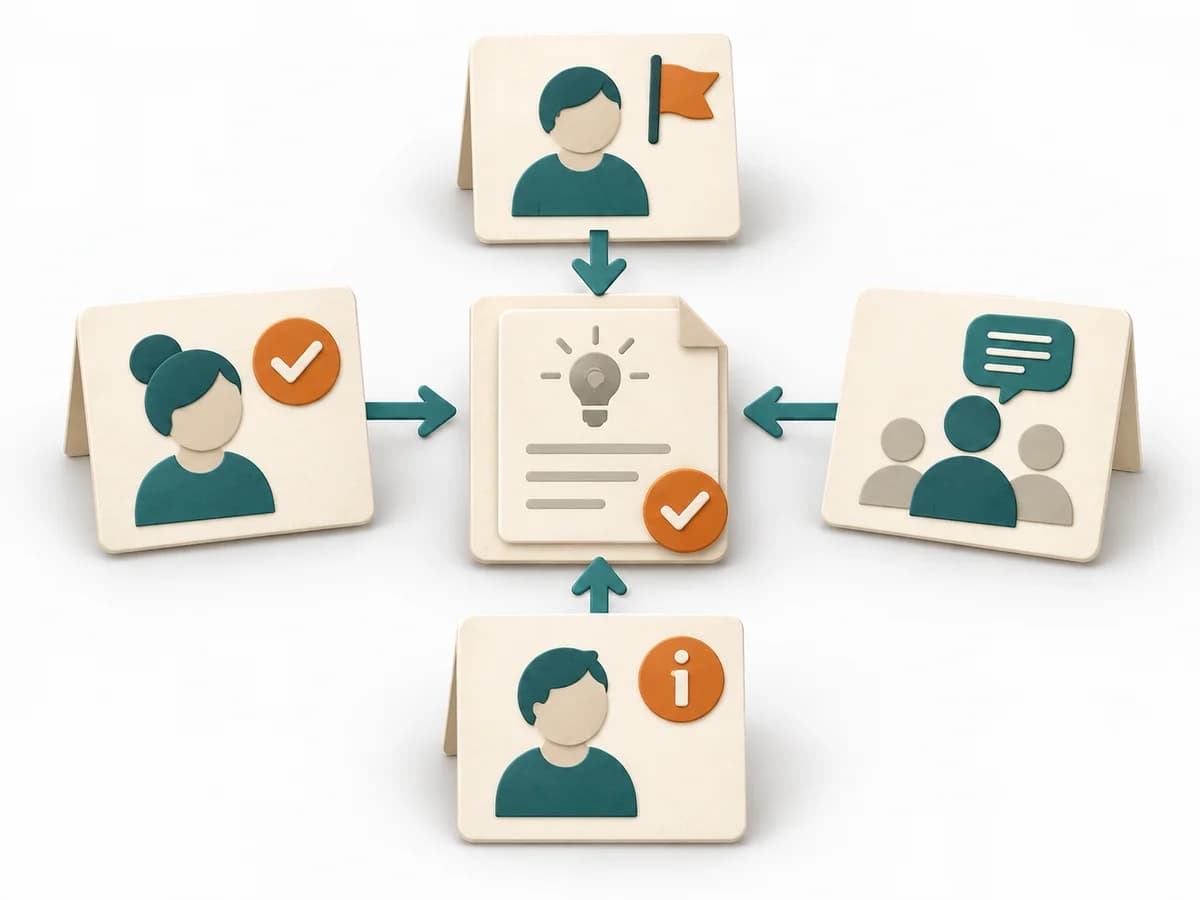 Decision Making DACI |  Facilitation Stakeholder Salience Model |
|---|---|---|---|---|
Purposedifferent | When knowledge is distributed and direct dominance should be avoided, groups quickly fall under the sway of their opinion leaders. The Delphi Method gathers assessments iteratively and gradually brings expert judgments closer together. | When several people work toward one goal but hold different mental maps, Alignment Mapping makes the discrepancies visible. It arranges goals, assumptions, and priorities so shared direction becomes verifiable. | In cross-functional decisions, responsibilities quickly blur between approval, influence, and execution. DACI arranges these roles so decision pressure, contribution, and information stay cleanly separated. | When stakeholders appear to matter very differently, the Stakeholder Salience Model rates their actual priority through power, legitimacy, and urgency. It turns individual contributions into a visible selection. The result is captured as a Salience diagram and a class-based strategy. |
Complexitydifferent | High | Medium | Low | Medium |
Timedifferent | 1-4 Wochen | 1-2 h | 30-60 min | 60-90 min |
Participantsdifferent | 6-30 Experten | 4-12 | 2-10 | 3-6 |
Formatdifferent | Async | Workshop | Workshop + async | Workshop |
Outputdifferent | Expert Forecast, Consensus Range, Assumption Notes | Alignment Map, Open Issues, Decision Questions | DACI Matrix, Decision Owner, Decision Log | Salience Diagram, Strategy per Class |
Tagsno overlap | ForecastingExpertsDecisionStrategy | AlignmentStakeholdersStrategyFacilitation | DecisionRolesGovernanceAlignment | StakeholdersFacilitationAlignmentGovernance |