View methods side by side.
Choose up to four methods. Add them using the search and share the comparison by copying its link.
| Criterion |  Decision Making Decision Tree |  Systems Thinking Leverage Points |  Systems Thinking Systems Mapping | 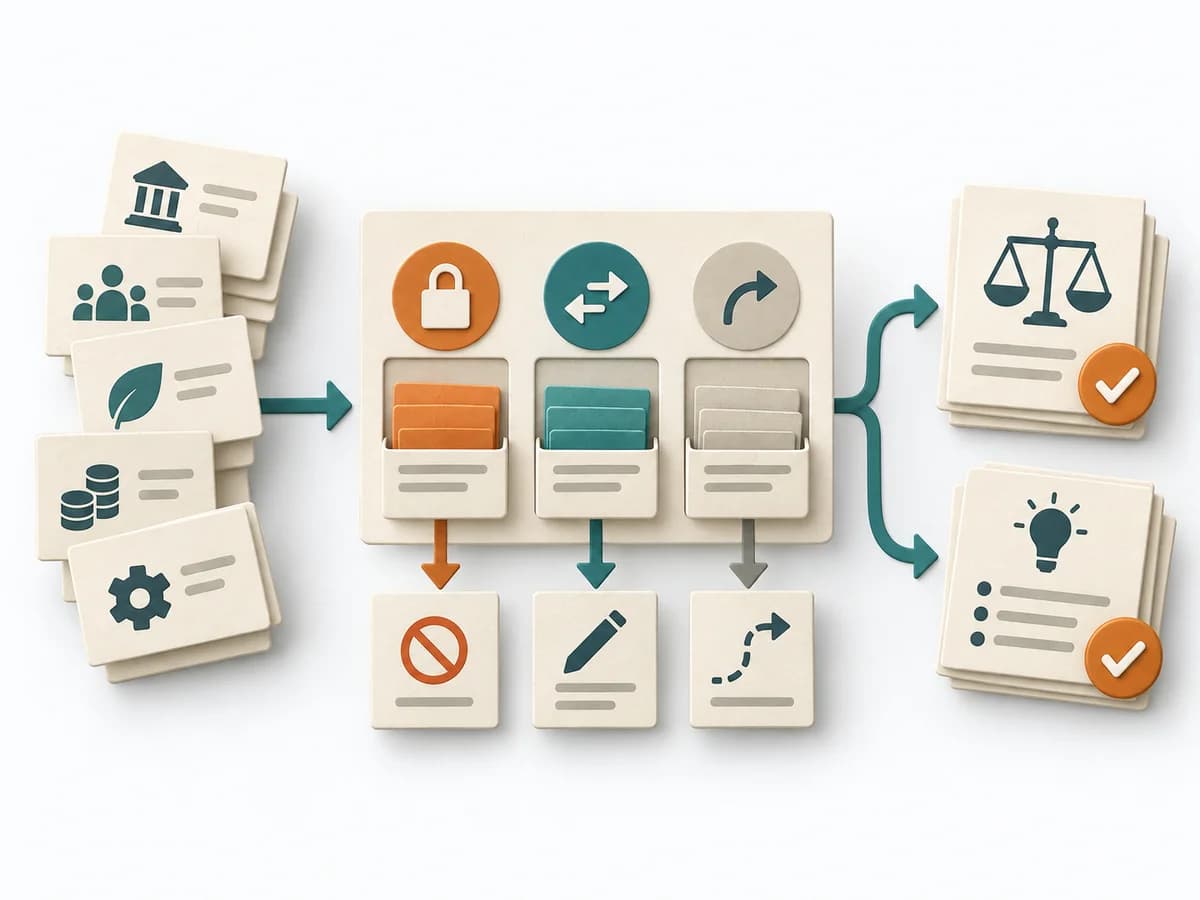 Decision Making Constraint Analysis |
|---|---|---|---|---|
Purposedifferent | For decisions with follow-on paths and dependencies, a linear comparison is often not enough. A Decision Tree shows how options branch under conditions and which consequences hang on each branch. | Leverage Points show exactly where interventions in a system produce a disproportionate effect. It draws relationships, patterns, and feedback loops. The result is captured as a leverage map and action strategy. | Systems Mapping arranges elements, relationships, and boundaries so a complex field becomes legible at a glance. The overview stabilizes the overall picture before detail work or steering begins. | When an initiative stalls, the limit often lies not in the idea but in hard or soft boundary conditions. Constraint Analysis separates these limits and shows which of them can actually be shaped. |
Complexitydifferent | Medium | High | Medium | Low |
Timedifferent | 30-90 min | Half day | 1-3 h | 30-90 min |
Participantsdifferent | 1-6 | 3-12 | 3-12 | 2-8 |
Formatdifferent | Workshop + async | Workshop | Workshop + async | Workshop + async |
Outputdifferent | Decision Tree, Option Map, Assumption List | Leverage Map, Action Strategy | System Map, Dependencies, Leverage Points | Constraint List, Hard/Soft Classification, Option Impact Notes, Decision Boundaries |
Tagsno overlap | DecisionTreeOptions | Systems thinkingChangeStrategy | Systems thinkingMappingBoundariesChange | ConstraintsDecisionPlanningOptions |