View methods side by side.
Choose up to four methods. Add them using the search and share the comparison by copying its link.
| Criterion |  Decision Making Decision Tree |  Systems Thinking Leverage Points | 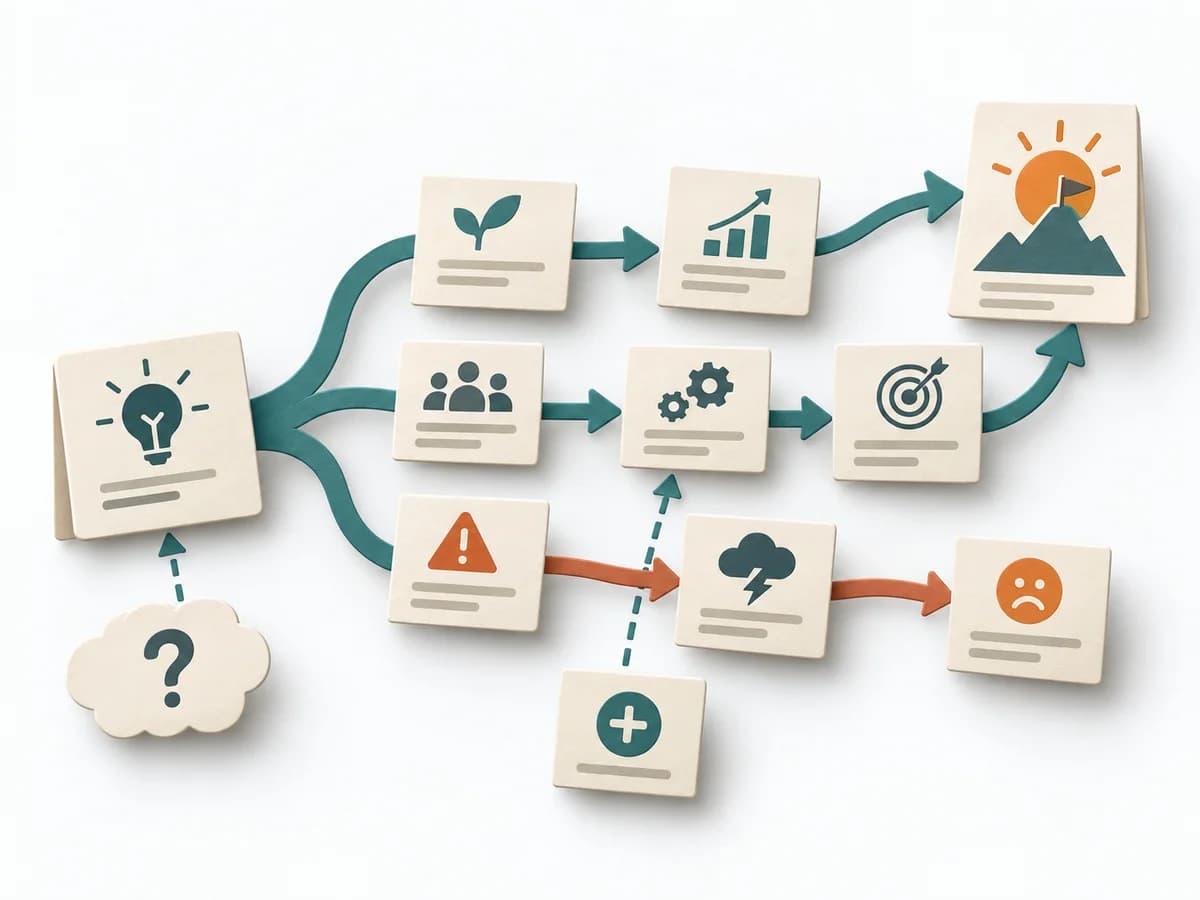 Systems Thinking Future Reality Tree |  Decision Making Delphi Method |
|---|---|---|---|---|
Purposedifferent | For decisions with follow-on paths and dependencies, a linear comparison is often not enough. A Decision Tree shows how options branch under conditions and which consequences hang on each branch. | Leverage Points show exactly where interventions in a system produce a disproportionate effect. It draws relationships, patterns, and feedback loops. The result is captured as a leverage map and action strategy. | A Future Reality Tree shows how desired actions are meant to lead to a better system state. The method checks whether a path of change holds together logically before time flows into implementation. | When knowledge is distributed and direct dominance should be avoided, groups quickly fall under the sway of their opinion leaders. The Delphi Method gathers assessments iteratively and gradually brings expert judgments closer together. |
Complexitydifferent | Medium | High | High | High |
Timedifferent | 30-90 min | Half day | 2-4 h | 1-4 Wochen |
Participantsdifferent | 1-6 | 3-12 | 3-8 | 6-30 Experten |
Formatdifferent | Workshop + async | Workshop | Workshop | Async |
Outputdifferent | Decision Tree, Option Map, Assumption List | Leverage Map, Action Strategy | Future Reality Tree, Negative Branches, Assumption List, Improved Injections | Expert Forecast, Consensus Range, Assumption Notes |
Tagsno overlap | DecisionTreeOptions | Systems thinkingChangeStrategy | Theory of ConstraintsSystems thinkingChange | ForecastingExpertsDecisionStrategy |