View methods side by side.
Choose up to four methods. Add them using the search and share the comparison by copying its link.
| Criterion |  Decision Making Decision Tree |  Knowledge Modeling IBIS | 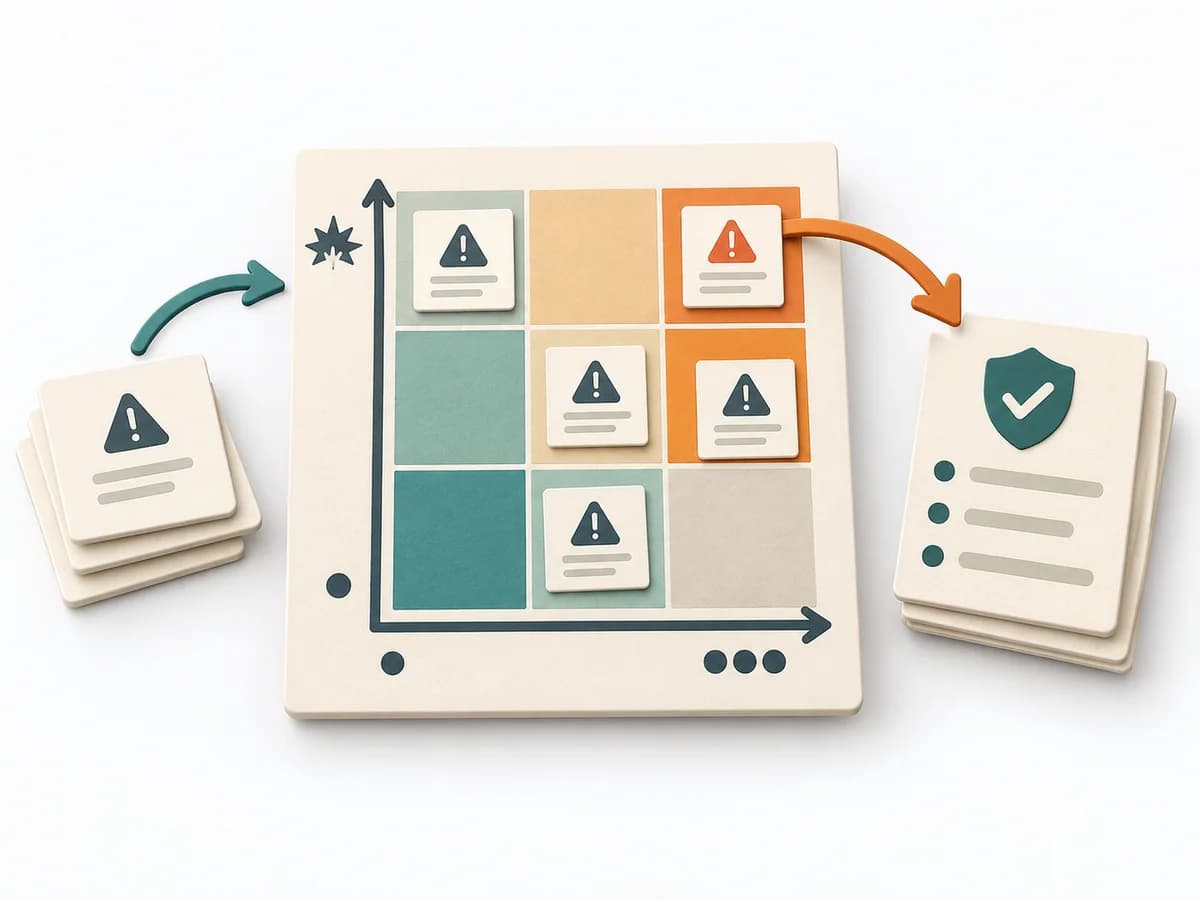 Decision Making Risk Matrix |  Decision Making Constraint Analysis |
|---|---|---|---|---|
Purposedifferent | For decisions with follow-on paths and dependencies, a linear comparison is often not enough. A Decision Tree shows how options branch under conditions and which consequences hang on each branch. | IBIS structures thinking about complex questions as a sequence of issues, ideas, and arguments. The method keeps discussions open without forcing them into premature consensus. | When a project faces many possible disruptions, it quickly becomes unclear which risks deserve attention first. It separates options, evaluation criteria, and open risks. The result is captured as a Risk Matrix and a Top Risk List. | When an initiative stalls, the limit often lies not in the idea but in hard or soft boundary conditions. Constraint Analysis separates these limits and shows which of them can actually be shaped. |
Complexitydifferent | Medium | Medium | Low | Low |
Timedifferent | 30-90 min | 1-3 h | 30-60 min | 30-90 min |
Participantsdifferent | 1-6 | 2-8 | 3-10 | 2-8 |
Formatsame | Workshop + async | Workshop + async | Workshop + async | Workshop + async |
Outputdifferent | Decision Tree, Option Map, Assumption List | Issue Map, Positions, Argument Notes | Risk Matrix, Top Risk List | Constraint List, Hard/Soft Classification, Option Impact Notes, Decision Boundaries |
Tags1 shared | DecisionTreeOptions | RationaleKnowledgeDecision | RiskDecisionPrioritizationAssessment | ConstraintsDecisionPlanningOptions |