View methods side by side.
Choose up to four methods. Add them using the search and share the comparison by copying its link.
| Criterion |  Facilitation Decision Jam | 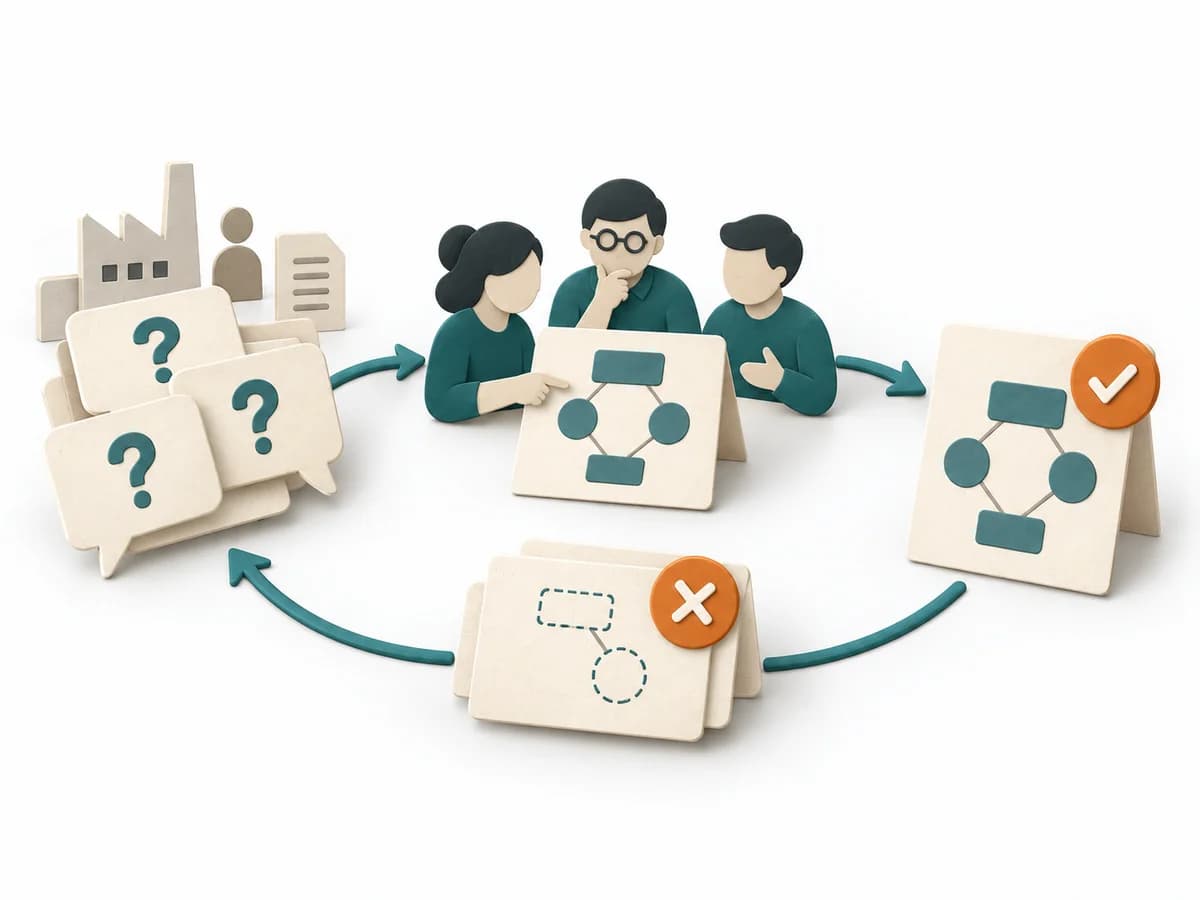 Knowledge Modeling Competency Questions |  Decision Making Decision Rights Mapping |  Facilitation Stakeholder Salience Model |
|---|---|---|---|---|
Purposedifferent | When a decision is stuck, Decision Jam loosens the knot through structured separation of problem, idea, and selection. The format creates movement without jumping prematurely at the first seemingly elegant answer. | Competency Questions translate a domain model into concrete questions that it must be able to answer. The method keeps the model's scope clean and prevents pretty but useless structures. | In organizations with many stakeholders, it often blurs who actually decides and who is merely consulted. It separates options, evaluation criteria, and open risks. The result is captured as a Decision Rights matrix and an agreement. | When stakeholders appear to matter very differently, the Stakeholder Salience Model rates their actual priority through power, legitimacy, and urgency. It turns individual contributions into a visible selection. The result is captured as a Salience diagram and a class-based strategy. |
Complexitydifferent | Low | Medium | Medium | Medium |
Timedifferent | 60-90 min | 2-4 h | 90-180 min | 60-90 min |
Participantsdifferent | 4-10 | 2-8 | 4-12 | 3-6 |
Formatdifferent | Workshop | Workshop + async | Workshop | Workshop |
Outputdifferent | Problem Cluster, Prioritized Challenge, Experiment | Competency Question Set, Required Concepts, Test Queries, Coverage Matrix | Decision Rights Matrix, Agreement | Salience Diagram, Strategy per Class |
Tagsno overlap | FacilitationDecisionProblem solvingWorkshop | OntologyKnowledge graphScopeRequirementsSemantic | DecisionGovernanceAlignmentResponsibility | StakeholdersFacilitationAlignmentGovernance |