View methods side by side.
Choose up to four methods. Add them using the search and share the comparison by copying its link.
| Criterion |  Decision Making Decision Framing Workshop |  Growth Hooked Model |  Growth Flywheel | 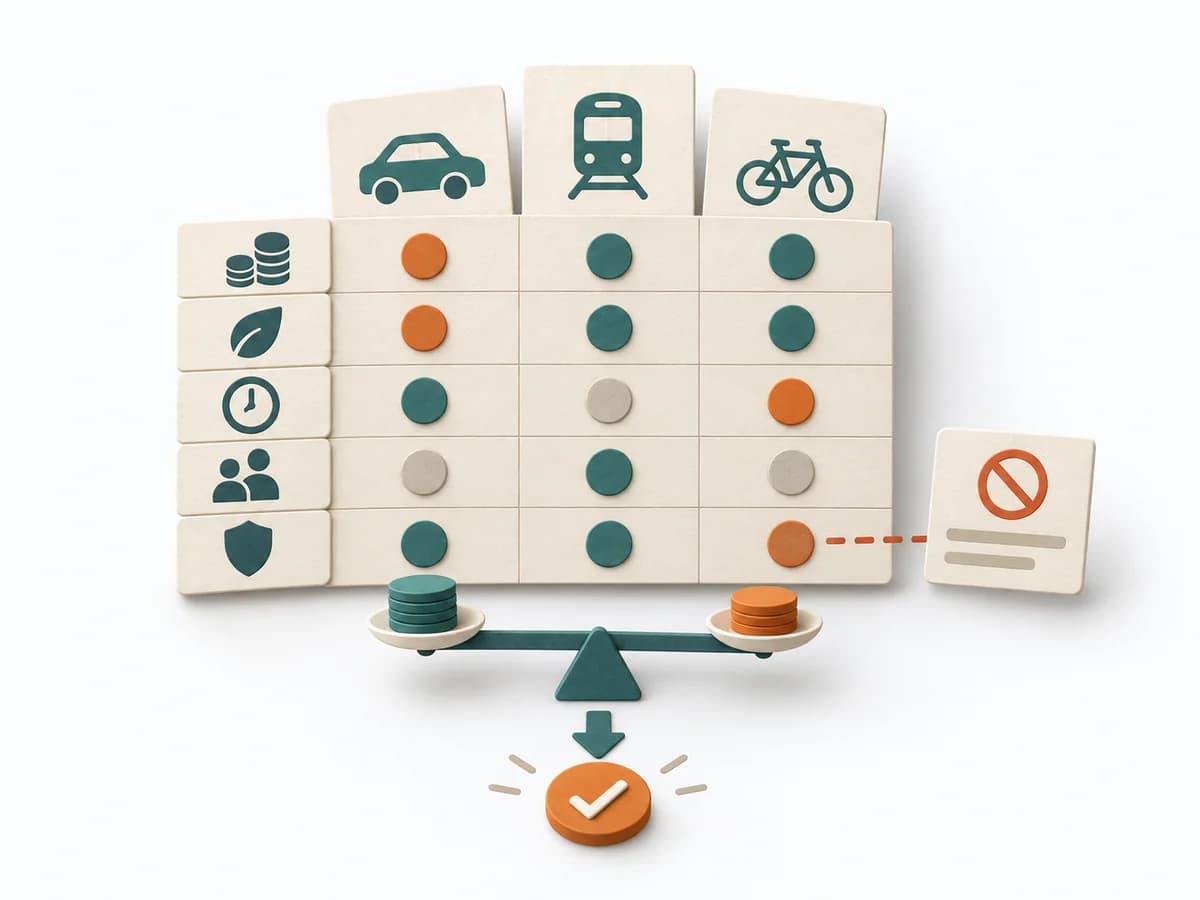 Decision Making Trade-off Analysis |
|---|---|---|---|---|
Purposedifferent | When a decision is poorly framed, even good answers deliver little value. A Decision Framing Workshop sharpens the problem, goal, and boundaries before the actual weighing begins. | The Hooked Model helps clarify engagement loops, user behavior, and experiments. It makes repeat behavior measurable and captures the result as a hooked loop, trigger map, and reward design. | Growth often breaks down where a reinforcing mechanism builds up too much friction. A Flywheel shows the cycle of value, repetition, and reinforcement meant to sustain growth. | With limited resources, quality, speed, cost, and risk almost always compete with each other. Trade-off Analysis makes these tensions explicit and prevents decisions from producing hidden side effects. |
Complexitysame | Medium | Medium | Medium | Medium |
Timedifferent | 60-120 min | Multiple workshops over several weeks | 60-120 min | 45-120 min |
Participantsdifferent | 4-10 | 2-8 | 3-8 | 2-8 |
Formatdifferent | Workshop | Workshop + async | Workshop | Workshop + async |
Outputdifferent | Decision Frame, Decision Question, Criteria List, Evidence Plan | Hooked loop, Trigger map, Reward design, Ethics check | Flywheel Map, Friction Points, Growth Levers, Experiment Backlog | Trade-off Matrix, Criteria List, Decision Rationale, Accepted Downsides |
Tagsno overlap | Decision framingAlignmentCriteriaOptions | GrowthBehaviorRetention | GrowthRetentionConversion | TradeoffsDecisionCriteriaOptions |