View methods side by side.
Choose up to four methods. Add them using the search and share the comparison by copying its link.
| Criterion | 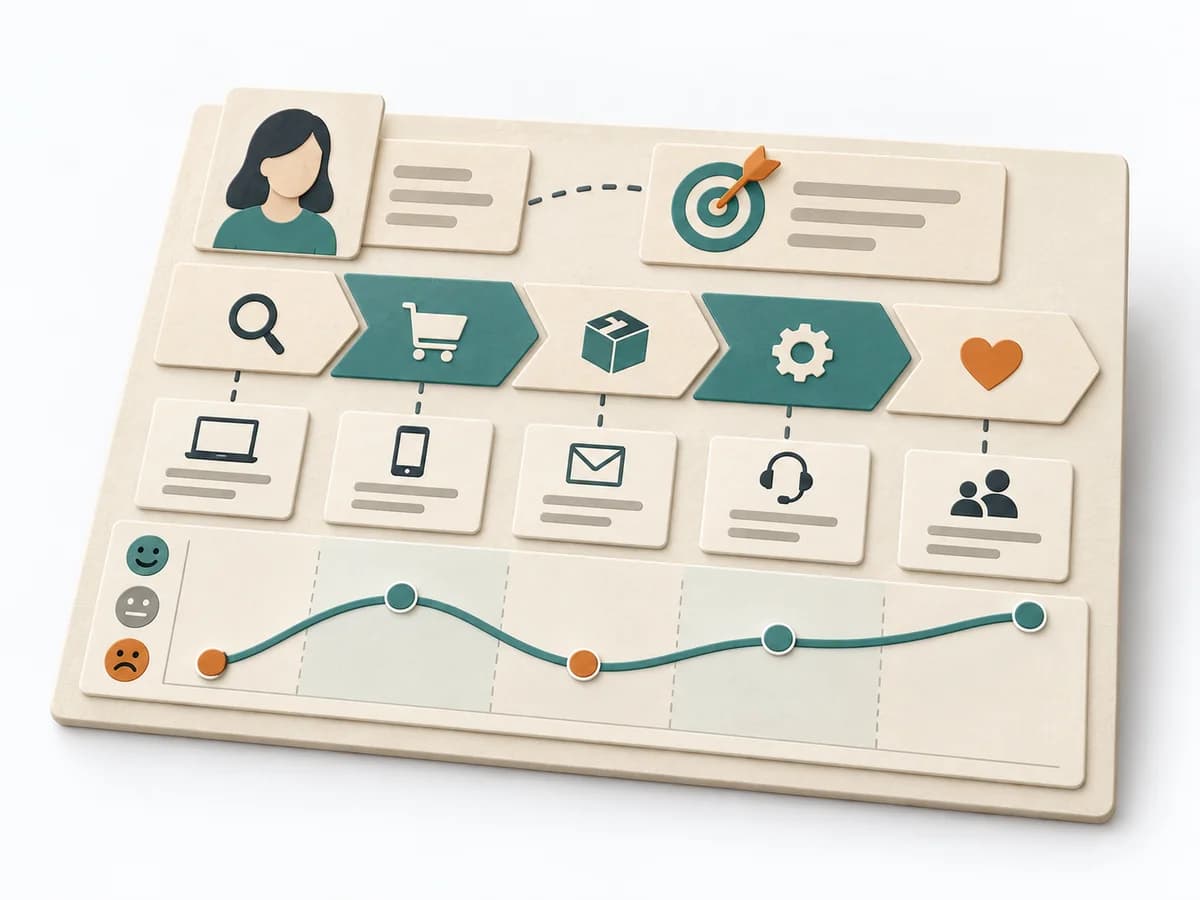 UX Design Customer Journey Canvas |  UX Research Customer Journey Mapping |  Product Discovery Learning Card |  Product Discovery Fake Door Test |
|---|---|---|---|---|
Purposedifferent | When a journey needs to be understood across several phases, it arranges experience, touchpoints, and opportunities into one picture. It makes gaps and friction along the user path clear. | When a user journey falls apart across many touchpoints, customer journey mapping makes the experience visible as a coherent arc. Phases, emotions, and breaks become legible enough to prioritize critical moments deliberately. | The Learning Card connects traceable test results to a reasoned next action while keeping the limits of the insight visible. | When demand is still unclear, it measures interest in a feature before it is built. It separates real behavior from polite agreement and deliberately keeps build effort small. |
Complexitydifferent | Medium | Medium | Low | Medium |
Timedifferent | 1-3 h | 2-4 h | 25-40 min | 1-5 Tage |
Participantsdifferent | 3-10 | 4-10 | 1-5 | Nutzertraffic |
Formatdifferent | Workshop | Workshop | Workshop + async | Async |
Outputdifferent | Customer Journey Canvas, Pain Points, Experience Opportunities | Journey Map, Pain-point List, Opportunity Backlog | Learning Card with evidence and next action | Click Data, Interest Signal, Learning Decision |
Tagsno overlap | JourneyCustomerService designCanvas | JourneyServiceService design | ExperimentsValidationDiscoveryLearning | ValidationExperimentsDemandDiscovery |