View methods side by side.
Choose up to four methods. Add them using the search and share the comparison by copying its link.
| Criterion | 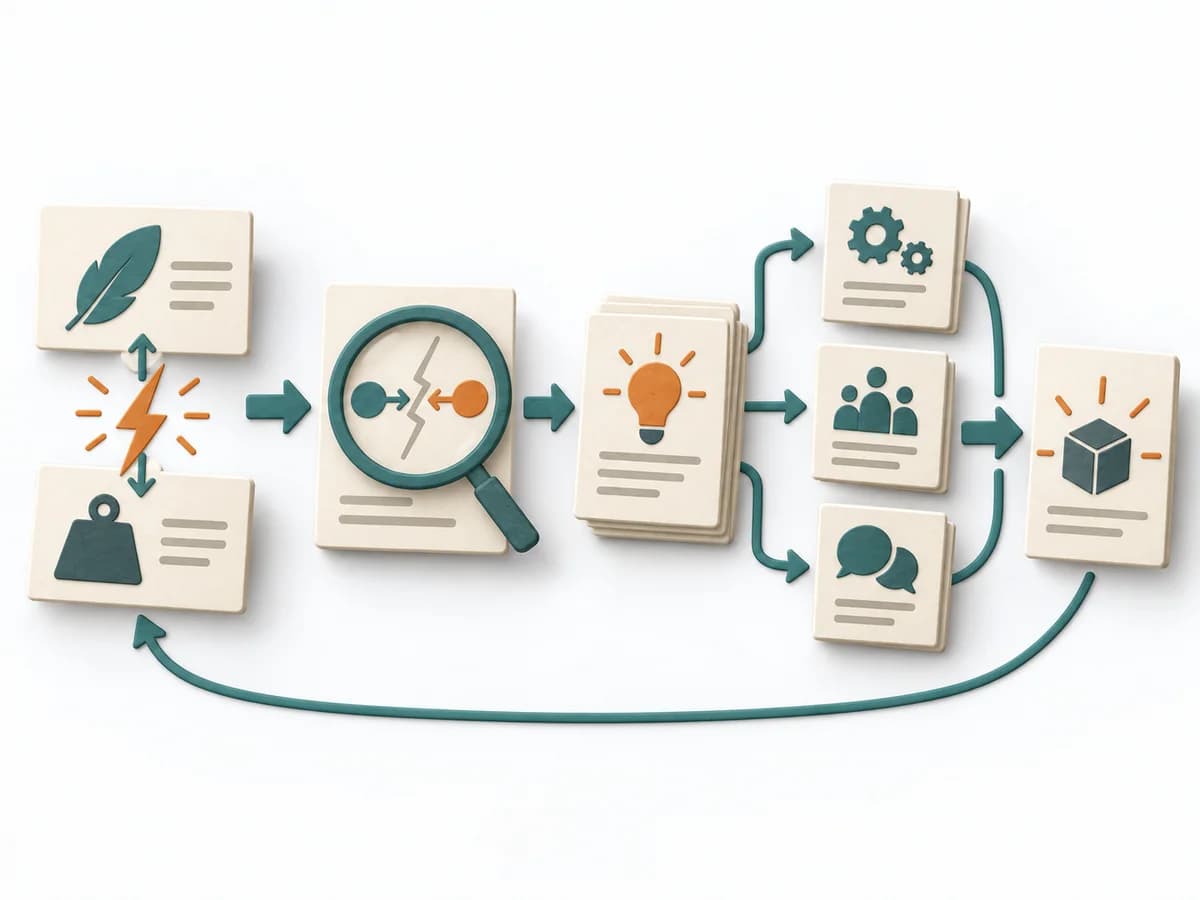 Innovation Contradiction Analysis |  Decision Making Decision Tree |  Decision Making Constraint Analysis |  Operations Kepner-Tregoe |
|---|---|---|---|---|
Purposedifferent | When a system should improve while another measure suffers as a result, the method makes the underlying conflict precisely formulable. It separates the desired effect from its side effect. This makes solutions possible that address the contradiction deliberately instead of half-heartedly. | For decisions with follow-on paths and dependencies, a linear comparison is often not enough. A Decision Tree shows how options branch under conditions and which consequences hang on each branch. | When an initiative stalls, the limit often lies not in the idea but in hard or soft boundary conditions. Constraint Analysis separates these limits and shows which of them can actually be shaped. | For a disturbance that's hard to pin down, the method cleanly separates problem, cause, and decision. It reduces mixing when symptoms allow several interpretations. |
Complexitydifferent | Medium | Medium | Low | High |
Timedifferent | 60-120 min | 30-90 min | 30-90 min | 2-8 h |
Participantsdifferent | 2-8 | 1-6 | 2-8 | 2-8 |
Formatdifferent | Workshop | Workshop + async | Workshop + async | Workshop + async |
Outputdifferent | Contradiction Statement, Abstraction Notes, Solution Principles, Concept Ideas | Decision Tree, Option Map, Assumption List | Constraint List, Hard/Soft Classification, Option Impact Notes, Decision Boundaries | Problem Analysis, Decision Analysis, Risk Plan |
Tagsno overlap | ContradictionsInnovationProblem solving | DecisionTreeOptions | ConstraintsDecisionPlanningOptions | Problem solvingRoot causeDecisionOperations |