View methods side by side.
Choose up to four methods. Add them using the search and share the comparison by copying its link.
| Criterion | 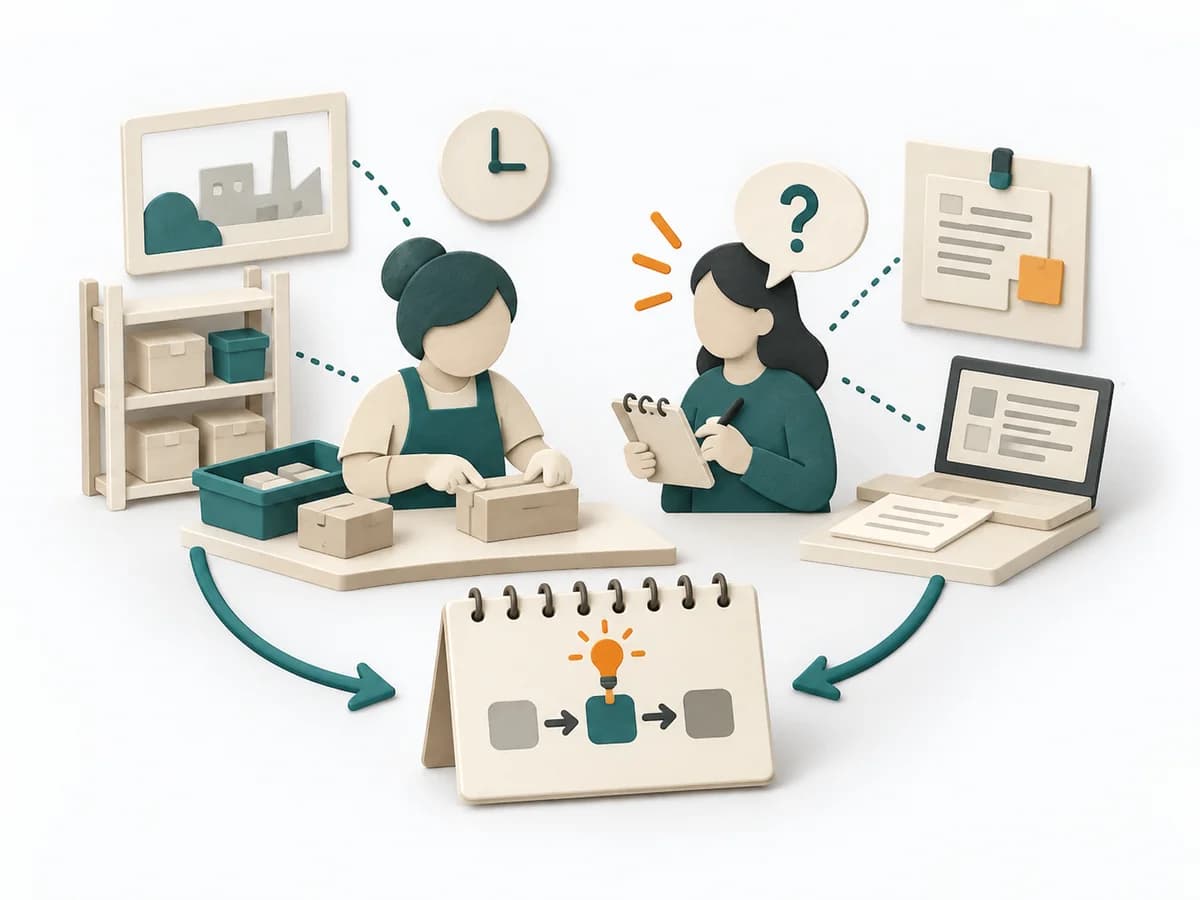 UX Research Contextual Inquiry |  Knowledge Modeling Knowledge Mapping |  Operations 5 Whys |  Operations Root Cause Analysis |
|---|---|---|---|---|
Purposedifferent | When work processes are known only from accounts and the real context stays hidden, Contextual Inquiry makes behavior at the workplace visible. Observation and follow-up questions together show how people actually work, get interrupted, and improvise. | Knowledge Mapping makes knowledge, gaps, and transfer paths visible across a field. It fits when expertise should not just exist but also be findable and transferable. | For a single, hard-to-explain deviation, the method exposes the causal chain behind the visible symptom. It keeps the cause open until a controllable condition emerges instead of a mere description. | When a problem keeps recurring and the cause stays unclear, the method exposes the underlying mechanism. It separates symptom, guess, and robust explanation from one another. |
Complexitydifferent | Medium | Medium | Low | Medium |
Timedifferent | 1-3 Wochen | 1-3 h | 15-30 min | 1-4 h |
Participantsdifferent | 4-12 Beobachtungen | 3-12 | 2-6 | 3-8 |
Formatdifferent | Workshop + async | Workshop | Workshop | Workshop + async |
Outputdifferent | Field Notes, Workflow Insights, Pain Points | Knowledge Map, Critical Knowledge Areas, Transfer Plan | Root cause notes, Countermeasures | Problem Statement, Cause Hypotheses, Confirmed Causes, Action Plan |
Tagsno overlap | UX researchObservationContext | KnowledgeMappingRisk | Root causeIncidentLeanProblem solving | Root causeProblem solvingQualityIncident |