View methods side by side.
Choose up to four methods. Add them using the search and share the comparison by copying its link.
| Criterion | 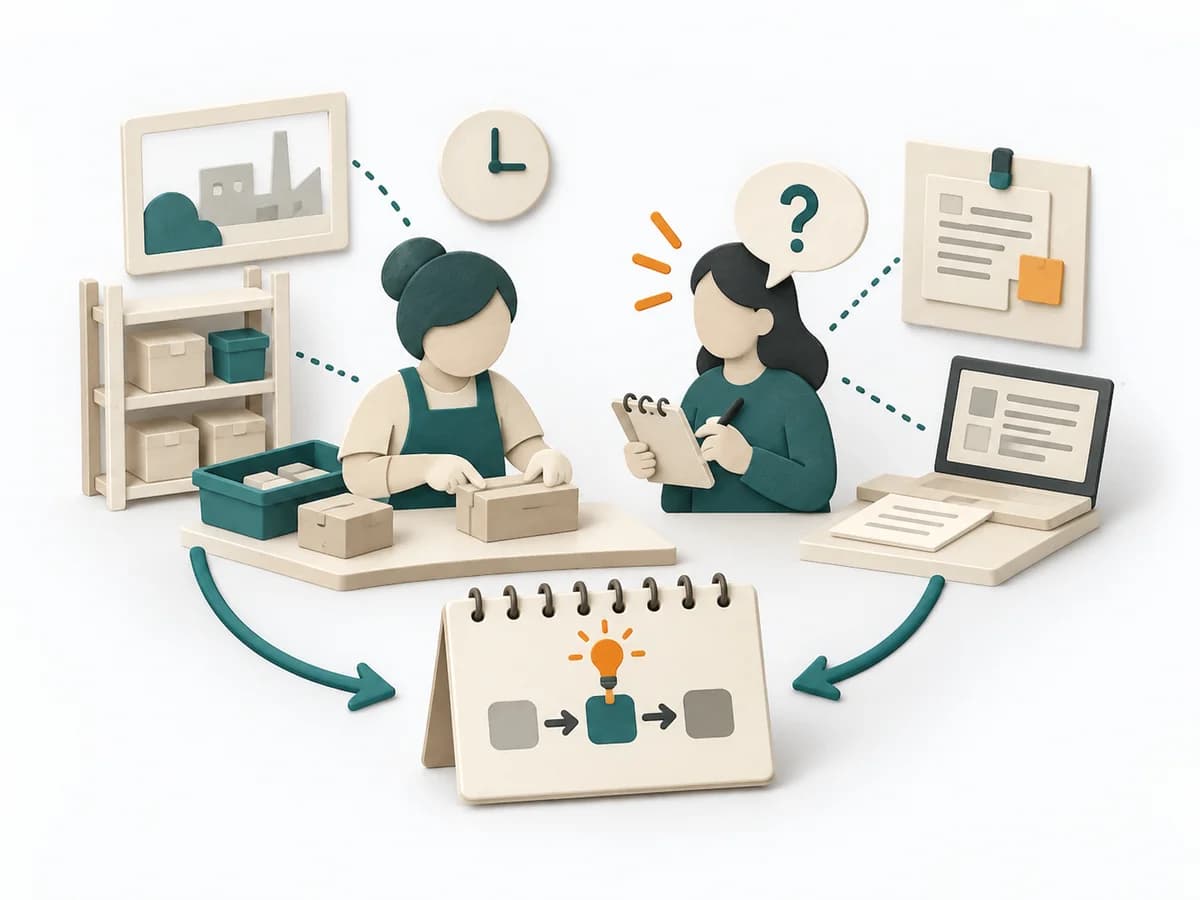 UX Research Contextual Inquiry |  Decision Making Decision Tree |  Decision Making Argument Mapping |  Knowledge Modeling IBIS |
|---|---|---|---|---|
Purposedifferent | When work processes are known only from accounts and the real context stays hidden, Contextual Inquiry makes behavior at the workplace visible. Observation and follow-up questions together show how people actually work, get interrupted, and improvise. | For decisions with follow-on paths and dependencies, a linear comparison is often not enough. A Decision Tree shows how options branch under conditions and which consequences hang on each branch. | When statements, evidence, and counterarguments get mixed up, a debate quickly loses its structure. Argument Mapping breaks a thesis down into its reasoning and makes visible what it really rests on. | IBIS structures thinking about complex questions as a sequence of issues, ideas, and arguments. The method keeps discussions open without forcing them into premature consensus. |
Complexitysame | Medium | Medium | Medium | Medium |
Timedifferent | 1-3 Wochen | 30-90 min | 1-3 h | 1-3 h |
Participantsdifferent | 4-12 Beobachtungen | 1-6 | 1-8 | 2-8 |
Formatsame | Workshop + async | Workshop + async | Workshop + async | Workshop + async |
Outputdifferent | Field Notes, Workflow Insights, Pain Points | Decision Tree, Option Map, Assumption List | Argument Map, Evidence Gaps, Decision Rationale | Issue Map, Positions, Argument Notes |
Tagsno overlap | UX researchObservationContext | DecisionTreeOptions | SensemakingDecisionRationale | RationaleKnowledgeDecision |