View methods side by side.
Choose up to four methods. Add them using the search and share the comparison by copying its link.
| Criterion | 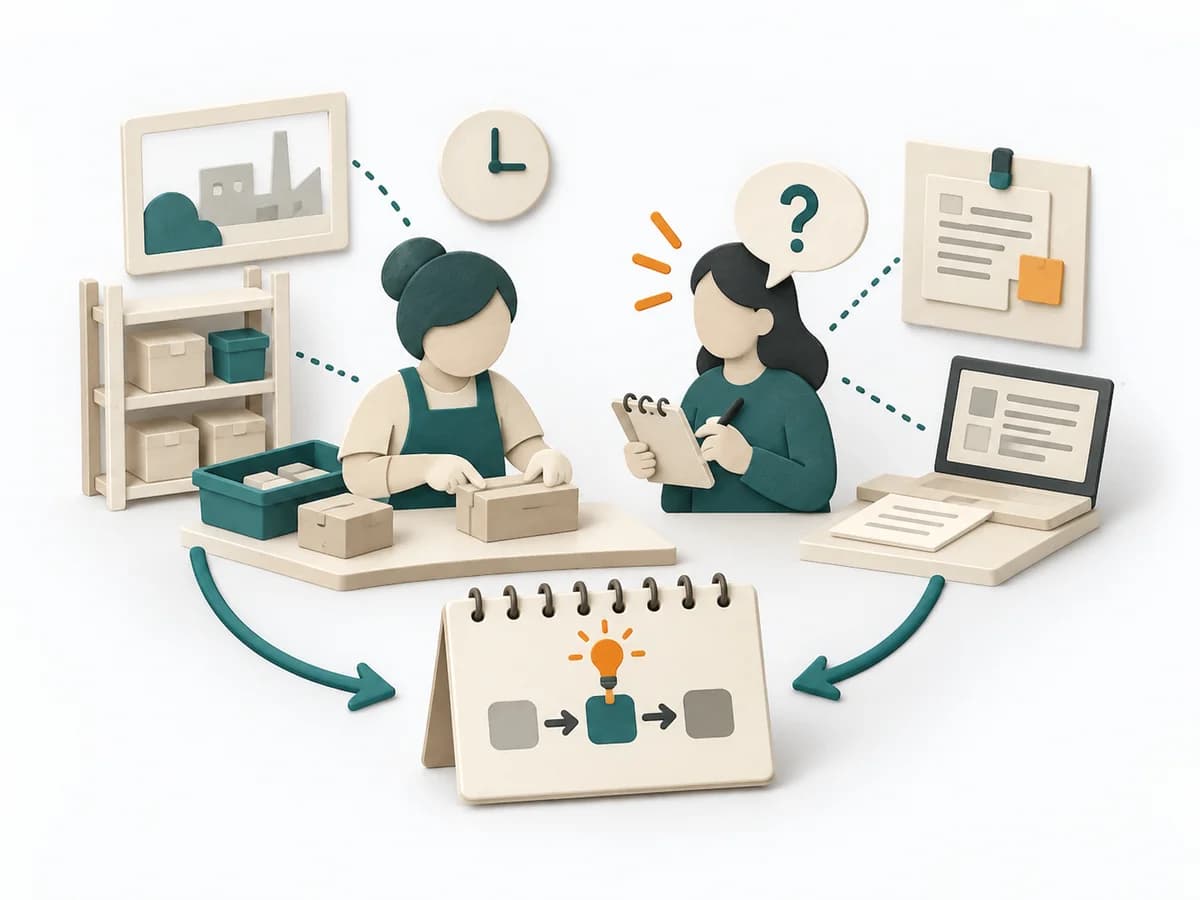 UX Research Contextual Inquiry |  Operations After-Action Review |  Domain Modeling Context Map |  Operations Gemba Walk |
|---|---|---|---|---|
Purposedifferent | When work processes are known only from accounts and the real context stays hidden, Contextual Inquiry makes behavior at the workplace visible. Observation and follow-up questions together show how people actually work, get interrupted, and improvise. | After missions or project phases with unclear outcomes, the method makes visible what actually happened and what can be learned from it. It separates course, effect, and causes so experience turns into solid improvement. | When several contexts need to talk to each other, it makes their relationships and dependencies legible. It helps sort integration pressure and responsibilities across system boundaries. | When there is uncertainty about the real course of a process, the method brings observation to the place where work happens. It combines perception, follow-up questions, and process knowledge so decisions rest on actual workflows instead of assumptions. |
Complexitydifferent | Medium | Low | Medium | Low |
Timedifferent | 1-3 Wochen | 20-45 min | 1-3 h | 30-120 min |
Participantsdifferent | 4-12 Beobachtungen | 3-12 | 2-8 | 2-6 |
Formatdifferent | Workshop + async | Workshop + async | Workshop + async | Workshop |
Outputdifferent | Field Notes, Workflow Insights, Pain Points | Lessons learned, Action items, Event summary | Context Map, Integration Patterns, Boundary Notes | Observation Notes, Improvement Ideas |
Tagsno overlap | UX researchObservationContext | LearningOperationsImprovement | Domain-Driven DesignBoundariesStrategy | LeanObservationProcessOperations |