View methods side by side.
Choose up to four methods. Add them using the search and share the comparison by copying its link.
| Criterion |  Domain Modeling Context Map |  Systems Thinking Leverage Points |  Product Discovery Smoke Test | 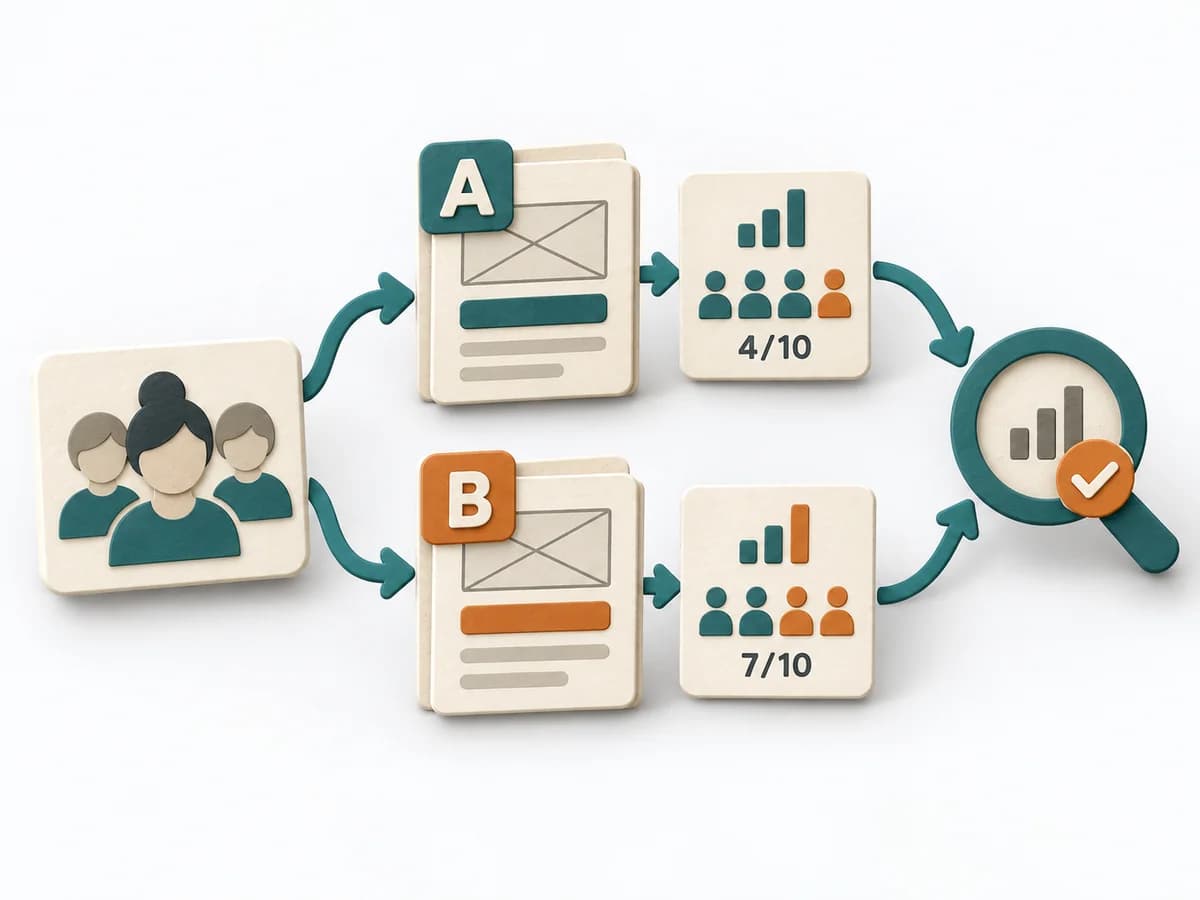 Growth A/B Testing |
|---|---|---|---|---|
Purposedifferent | When several contexts need to talk to each other, it makes their relationships and dependencies legible. It helps sort integration pressure and responsibilities across system boundaries. | Leverage Points show exactly where interventions in a system produce a disproportionate effect. It draws relationships, patterns, and feedback loops. The result is captured as a leverage map and action strategy. | When demand only needs to be roughly verified, it tests interest with minimal effort. It measures whether people would take a next step at all. | When two variants compete, discussions quickly decide by taste rather than effect. A/B Testing checks behavior under controlled conditions and separates real improvement from chance or expectation effects. |
Complexitydifferent | Medium | High | Low | High |
Timedifferent | 1-3 h | Half day | 1-5 Tage | 1-4 Wochen |
Participantsdifferent | 2-8 | 3-12 | Nutzertraffic | 1-6 |
Formatdifferent | Workshop + async | Workshop | Async | Async |
Outputdifferent | Context Map, Integration Patterns, Boundary Notes | Leverage Map, Action Strategy | Interest Metrics, Conversion Signal, Learning Note | Experiment results, Decision log, Learning summary |
Tagsno overlap | Domain-Driven DesignBoundariesStrategy | Systems thinkingChangeStrategy | ValidationExperimentsDemandGrowth | ExperimentsGrowthAnalyticsValidation |