View methods side by side.
Choose up to four methods. Add them using the search and share the comparison by copying its link.
| Criterion |  Domain Modeling Context Map | 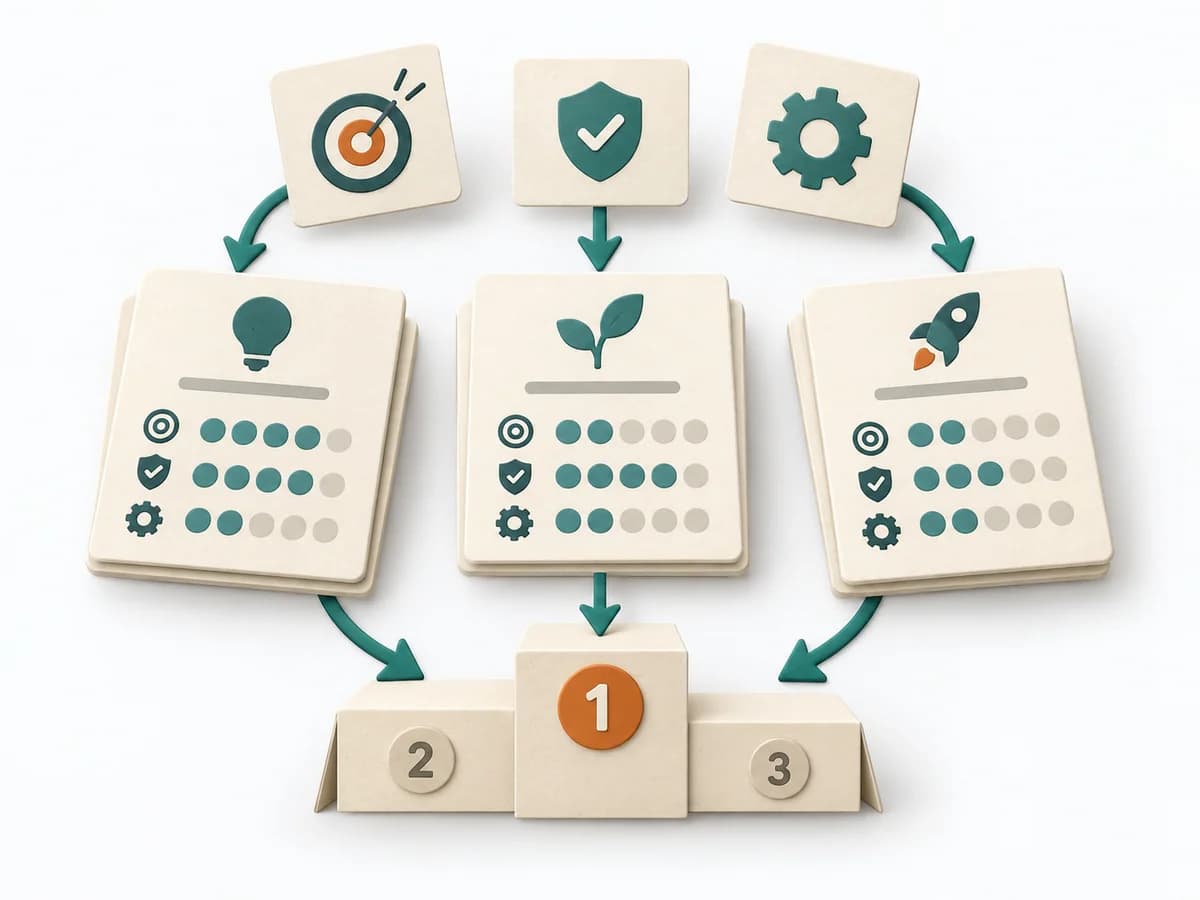 Product Strategy ICE Scoring |  Product Discovery Assumption Mapping |  Product Strategy DIBB |
|---|---|---|---|---|
Purposedifferent | When several contexts need to talk to each other, it makes their relationships and dependencies legible. It helps sort integration pressure and responsibilities across system boundaries. | When ideas need sorting quickly, it condenses impact, confidence, and effort into one compact score. It connects customer value, product logic, and decision priorities. The result is captured as an ICE table and top-ideas list. | When assumptions still sit unordered in the room, it weighs uncertainty against leverage. It makes visible which hypotheses should be checked first. | DIBB helps clarify target groups, value, goals, and priorities by making the logic behind a decision explicit. It captures results as a DIBB document, belief list, bet list, and learning report. |
Complexitydifferent | Medium | Low | Medium | Low |
Timedifferent | 1-3 h | 30-60 min | 45-60 min | 1-2 h |
Participantssame | 2-8 | 2-8 | 2-8 | 2-8 |
Formatsame | Workshop + async | Workshop + async | Workshop + async | Workshop + async |
Outputdifferent | Context Map, Integration Patterns, Boundary Notes | ICE Table, Top Idea List | Assumption map, Test backlog, Risk ranking | DIBB document, Belief list, Bet list, Learning report |
Tagsno overlap | Domain-Driven DesignBoundariesStrategy | PrioritizationScoringGrowthDecision | AssumptionsRiskExperimentsValidation | StrategyDecisionAssumptionsHypothesis |