View methods side by side.
Choose up to four methods. Add them using the search and share the comparison by copying its link.
| Criterion |  Domain Modeling Context Map |  Decision Making Decision Tree | 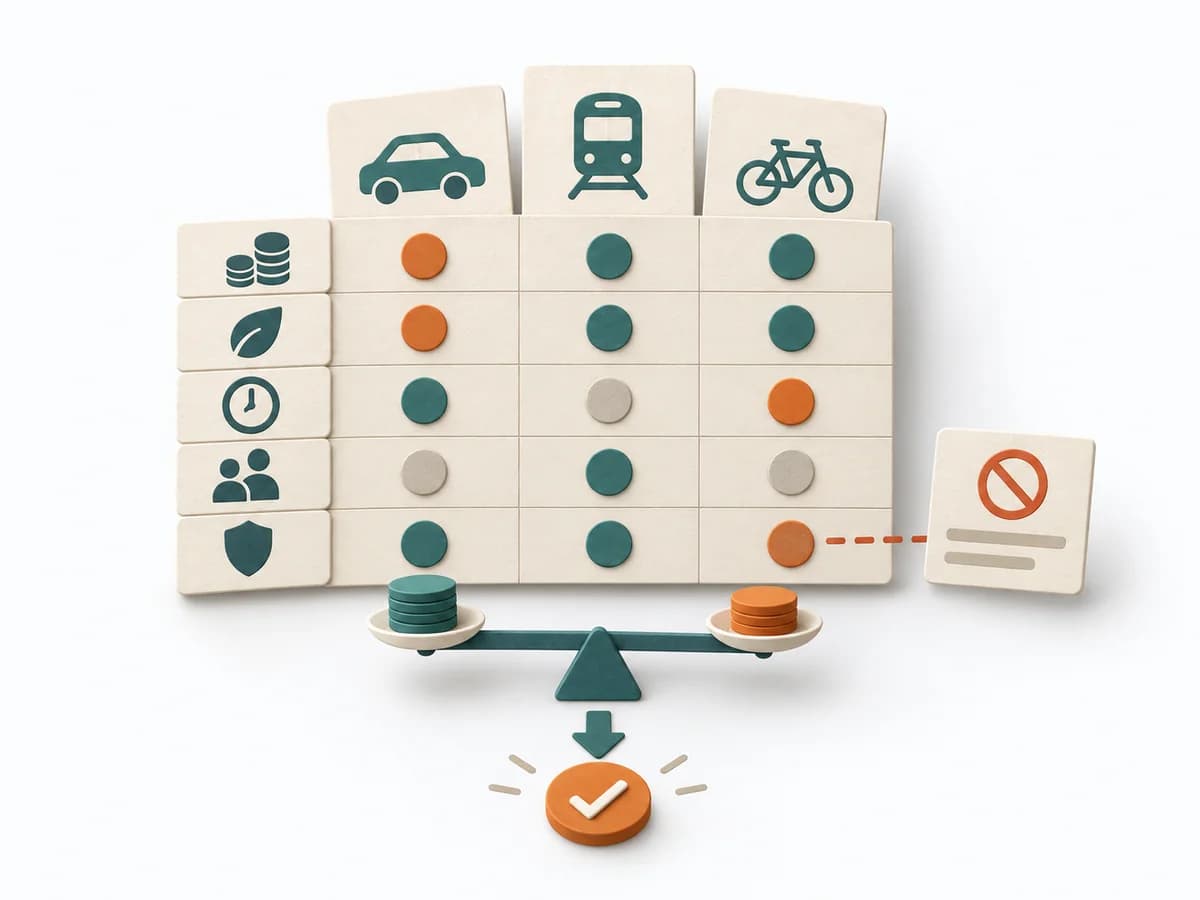 Decision Making Trade-off Analysis |  Domain Modeling Bounded Context Canvas |
|---|---|---|---|---|
Purposedifferent | When several contexts need to talk to each other, it makes their relationships and dependencies legible. It helps sort integration pressure and responsibilities across system boundaries. | For decisions with follow-on paths and dependencies, a linear comparison is often not enough. A Decision Tree shows how options branch under conditions and which consequences hang on each branch. | With limited resources, quality, speed, cost, and risk almost always compete with each other. Trade-off Analysis makes these tensions explicit and prevents decisions from producing hidden side effects. | When a business context is still loosely outlined, it shapes language, responsibility, and integration space. It clarifies what belongs together and where a boundary needs to hold. |
Complexitysame | Medium | Medium | Medium | Medium |
Timedifferent | 1-3 h | 30-90 min | 45-120 min | 1-3 h |
Participantsdifferent | 2-8 | 1-6 | 2-8 | 3-8 |
Formatsame | Workshop + async | Workshop + async | Workshop + async | Workshop + async |
Outputdifferent | Context Map, Integration Patterns, Boundary Notes | Decision Tree, Option Map, Assumption List | Trade-off Matrix, Criteria List, Decision Rationale, Accepted Downsides | Context Canvas, Glossary, Integration Notes |
Tagsno overlap | Domain-Driven DesignBoundariesStrategy | DecisionTreeOptions | TradeoffsDecisionCriteriaOptions | Domain-Driven DesignBoundariesModeling |