View methods side by side.
Choose up to four methods. Add them using the search and share the comparison by copying its link.
| Criterion |  Product Discovery Context Canvas | 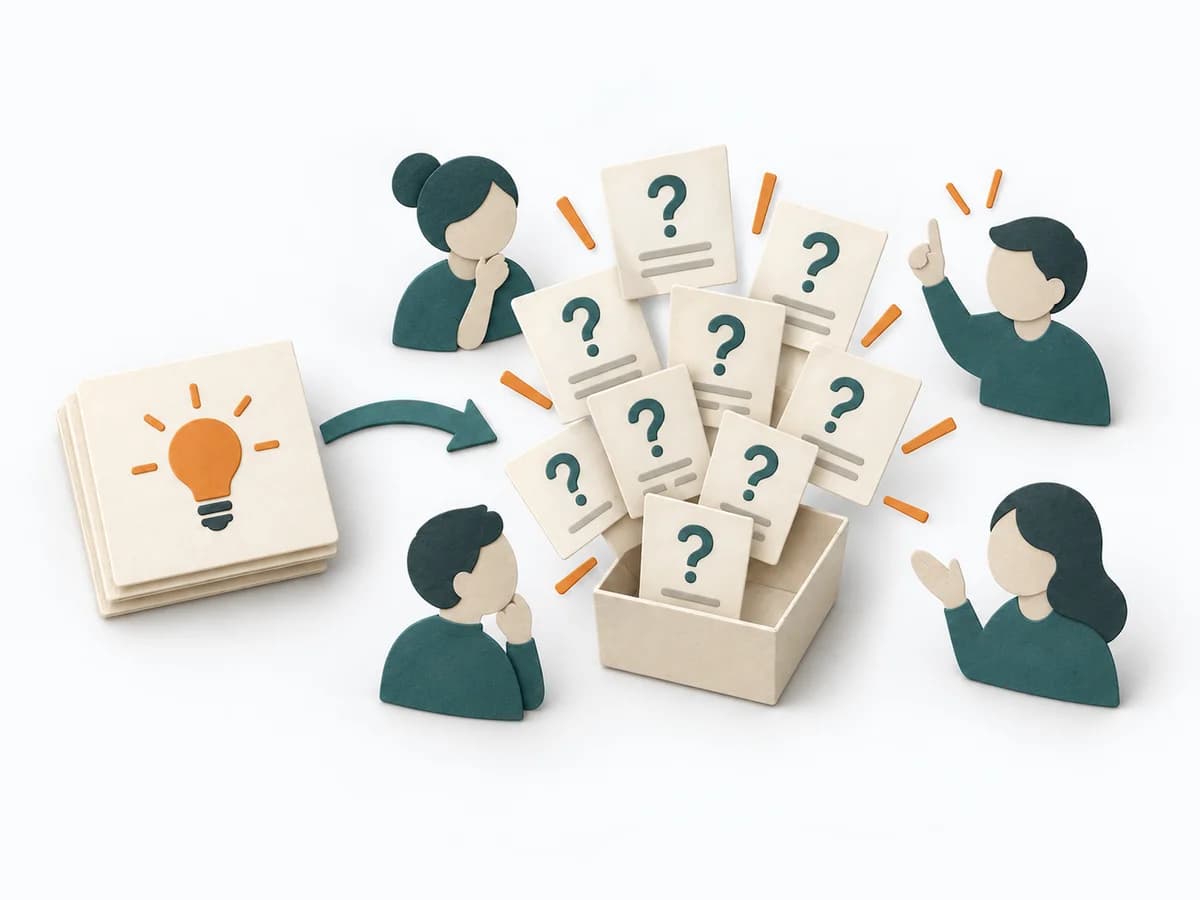 Facilitation Question Burst |  Knowledge Modeling IBIS |  Facilitation Decision Jam |
|---|---|---|---|---|
Purposedifferent | When an environment of users, systems, and constraints is hard to grasp, it puts the context compactly on the table. It creates a clear reading of influence, boundary, and dependency. | When a problem gets covered up too quickly with answers, Question Burst puts the better question at the center. The format opens the thinking space before the group commits to an interpretation. | IBIS structures thinking about complex questions as a sequence of issues, ideas, and arguments. The method keeps discussions open without forcing them into premature consensus. | When a decision is stuck, Decision Jam loosens the knot through structured separation of problem, idea, and selection. The format creates movement without jumping prematurely at the first seemingly elegant answer. |
Complexitydifferent | Low | Low | Medium | Low |
Timedifferent | 45-90 min | 15-30 min | 1-3 h | 60-90 min |
Participantsdifferent | 3-10 | 2-8 | 2-8 | 4-10 |
Formatdifferent | Workshop | Workshop | Workshop + async | Workshop |
Outputdifferent | Context canvas, Open questions, Shared context notes | Question List, Reframed Challenge, Learning Prompts | Issue Map, Positions, Argument Notes | Problem Cluster, Prioritized Challenge, Experiment |
Tagsno overlap | ContextFramingRequirementsCanvas | QuestionsReframingFacilitationSensemaking | RationaleKnowledgeDecision | FacilitationDecisionProblem solvingWorkshop |