View methods side by side.
Choose up to four methods. Add them using the search and share the comparison by copying its link.
| Criterion |  Product Discovery Context Canvas |  Facilitation Dot Voting | 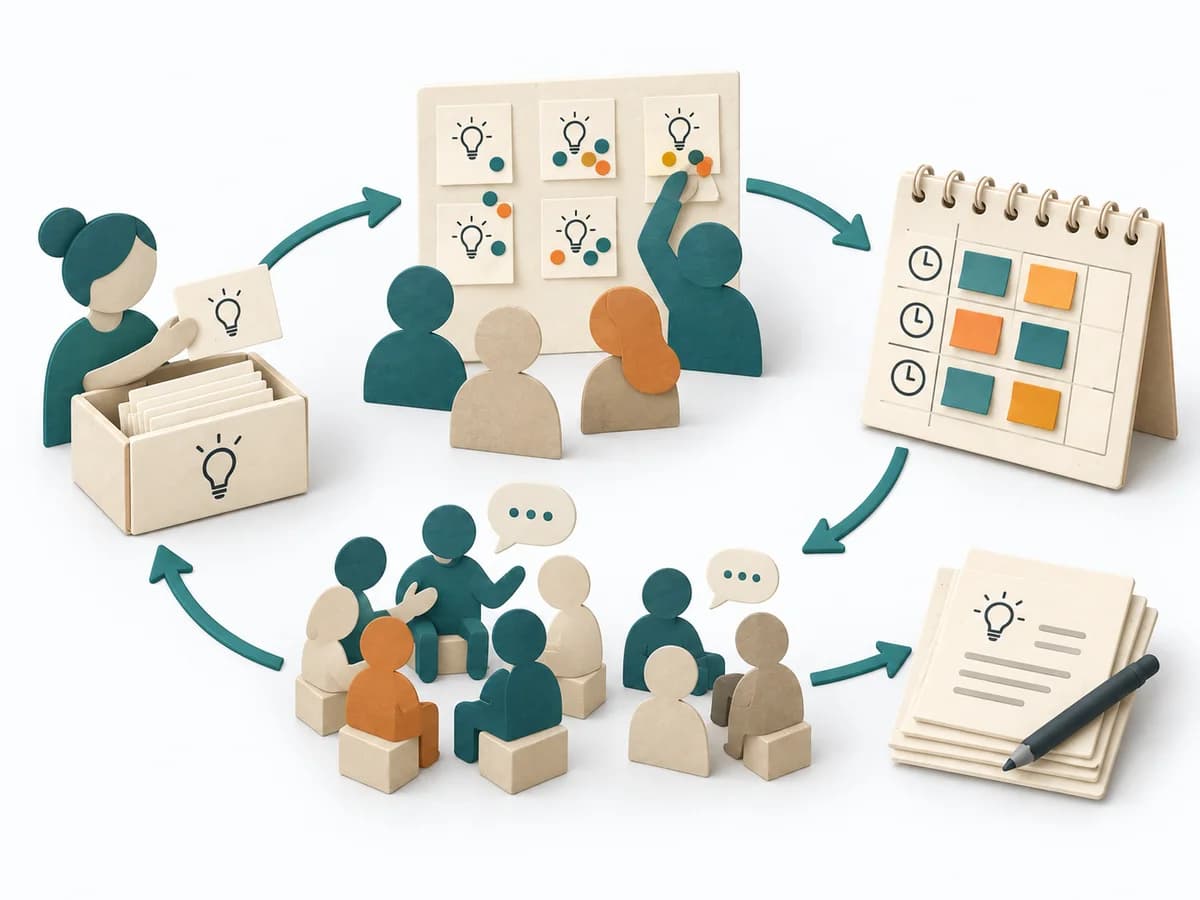 Facilitation Barcamp |  Facilitation Fishbowl Discussion |
|---|---|---|---|---|
Purposedifferent | When an environment of users, systems, and constraints is hard to grasp, it puts the context compactly on the table. It creates a clear reading of influence, boundary, and dependency. | When a workshop has produced too many options and the group needs to condense quickly, dot voting makes preferences visible in a short time. It bundles individual votes into a solid signal for the next selection. | When many people can contribute knowledge and the flow should stay open, Barcamp provides a framework for self-organized sessions. The format channels energy without defining the content too narrowly in advance. | When a controversial topic needs depth and discipline at the same time, Fishbowl Discussion makes the structure of the conversation transparent. The format keeps the core small enough for real dialogue and open enough for controlled turnover. |
Complexitydifferent | Low | Low | Medium | Medium |
Timedifferent | 45-90 min | 5-15 min | Halber Tag bis 2 Tage | 45-90 min |
Participantsdifferent | 3-10 | 3-20 | 15-200 | 8-80 |
Formatsame | Workshop | Workshop | Workshop | Workshop |
Outputdifferent | Context canvas, Open questions, Shared context notes | Ranked list, Consensus signal, Shortlist | Session Board, Session Notes, Community Learnings | Discussion Insights, Observed Tensions, Follow-up Questions |
Tagsno overlap | ContextFramingRequirementsCanvas | FacilitationVotingConsensusPrioritization | FacilitationLarge groupLearning | FacilitationDialogueLarge group |