View methods side by side.
Choose up to four methods. Add them using the search and share the comparison by copying its link.
| Criterion |  Product Discovery Context Canvas |  Knowledge Modeling Competency Questions |  Agile Specification by Example | 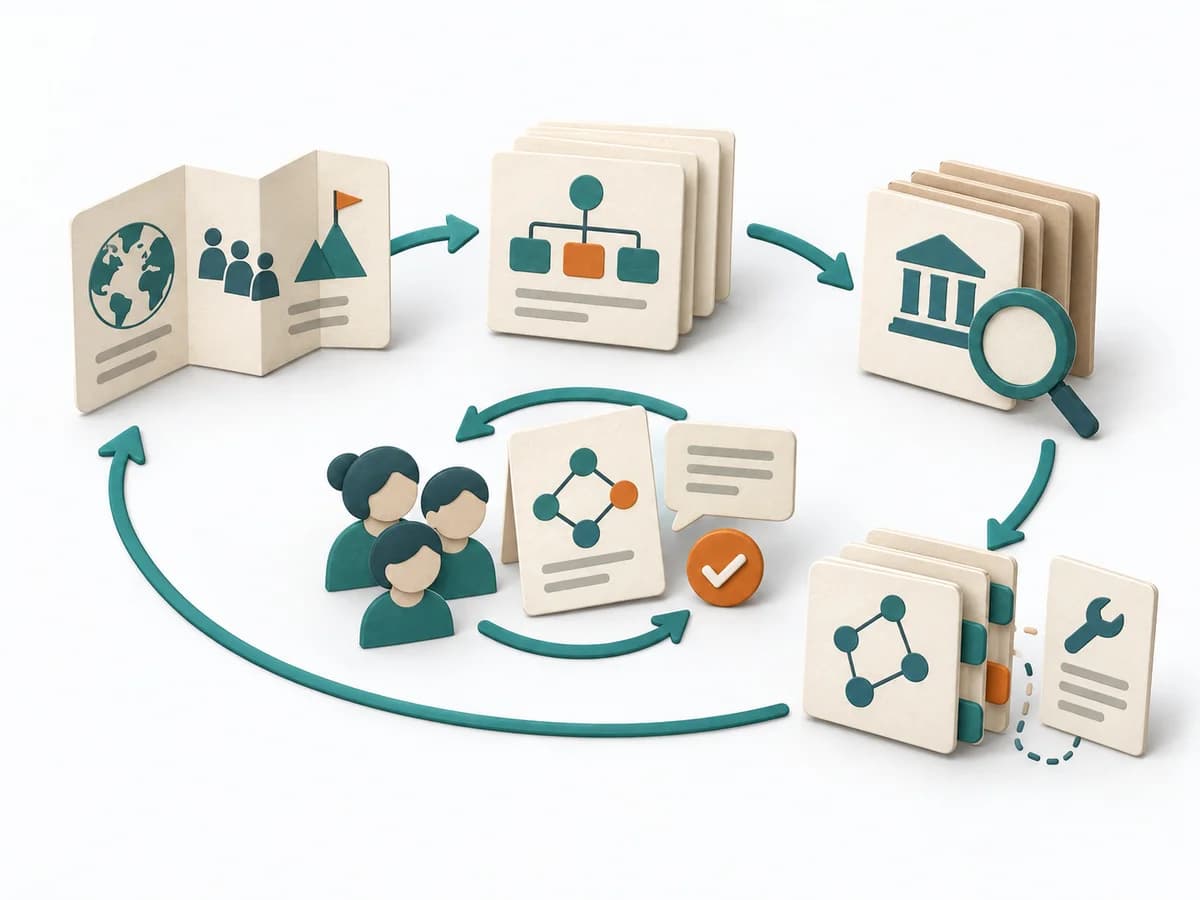 Knowledge Modeling NeOn Methodology |
|---|---|---|---|---|
Purposedifferent | When an environment of users, systems, and constraints is hard to grasp, it puts the context compactly on the table. It creates a clear reading of influence, boundary, and dependency. | Competency Questions translate a domain model into concrete questions that it must be able to answer. The method keeps the model's scope clean and prevents pretty but useless structures. | When business rules need to become precise, it ties language, example, and test together. It sorts work by value, risk, and delivery ability. The result is captured as an Example Table and Acceptance Tests. | The NeOn Methodology structures ontology work as a controlled process with reuse, scenarios, and reviews. It is useful when ontologies should not emerge ad hoc but modularly and reusably. |
Complexitydifferent | Low | Medium | Medium | High |
Timedifferent | 45-90 min | 2-4 h | 60-90 min pro Feature | Mehrere Wochen bis Monate |
Participantsdifferent | 3-10 | 2-8 | 3-6 | 2-10 |
Formatdifferent | Workshop | Workshop + async | Workshop | Workshop + async |
Outputdifferent | Context canvas, Open questions, Shared context notes | Competency Question Set, Required Concepts, Test Queries, Coverage Matrix | Example Table, Acceptance Tests | Ontology Requirements Specification, Reuse Plan, Ontology Modules, Evaluation Report |
Tagsno overlap | ContextFramingRequirementsCanvas | OntologyKnowledge graphScopeRequirementsSemantic | AgileRequirementsExamplesBehavior-Driven Development | OntologyMethodologyReuseSemanticEngineering |