View methods side by side.
Choose up to four methods. Add them using the search and share the comparison by copying its link.
| Criterion |  Product Discovery Context Canvas | 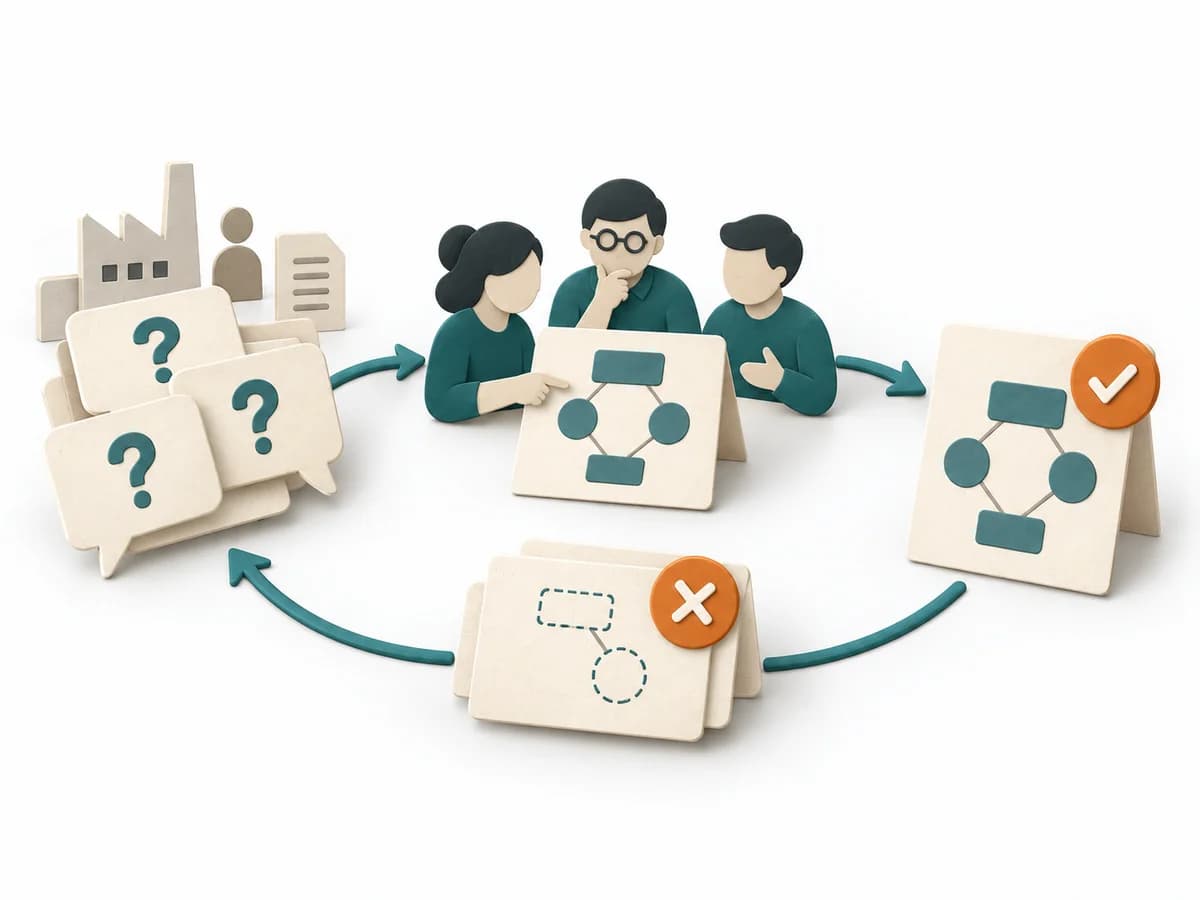 Knowledge Modeling Competency Questions |  Product Strategy DIBB |  Decision Making Delphi Method |
|---|---|---|---|---|
Purposedifferent | When an environment of users, systems, and constraints is hard to grasp, it puts the context compactly on the table. It creates a clear reading of influence, boundary, and dependency. | Competency Questions translate a domain model into concrete questions that it must be able to answer. The method keeps the model's scope clean and prevents pretty but useless structures. | DIBB helps clarify target groups, value, goals, and priorities by making the logic behind a decision explicit. It captures results as a DIBB document, belief list, bet list, and learning report. | When knowledge is distributed and direct dominance should be avoided, groups quickly fall under the sway of their opinion leaders. The Delphi Method gathers assessments iteratively and gradually brings expert judgments closer together. |
Complexitydifferent | Low | Medium | Low | High |
Timedifferent | 45-90 min | 2-4 h | 1-2 h | 1-4 Wochen |
Participantsdifferent | 3-10 | 2-8 | 2-8 | 6-30 Experten |
Formatdifferent | Workshop | Workshop + async | Workshop + async | Async |
Outputdifferent | Context canvas, Open questions, Shared context notes | Competency Question Set, Required Concepts, Test Queries, Coverage Matrix | DIBB document, Belief list, Bet list, Learning report | Expert Forecast, Consensus Range, Assumption Notes |
Tagsno overlap | ContextFramingRequirementsCanvas | OntologyKnowledge graphScopeRequirementsSemantic | StrategyDecisionAssumptionsHypothesis | ForecastingExpertsDecisionStrategy |