View methods side by side.
Choose up to four methods. Add them using the search and share the comparison by copying its link.
| Criterion |  Product Discovery Context Canvas |  Product Discovery Assumption Mapping | 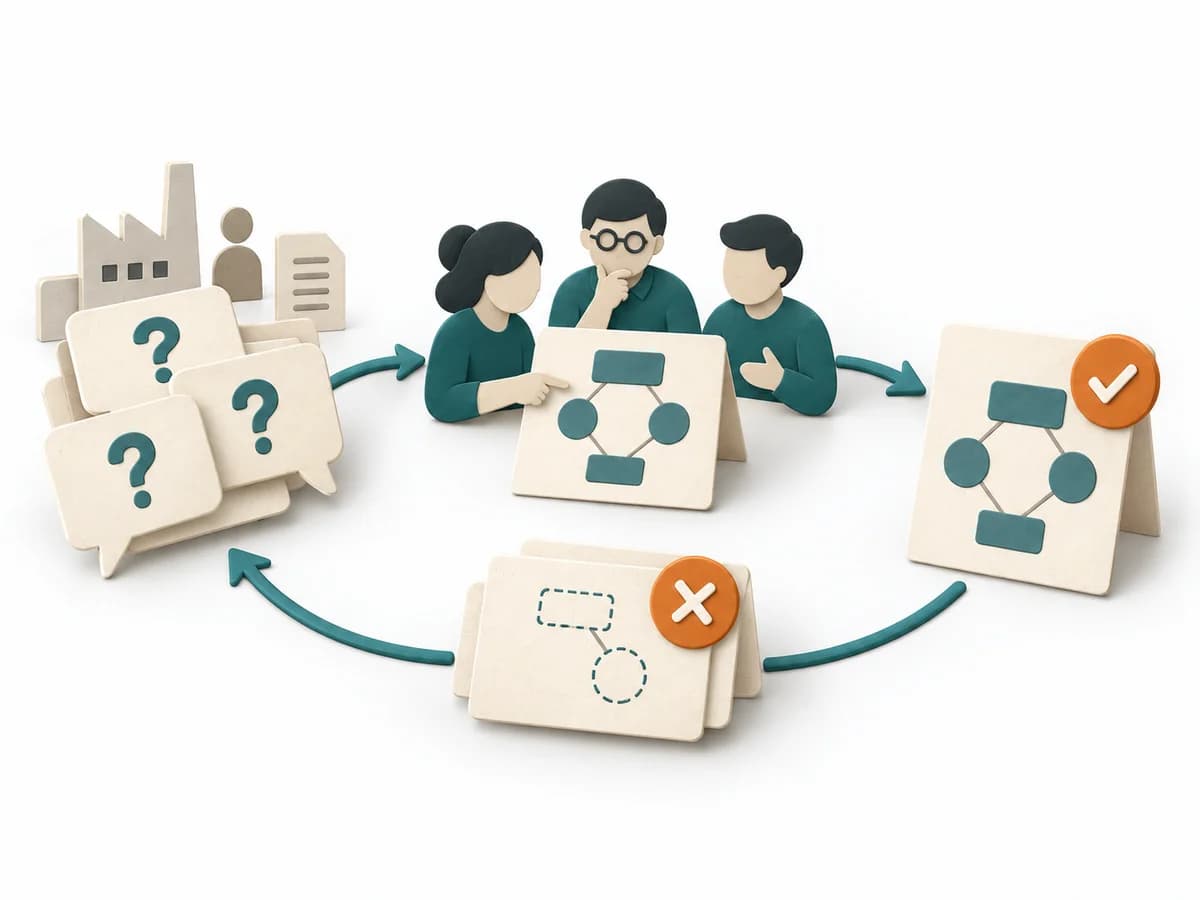 Knowledge Modeling Competency Questions | 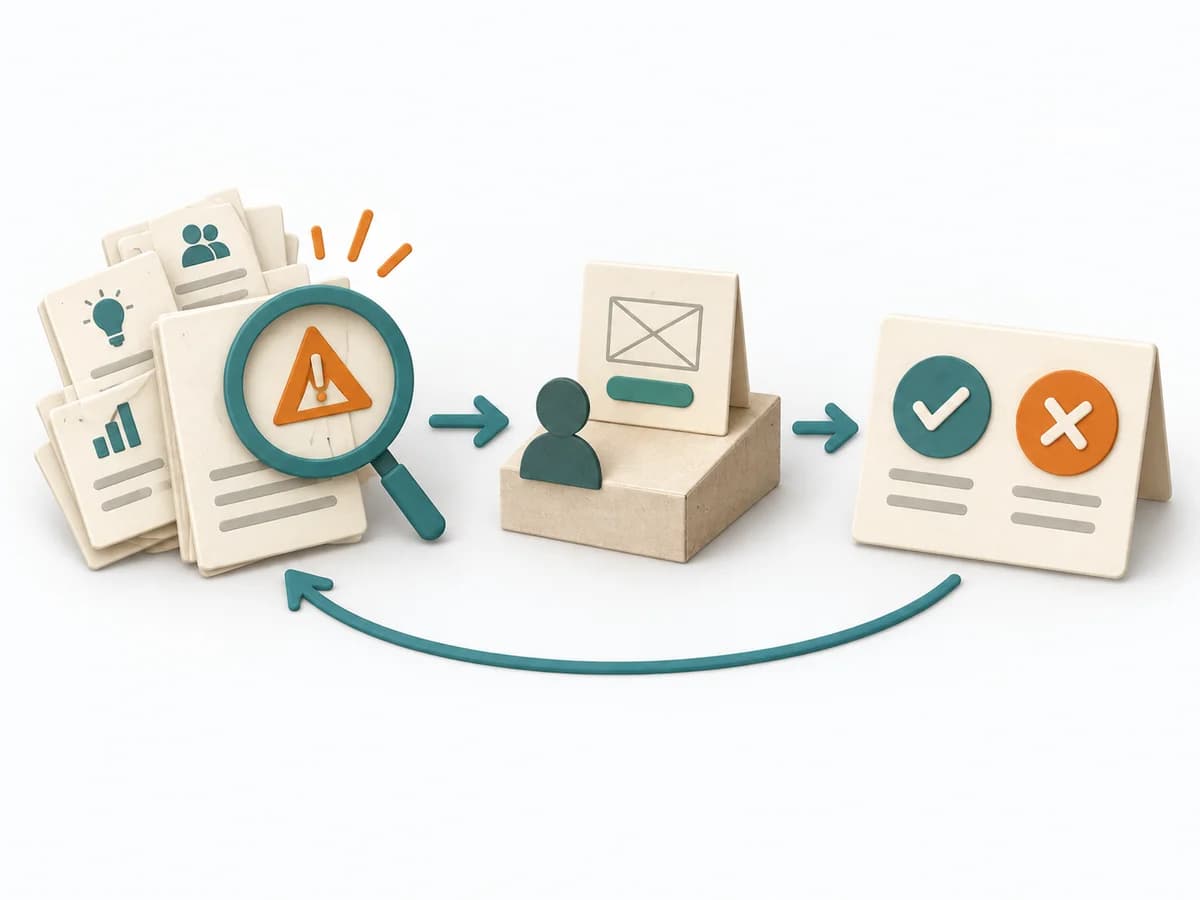 Product Discovery Riskiest Assumption Test |
|---|---|---|---|---|
Purposedifferent | When an environment of users, systems, and constraints is hard to grasp, it puts the context compactly on the table. It creates a clear reading of influence, boundary, and dependency. | When assumptions still sit unordered in the room, it weighs uncertainty against leverage. It makes visible which hypotheses should be checked first. | Competency Questions translate a domain model into concrete questions that it must be able to answer. The method keeps the model's scope clean and prevents pretty but useless structures. | When an idea hinges on one critical unknown, it prioritizes testing that exact piece of uncertainty first. It separates problem, assumption, solution, and evidence. The result is captured as a prioritized list of assumptions, a test plan, and a result report. |
Complexitydifferent | Low | Medium | Medium | Medium |
Timedifferent | 45-90 min | 45-60 min | 2-4 h | 1-2 Wochen pro Iteration |
Participantsdifferent | 3-10 | 2-8 | 2-8 | 2-6 |
Formatdifferent | Workshop | Workshop + async | Workshop + async | Workshop + async |
Outputdifferent | Context canvas, Open questions, Shared context notes | Assumption map, Test backlog, Risk ranking | Competency Question Set, Required Concepts, Test Queries, Coverage Matrix | Prioritized Assumption List, Test Plan, Results Report |
Tagsno overlap | ContextFramingRequirementsCanvas | AssumptionsRiskExperimentsValidation | OntologyKnowledge graphScopeRequirementsSemantic | ExperimentsValidationDiscoveryAssumptions |