View methods side by side.
Choose up to four methods. Add them using the search and share the comparison by copying its link.
| Criterion |  Decision Making Constraint Analysis |  Knowledge Modeling Feynman Technique |  DevOps Incident Timeline Analysis | 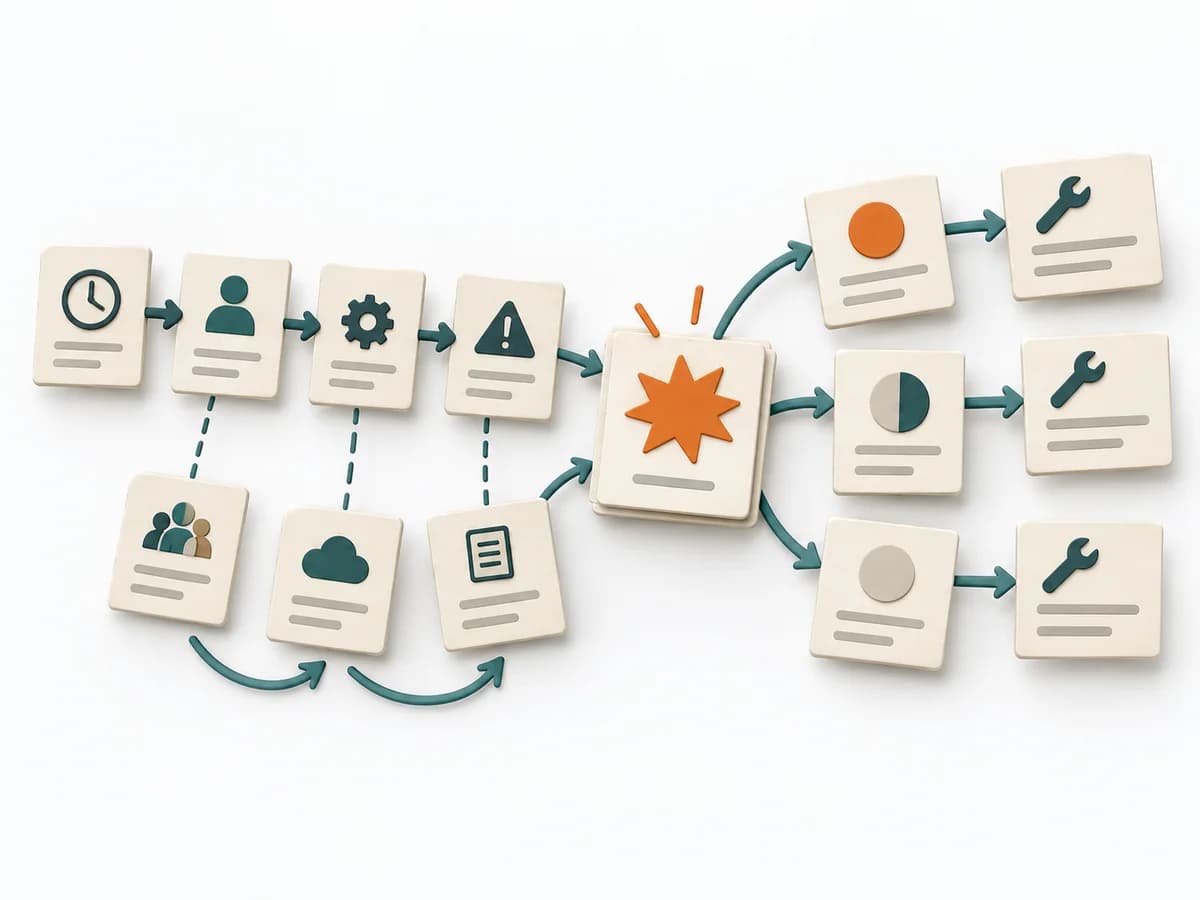 Operations Causal Factor Analysis |
|---|---|---|---|---|
Purposedifferent | When an initiative stalls, the limit often lies not in the idea but in hard or soft boundary conditions. Constraint Analysis separates these limits and shows which of them can actually be shaped. | The Feynman Technique checks understanding by explaining a topic so that it stays easy for others to understand. It makes knowledge gaps visible before they become costly in everyday work. | For an incident with an unclear sequence, the method makes the timeline precisely visible. It separates perception, reaction, and delay so cause and effect become more clearly readable. | For an event with a complicated course, the method breaks down the contributing factors along the timeline. It shows how conditions, decisions, and reactions together produce a course of events. |
Complexitydifferent | Low | Low | Medium | High |
Timedifferent | 30-90 min | 20-60 min | 60-180 min | 2-6 h |
Participantsdifferent | 2-8 | 1 | 3-10 | 3-10 |
Formatdifferent | Workshop + async | Async | Workshop + async | Workshop + async |
Outputdifferent | Constraint List, Hard/Soft Classification, Option Impact Notes, Decision Boundaries | Plain-language Explanation, Knowledge Gaps, Study Notes | Incident Timeline, Evidence Log, Delay Analysis, Improvement Actions | Event Timeline, Causal Factor Chart, Cause List, Corrective Actions |
Tagsno overlap | ConstraintsDecisionPlanningOptions | LearningKnowledgeUnderstanding | IncidentTimelineSite Reliability Engineering | CausalityIncidentRoot causeTimeline |